 Enterprise Knowledge
Agent
Enterprise Knowledge
Agent Realtime Intelligence
 Customer Support 360
 Analytica
 CreditIQ
 City Intelligence
 Smart Utilities
 Connected Worker & Assets
 Drone Based Infra Monitoring
 SceneTrack



Dr. Alok Aggarwal
 Accounts Reconciliation
 Financial Spreading
 Digital Archive
 SchematicIQ
 Loan Ops
 Docutwin
 Contract intelligence
 KYC/KYB
 Form Processing
 Investment Statements


Automate your workflow with Scry AI Solutions
Get in TouchPatents are important sources of technical and business information. They provide insight on
technology, business, and competition, and have the potential to affect key decisions of an
organization. Strategies based on effective utilization of patents and patent information can
significantly boost the profits of an organization.
The key challenge involved in utilizing this patent information effectively is identifying the relevant
information from a multitude of data. Patent data is spread across multiple databases and multiple
languages, and services of experts are required to identify and analyze the relevant information.
The patent information services market comprises companies that provide products and services
related to searching, mining, analyzing, and managing of patents and patent-related information.
These companies provide varying level of services related to patent information.
Strategic Importance of Patent Information
Patents are important sources of technical and business information. They provide insights on
technology, business and competition, and have the potential to affect key decisions, such as those
related to the R&D strategies and business strategies of a company, research organization and/or
university.
In recent years, many technology-based companies have increased their profits by developing their
business strategies around patents and patent information.
IBM generated US $ 562 million by the sale and other transfers of intellectual property (IP) in FY ending
December 2003 [1]. IBM pursues an aggressive IP-based strategy. For the past 11 years, it has been the
largest recipient of US patents worldwide.
Hoffman La-Roche established Roche Molecular Systems Inc. in 1991, to develop and commercialize the
patents covering the Polymerase Chain Reaction (PCR) technology. Hoffman La-Roche acquired the rights
to basic patents covering PCR from Cetus Corporation in 1991 as a part of a US $ 300 million deal.
Currently, Roche Molecular Systems holds rights to more than 130 US patents related to the PCR process.
According to an estimate, in 2000, the company’s revenues from the PCR technology totaled US $ 470
million [2] and were expected to grow at a rate of 26% annually.
Amazon.com protected its business method by patenting its one-click method. This not only aided the
company in protecting its methodology from competitors, but also helped it in creating a niche for itself
amongst a multitude of online shopping portals [3].
Recent years have also witnessed cases where companies had to pay a heavy price for neglecting
patent information in their business strategy.
British Telecom’s (BT) failure in identifying and analyzing the true potential of the hyperlink patent (US
4873662 [4], filed in 1976 and granted in 1989) not only resulted in a lost opportunity but also led to a legal
battle, which BT eventually lost. The patent was unearthed in a routine update of the company’s 15,000
global patents [5]. One of the allegations made against BT was that “had the company piped up when those
first Web pages were published and informed people that it owned hyperlink technology, then businesses
and Web publishers could have chosen whether to use hyperlinks or not. Showing up now, more than a
decade after the party started, has effectively killed any chance of collecting prior-usage fees.”
Some Thoughts to Mull Over
Deriving Value from Patent Information: Key Challenges and Solutions
Clearly, the potential of patent information is immense, and the coming years are expected to witness
a rise in the influence patents and patent information exert on business decisions. This is so because
the number of patents is on the rise, and enhanced tools and services that help in analyzing and
interpreting patent data are becoming available. The key challenge faced in utilizing patent
information effectively is identifying the relevant information from a multitude of data.
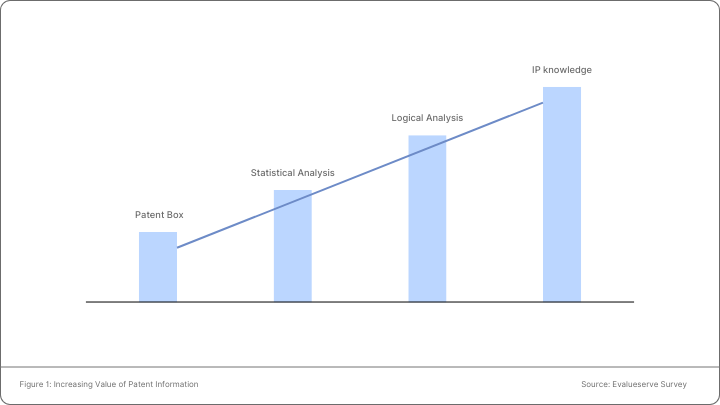
Figure 1 below details the increasing value of patent information.
Espacenet estimates that all the patents put together contain more than 80 percent of the world’s
technical literature [7]. The quantum of this data is expected to rise at 8 percent per year. The growth
in the magnitude of data increases the complexity of analyzing it; therefore much more time and
effort is required to derive the right inferences.
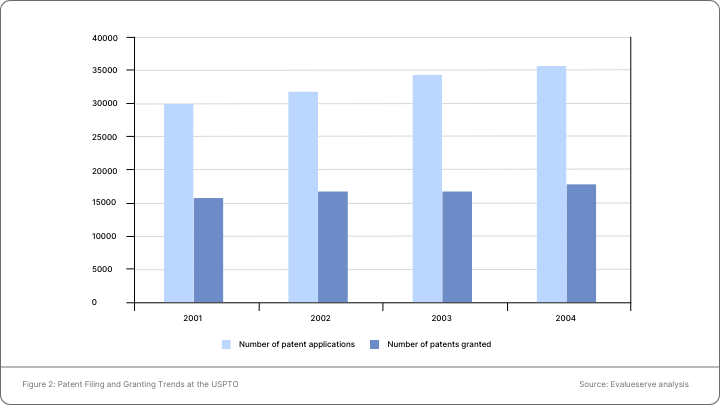
Figure 2 below depicts UPSTO’s patent filing and granting trends.
Apart from the magnitude of the patent data available, other concerns associated with the use of
patent information include:
Currently, several tools and services are available in the market, which help in deriving relevant
information and indicators based on patent data. These tools and services facilitate access to and
the analysis of patent information. Examples of such tools and services include advanced patent
databases, tools for analysis, visualization of patent information, and various customized services.
They reduce human involvement in analyzing and utilizing patent information. Though they are not
perfect, intelligent usage of these tools and services can enhance productivity while using and
analyzing patent information.
Checklist: Are You Deriving Maximum Value from Patent Information?
Patent Information and its Uses
Researchers in corporate and academic organizations use the technical information obtained from
patents as starting points for their research. By using patent information, they can avoid reinventing
the wheel because they can potentially license and use patented technologies instead of wasting
valuable time and money in developing identical technologies.
Additionally, technology landscape analysis based on patent information helps in identifying niche
areas, wherein the return on research investment may be higher. Hence, most corporations and
research enterprises use available patent information while formulating their R&D and business
strategies. They utilize this information specifically while conducting competitive analysis and ‘due
diligence’ with respect to mergers and acquisitions.
Finally, research analysts often use patent information to benchmark the innovativeness of a
company, in comparison with that of its competitors. Similarly, a company’s patent filing trends are often used as indicators of the research and business focus of the organization.
Patent Information Services
The patent information services market comprises several companies that provide tools and services
to facilitate the searching, mining, analysis, management and utilization of patent information.
Players in the patent information services market can broadly be classified in the following
categories:
Patent database providers provide access to various patent databases and offer tools for analyzing
and presenting the data. Some patent database providers also provide patent information services as customized services. Patent information providers, on the other hand, analyze patent data obtained
from patent database providers and offer this analysis to clients. They do not provide access to
patent databases, although some offer delivery services for patent documents.
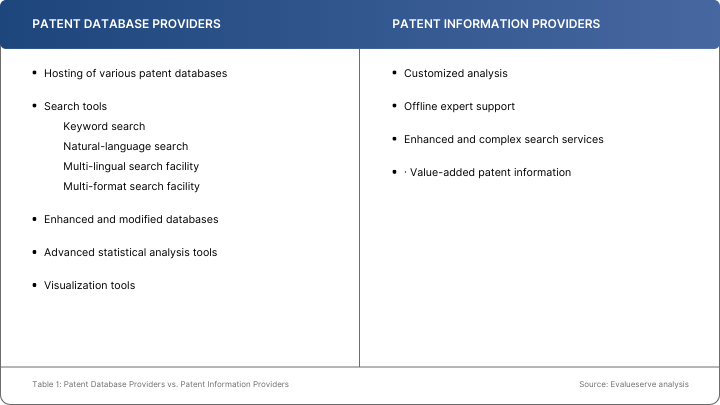
Table 1 illustrates the difference between the services provided by patent database providers and
patent information providers.
Patent Database Providers
As Table 1 suggests, patent database providers offer users access to the patent databases of
various patent offices. They also provide some analytical and visualization tools for various kinds of
patent data. Most database providers offer at least one value-added service to differentiate
themselves from other providers.
The following are common products and services offered by patent database providers:
Some factors that differentiate one patent database provider from another include:
Types of Search Tools
Search capabilities often have a great impact on the analysis that can be derived from patent data.
Two kinds of errors usually plague search services – the inclusion of unnecessary information and
the exclusion of relevant information. A good search facility should be able to counter errors of both
types and should allow identification of the relevant information from a multitude of data, with
minimum (preferably zero) errors.
The search methodologies currently supported by patent database providers include keyword- based search, natural language search, and concept-based search. In keyword-based search,the occurrence of exact keywords in the patent text is searched. Natural language search is an extension of keyword-based search, wherein variations and extensions of keywords are also searched. In concept-based search, the search for patents is carried out on the basis of the concept defined by a search query. Concept-based search reduces the probability of missing a relevant patent during the search. For example, in a concept-based search, the keyword ‘computer’
will also identify patents that contain various words and phrases such as ‘data processing system’.
Based on the above-mentioned methodologies, database providers offer various kinds of search
services. These include quick search, standard search, special search and complex search.
Quick search is based on a single keyword provided by a user. Standard search is based on
multiple keywords provided by a user. Users can search the text by using Boolean operators along
with these keywords. Special search is an extension of Standard search, wherein the user further
refines the obtained search results by using additional criteria provided by him/her. Complex
search is based on an idea, concept, figure, diagram or picture provided by the user.
Analytical/Visualization Tools and Services
Analytical and visualizations tools and services enable users to derive important inferences from the
obtained patent data. For example, they facilitate the identification, comparison and analysis of
trends from the obtained patent data. Further, visualization tools allow users to represent this
information in a user-friendly format.
Tools-based analysis often utilizes predefined criteria (such as the assignee’s name, the year of the
grant/publication/filing, the International Patent Classification (IPC) code, the inventor’s name, etc.)
for analysis, and, is therefore limited in its applicability. Hence, manual intervention is usually
required to analyze patent data. Some patent database providers offer offline manual analysis
support along with their analysis tools.
Globalization Support
Patent information is distributed across multiple languages, and for a comprehensive analysis, data
from all these languages should be taken into account. Patent database providers often provide
support in multiple languages, as a part of their services. Globalization support can be based on
machine translation, where computer-aided translations of patent text are used to search for and
analyze data.
Key Players and their Comparison
Table 2 provides a summary of the comparison of services offered by key patent database providers.
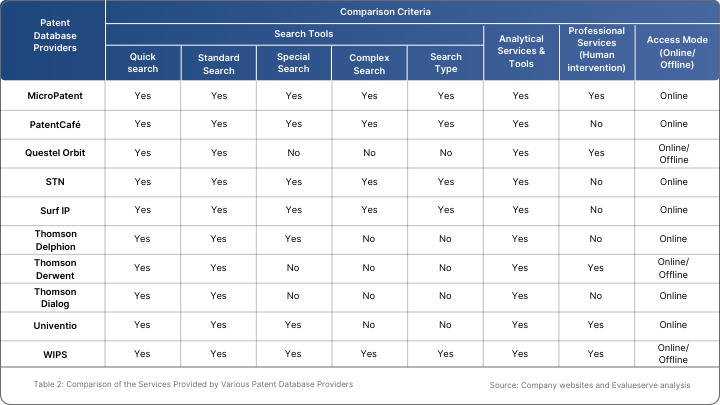
Currently, in most cases, the deciding factor for selecting patent database providers seems to be the
cost of the subscription. However, considering the growing importance of patent information in
making critical decisions, and with an increase in the availability of tools providing complex analysis,
it is likely that other factors will gradually gain importance.
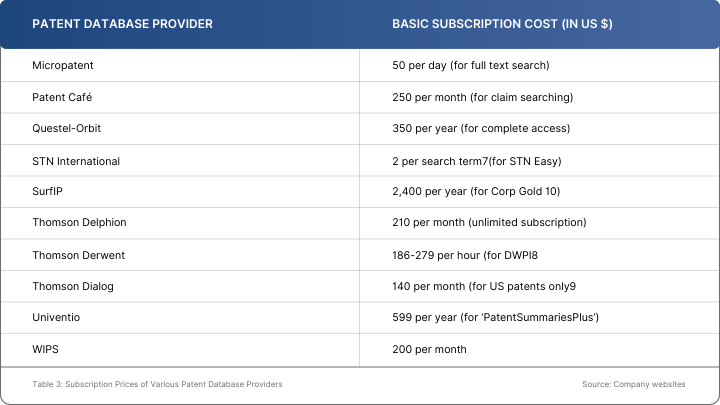
Table 3 provides a comparison of the patent database in terms of subscription costs.
Patent Information Providers
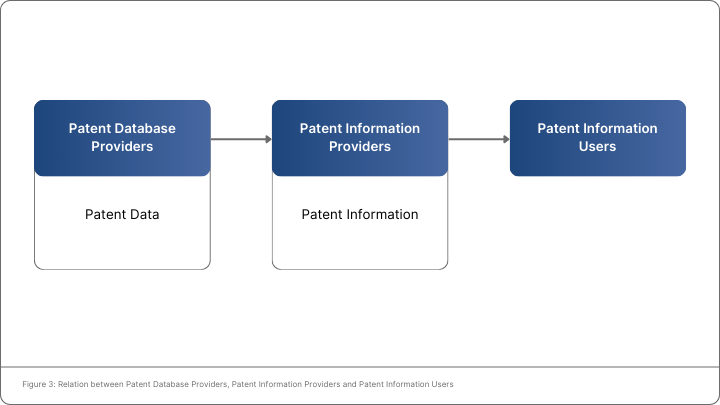
Patent information providers use the results of patent data and provide an analysis as per the needs
of a user. Therefore, these providers act as an interface between patent database providers and actual users of patent information.
As mentioned earlier, most tool-based services allow search and analysis based on certain pre-
defined criteria. Although certain tools allow a certain amount of flexibility to the user to re-define these criteria, these services are very limited in their scope.
Manual intervention helps in overcoming these limitations by customizing search and analysis, as per
the needs of the end user. These services often require experts, to analyze the problem and develop
a framework for solving it.
Examples of value-added patent information provided by patent information
providers include:
Patentability analysis: An analysis of the novelty of an invention in light of existing
patent prior art
Patent portfolio analysis: The identification of the value generation potential of a
patent portfolio, by identifying the diamond, medium value and triage patents in the
portfolio
Patent infringement analysis: The identification of patents and/or products that
may map onto to a set of patents – based on the analysis, infringers can be detected
and appropriate action initiated
Patent licensing analysis: The identification of the licensing potential of a portfolio
of patents, which usually also involves a valuation of the patents
Potential licensee identification: The identification of a list of potential licensees for
a given set of patents
Technology landscaping: The identification of patent gaps in a technology domain,
which also includes an assessment of the major players and a comparison of their
patents
Value-chain analysis/Technology chain analysis: The identification of the value
/technology chain of an industry and mapping the existing patents onto this value
chain, which also involves identifying potential areas for R&D investment and/or IP
acquisitions
Competitor analysis: The monitoring of the patenting activity of competitors and
identifying their research focus
Patent watch: The identification of new patents in a technology domain, or
monitoring a competitor’s patenting activity
Key Players and their Comparison
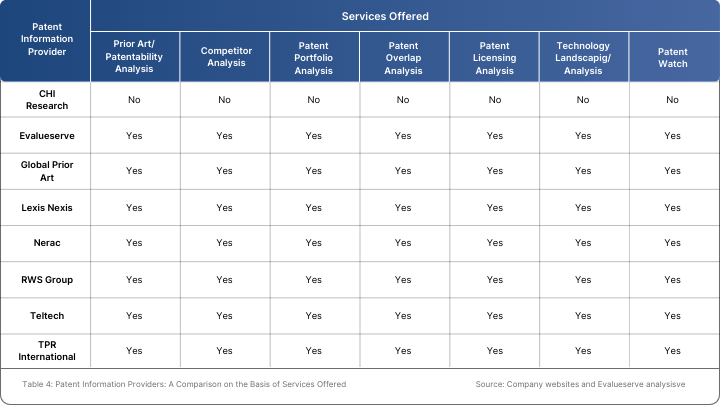
Table 4 provides a detailed comparison between patent information providers on the basis of the
services offered.
Patent information will continue to play an increasingly important role in technical and business
decisions. Both patent database providers and patent information providers are responsible for
providing this patent information to organizations. These patent information service providers will
continue providing value-added and customized services, while ensuring that the cost of these
services remains competitive.
Blog Written by
CEO, Chief Data Scientist at Scry AI
Author of the book The Fourth Industrial Revolution
and 100 Years of AI (1950-2050)


