 Enterprise Knowledge
Agent
Enterprise Knowledge
Agent Realtime Intelligence
 Customer Support 360
 Analytica
 CreditIQ
 City Intelligence
 Smart Utilities
 Connected Worker & Assets
 Drone Based Infra Monitoring
 SceneTrack



Dr. Alok Aggarwal
 Accounts Reconciliation
 Financial Spreading
 Digital Archive
 SchematicIQ
 Loan Ops
 Docutwin
 Contract intelligence
 KYC/KYB
 Form Processing
 Investment Statements


Automate your workflow with Scry AI Solutions
Get in TouchThe success in offshoring Business Process operations with respect to reducing costs and often improving quality has encouraged many firms to start offshoring their high-end knowledge work as well. Their underlying expectation is that offshoring high-end processes will result in additional cost savings and operational efficiencies, coupled with access to very good talent in the low-wage offshore countries. In this paper, we will refer to this offshoring of higher- end services as Knowledge Process Offshoring (KPO).
This paper analyzes the evolving KPO market, the opportunities it offers, the associated challenges, and the key drivers associated with the move from BPO to KPO.
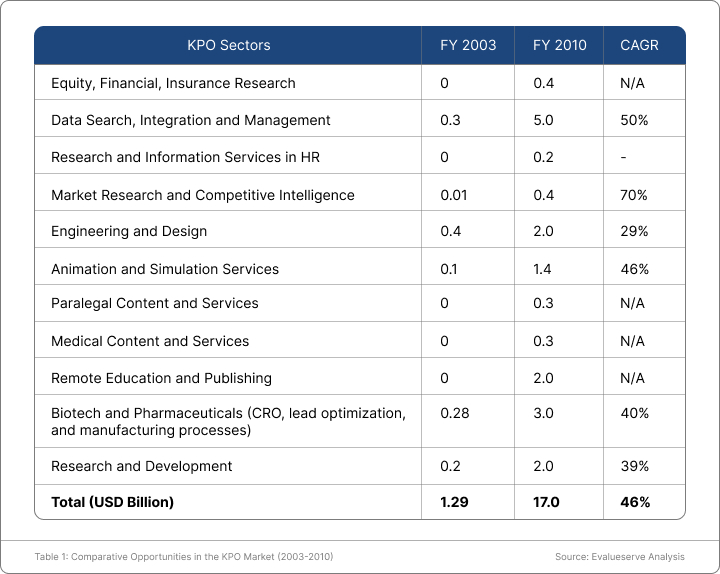
According to our estimate, the KPO market is expected to grow from USD 1.2 billion in FY1 2003 to USD 16 billion in FY 2010. The sectors that are expected to ‘shine’ within the KPO industry include data search, integration and management services, financial and insurance research, biotech and pharmaceutical research and computer-aided simulation and engineering design.
In terms of challenges, this paper analyzes the impact of key parameters such as quality, precision, confidentiality and project management expertise in the KPO industry. This paper also forecasts the number of professionals that are likely to be employed by this industry and we also present some important drivers behind the movement from BPO to KPO.
Finally, this paper attempts to compare countries (such as China, India, the Philippines, Ireland, Israel and Russia) that can provide KPO services with respect to labor costs, geographic location, demographic factors and other miscellaneous factors. The paper also discusses the future outlook of the global offshoring industry.
The maturity and evolution of outsourcing strategies is leading businesses to shift towards the offshoring of high-end processes to low-wage destinations, a trend referred to as KPO. This involves offshoring of knowledge-intensive business processes that require significant domain expertise.
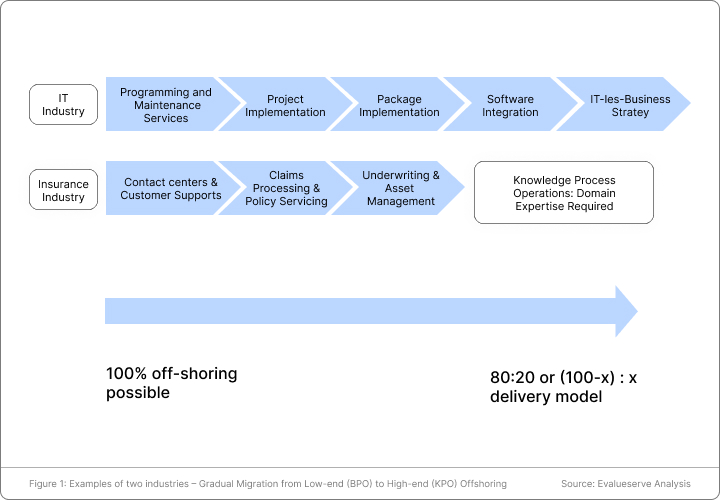
In comparison to BPO, KPO delivers higher value to organizations that offshore their domain-based processes, thereby enhancing BPO’s traditional cost-quality paradigm. The central theme of KPO is to create value for the client2 by providing business expertise rather than process expertise. Hence, KPO entails the shifting from simple execution of ‘standardized processes’ to carrying out processes that demand advanced analytical and technical skills as well as decisive judgment. Figure 1 provides two examples – one relating to IT services and the other relating to insurance services.
With global businesses becoming more competitive, the cycle time for introducing products and services has become smaller, and customers are more demanding with respect to the quality of services provided. This has forced enterprises to adopt systems and business models that will not only provide operational efficiency, but also add strategic value to their products and services.
KPO services can enable enterprises to reduce design-to-market lead times; manage critical hardware efficiently; provide research on markets, competition, products and services; enhance organizational effectiveness in business administration; and help in dealing with rapidly evolving business scenarios. Finally, the outsourcing solutions for high-end processes, unlike traditional BPO solutions that are commoditized fixed-price solutions, are usually customized and value based. It is often this customization that enhances the value proposition of KPO.
This section analyzes the opportunities presented by the KPO industry and also identifies some of the challenges that this emerging industry might face in the near future.
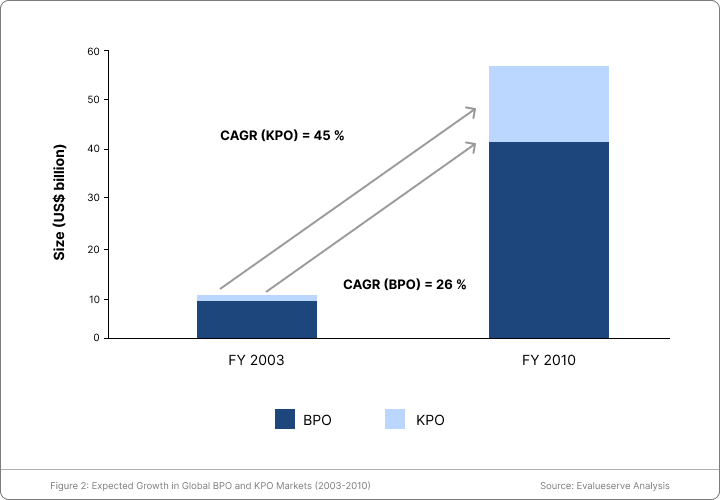
Evalueserve predicts that low-end outsourcing services will grow globally from USD 7.7 billion in FY3 2003 to USD 39.8 billion in FY 2010, which implies a Cumulative Annual Growth Rate (CAGR) of 26 percent.
In contrast, the revenue from the global KPO market was USD 1.2 billion in FY 2003 and this is expected to grow to USD 17 billion by FY 2010, which implies a CAGR of 46 percent (according to Evalueserve).
Figure 2 demonstrates the expected growth in the BPO and KPO markets over the next seven years.
The following is a list of potential high-end services for the KPO sector.
Table 1 provides the Evalueserve estimate on the market size of some of the above-mentioned high-end processes over the next seven years.
Table 1: Comparative Opportunities in the KPO Market (2003-2010)
The following are some examples of high-end KPO:
KPO presents substantial opportunities for players in the outsourcing business. However, there are some formidable challenges in the path of their development, which include the following:
KPO companies are faced with the challenge of hiring the best talent and imparting continuous training to these professionals. It is advisable for offshoring companies that venture into the KPO industry to focus on initial training and continuous development modules.
Another key challenge in the management of KPO is the identification of ‘performance criteria’. This involves setting the right expectations with the end client, as well as its professionals; continuous assessment and monitoring, constructive feedback, appropriate coaching and mentoring, and identification of the right career path for the company’s professionals.
The gradual shift from BPO to KPO in some offshore countries is expected to change the dynamics of job migration. Evalueserve predicts that more low-end jobs will migrate to emerging low-cost countries (from a percentage perspective and not as an absolute number) such as Ukraine, the Czech Republic, Belarus, Romania, China, the Philippines, and Malaysia. At the same time, KPO jobs are likely to be created in India, Russia, Ireland, Israel, and Canada. Even though some emerging countries, especially those in the Central and Eastern European Region (e.g., Ukraine and the Czech Republic), can provide KPO services, the ‘brand equity’ of these countries is quite low. Therefore, it is predicted that these emerging offshore locations will not attract KPO services, at least for the time being.
Some key factors that may fuel the transition from BPO to KPO are discussed in the following sections.
Buyers of offshoring services save more at the high end of the value chain, compared to the low end. Therefore, many of the current low-cost destinations will become a logical choice for companies for offshoring their high-end processes.
Developed economies such as the US, the UK, and Western European countries are already facing a shortage of highly trained and specialized professionals in some knowledge-intensive high-skill sectors, such as R&D in VLSI, engineering design, IT, financial risk management, etc. One way to mitigate this skill shortage is to source talent from low-wage developing countries, which produce highly educated scientists and professionals. This has been the practice in the US for the past several decades. The US permits emigration of engineers, scientists, and medical doctors from developing countries, such as India and China. With tighter visa regulations (in the developed countries) and cost-reduction pressures on MNCs, global offshoring of high-end services to low-wage countries to tap the existing talent pool in a cost-effective manner is a viable and lucrative option.
The evolution of present low-end destinations to the higher end of the value chain, aided by the maturity of the processes, will result in organizations moving up the value chain to provide KPO services. Commoditization of BPO services will further boost this transition and the better margins expected at the higher end of the value chain might act as a deterrent for companies in accepting low-end work. The barriers to entry in the KPO industry are also higher, and therefore, offshoring companies may not have the same competitive pressures as are there in traditional BPO.
Some current low-cost destinations may no longer remain low-cost due to increase in salaries and hence, may not be able to provide cost-arbitrage benefits to companies that want to offshore these services. For example, Indian salaries have increased at an average of 14 percent per year. If this trend continues, they are expected to increase 2.5 times the current salaries (in constant dollars) by FY 2010, thereby reducing the cost-arbitrage benefit from the present 40 to 25 percent.
The number of professionals working in the offshoring industry is expected to increase as more and more companies decide to become involved in BPO and KPO. This will further drive the trend towards the migration of low-end services to high-end services, especially as offshore service vendors (as well as the professionals working in this sector) gain substantial experience and capabilities to provide high-value services.
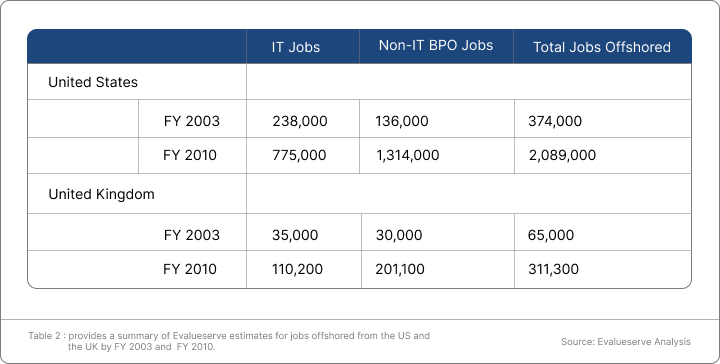
During 2000-2003, the US offshored 238,000 IT service jobs. Evalueserve predicts that this is likely to increase to 775,000 jobs by FY 2010. Further, by the end of March 2004, the US had offshored about 136,000 BPO (non-IT) jobs, mostly in the call centre segment. Forrester predicts that it is likely to offshore 1.314 million BPO (non-IT) jobs by FY 2010.Evalueserve estimates that the UK had offshored 35,000 IT service jobs by FY 2003, and this is expected to grow to 110,200 jobs by FY 2010. Evalueserve also estimates that 30,000 BPO (non-IT) jobs (mainly in call centers) have already been offshored by the UK by FY 2003, and 201,100 BPO (non-IT) jobs are expected to move from the UK by FY 2010.
Table 2 provides a summary of Evalueserve estimates for jobs offshored from the US and the UK by FY 2003 and FY 2010.
Ironically, the protectionist lobby and their anti-BPO drive in the US and the UK are indirectly helping the proliferation of global offshoring by providing free publicity.
In this regard, Evalueserve recently examined the free publicity that the anti-offshoring drive in the US has given India Inc., especially for its IT and non-IT export services sectors. Evalueserve estimates show that India Inc. received more than USD 89 million worth of free publicity due to the anti-offshoring drive in the US and the UK during June 1, 2002 and May 31, 2004.
Most of this free publicity stemmed from about 1,980 distinct articles, columns, and discussion documents written in newspapers and magazines in the period between June 1, 2002 and May 31, 2004. This publicity was related to:
In addition to the 1,980 or more articles, a simple Google search shows that the Internet web-logs and websites contain over 210,000 distinct references and ‘threads’ discussing these issues. Furthermore, CNN and one of its flagship programs, ‘Money line’ has been spending almost three minutes a day, five days a week, on this topic for the last six months, and it has been continuously updating the list of 350-400 companies that are offshoring to India and China.
Hence, the anti-offshoring drive has definitely increased India’s brand image because American and the British companies now feel that Indian companies are capable of almost anything, even rocket science! This is indeed an interesting contrast from the situation four years ago, when the same companies were under the impression that Indian companies can only ‘provide software coolies’ and ‘export cheap IT coders to solve the Y2K problem’. Because of this awareness, it has become easier for Indian companies to move from BPO to KPO, especially in then US and the UK.
Because of the anti-offshoring drive in the US and the UK (and to a small extent in other countries like Canada and Australia), not only India and China but also other low-wage countries including the Philippines, Russia, and Mexico, have gained in publicity. Hence, with the passage of time, this anti-offshoring movement is likely to help even these low-cost countries in improving their brand image and thereby moving up the value chain.
This section attempts to analyze key offshore destinations that are likely to emerge as the hubs of the BPO and KPO sectors. A comparative assessment of key low-wage destinations, with respect to some critical parameters, is provided in Table 3.
Table 3: Comparison of Key Low-wage Offshore BPO/KPO Locations
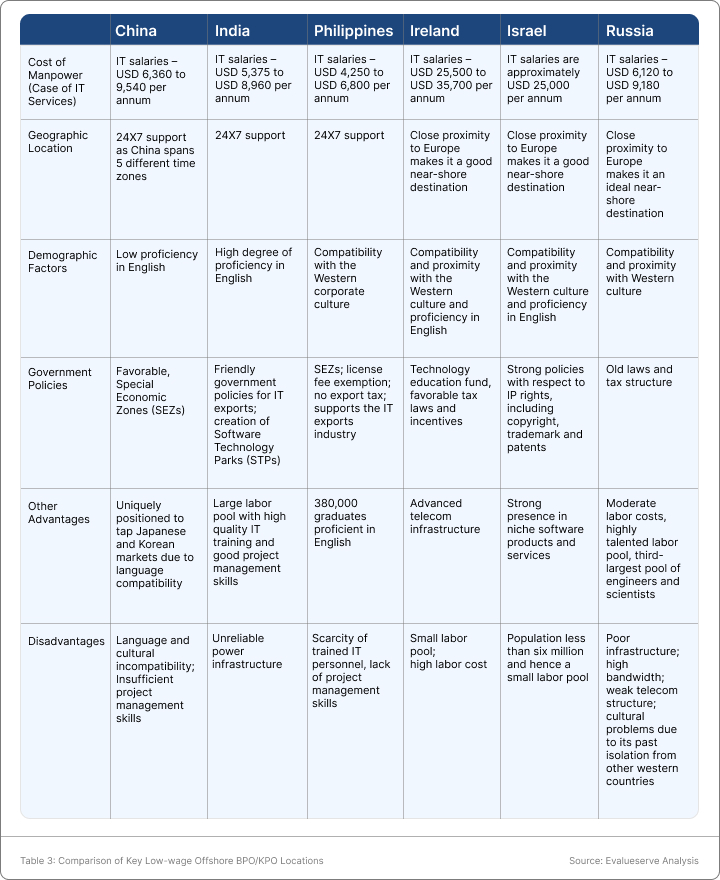
The above-mentioned destinations offer both IT and non-IT BPO services. Among them, India offers the widest range of IT and non-IT BPO services; the Philippines currently offers mainly BPO services; and Israel and Russia offer niche services especially in the IT offshoring domain. The maximum benefits of offshoring are currently being realized in the Philippines and India. Moreover, China and India are geographically best located to provide 24×7 support although the Philippines is a close contender in this aspect. From the perspective of cultural compatibility and with respect to proficiency in written and spoken English, Canada, Ireland and the Philippines seem to score over other countries.
Investment and labor policies have been made ‘offshoring friendly’ by most governments in these countries. Countries such as India, Russia, and Israel have the requisite talent pool to move up the value chain and provide KPO services.
The major impediments faced by offshore destinations taken up in this study are their small talent pools (e.g., the Philippines, Ireland and Israel) and non-English speaking population (e.g., China and Russia).
Globalization of services is in its nascent stage. In fact, even in the IT services sector, only 1.9 percent of the total jobs are being carried out in low-wage countries. By FY 2010, we expect the following scenario:
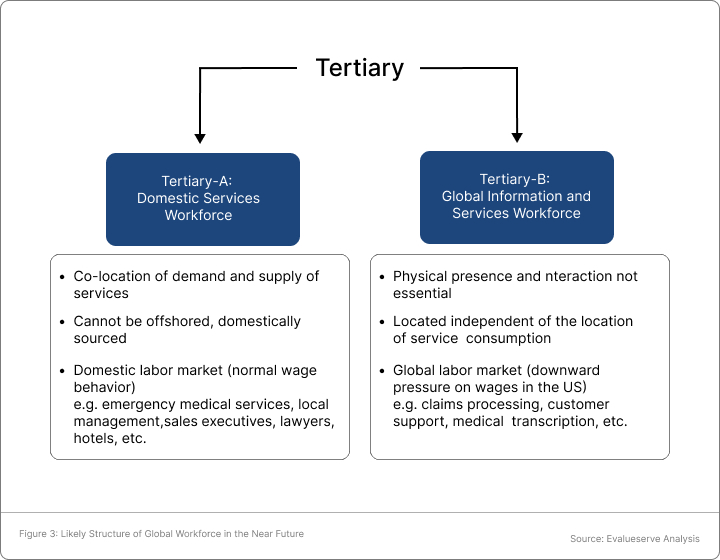
With the proliferation of global offshoring and distributed delivery models, the emergence of a strictly onshore services workforce (as part of Tertiary-A) and a global information and services workforce (as part of Tertiary-B) is expected, as depicted in Figure 3.
Emerging KPO Sourcing Models – InnoCentive: A Case Study on Research and Development
Global sourcing is constantly evolving, as industries are exploring new avenues to increase the scope of their operations and become globally competitive. With increasing R&D costs, US firms are finding it difficult to train their employees to carry out research. Therefore, these firms are increasingly on the lookout to tap the available talent pool. This has led to the emergence of a new R&D model that is being called ‘open innovation’.
Large corporations are reducing their internal spending on R&D and are increasingly tapping external resources to solve their problems. A case in point is InnoCentive, an independent venture launched by Eli Lilly and Co., which enables firms to tap into the global scientific community. Figure 4 illustrates the sourcing model used by InnoCentive to leverage the globally distributed scientific talent pool.
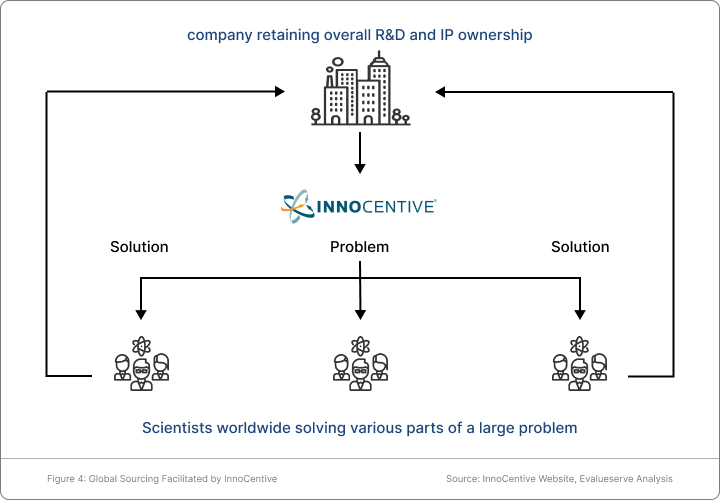
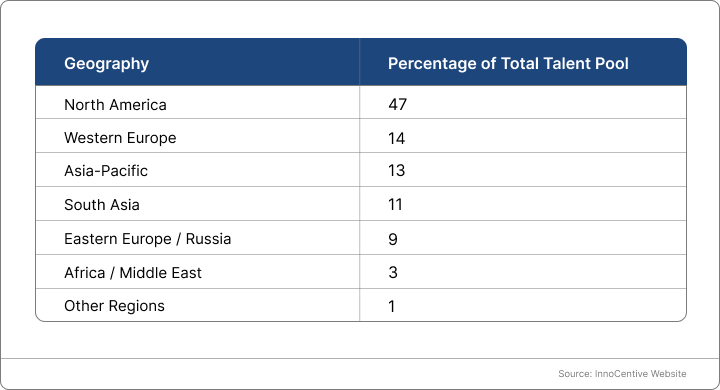
InnoCentive is an interface between corporations beset by unsolved R&D problems and the global scientific community. The scientific community assists corporations to solve their problems by submitting solutions via the Internet. InnoCentive already has over 30,000 scientists from more than 125 countries around the world. Table 4 provides the geographic split of the scientific talent pool that is registered with Innocentive:
Large chemical companies such as Proctor and Gamble (P&G), Dow Chemical Co. and BASF regularly post their problems by using the services offered by InnoCentive, and are realizing quick and cost-effective solutions to their problems. These companies usually pay between USD 5,000 and USD 100,000 per problem, in return for the Intellectual Property provided by the external scientists in solving their problems.
According to a study conducted by the Technology Review magazine of the Massachusetts Institute of Technology, most leading companies in struggling industries, including aerospace, computers, semiconductors, and telecommunications have trimmed their R&D budgets over the last few years. However, the pace of innovation has not really slowed down because many of these companies are now offshoring their R&D work to captive centers or third parties located in low-wage countries.
Blog Written by
CEO, Chief Data Scientist at Scry AI
Author of the book The Fourth Industrial Revolution
and 100 Years of AI (1950-2050)


