Book a Demo

Smart Grid Monitoring Solution for Real-Time Infrastructure Intelligence

Power grids stretch across vast landscapes, transmission lines cutting through forests, substations humming in remote locations, pipelines running beneath cities. Monitoring all of it manually is like trying to watch a thousand screens with two eyes. Scry AI's smart grid monitoring solutions, built on Concentio®, bring AI-powered visibility to every node, every feeder, every asset, so operators can detect faults before they become outages and act before conditions escalate.

Book a Demo
Investment Analytics Software Built for Real-Time Investment Intelligence

The Reality of Smart Grid Monitoring

Grid infrastructure operates at a scale that defies traditional oversight. Transmission lines span hundreds of kilometers; substations dot the landscape, pipelines run underground, and solar arrays spread across open terrain. Each asset generates signals, load fluctuations, thermal readings, visual wear, but these signals rarely reach operators in time to matter.

Traditional monitoring relies on field crews driving routes, climbing towers, and reviewing footage frame by frame. By the time an issue is spotted, it's often already a fault. And as grids grow more complex, integrating renewables, distributed generation, and smart devices, the gap between what's happening and what operators can see widens dangerously. Delayed detection means unplanned outages, safety risks, and spiraling maintenance costs.

How Grid Monitoring Still Works Today

Most utilities and infrastructure operators still depend on manual processes and fragmented systems that limit visibility and slow response.

1
Manual field inspections
Crews physically inspect transmission lines, pipelines, substations, and infrastructure assets on fixed schedules: slow, costly, and often unsafe.
2
Frame-by-frame video review
Drone and camera footage is reviewed manually, turning hours of captured data into days of analyst effort.
3
Delayed fault detection
Issues surface only after scheduled inspection cycles, or worse, after failures and outages have already occurred.
4
Siloed monitoring systems
Grid operational data and visual inspection data live in separate systems, preventing unified analysis.
5
Reactive maintenance culture
Repairs are triggered by faults and failures rather than early warning signals, driving up costs and downtime.

Scry AI’s Smart Grid Monitoring and Intelligence Solution

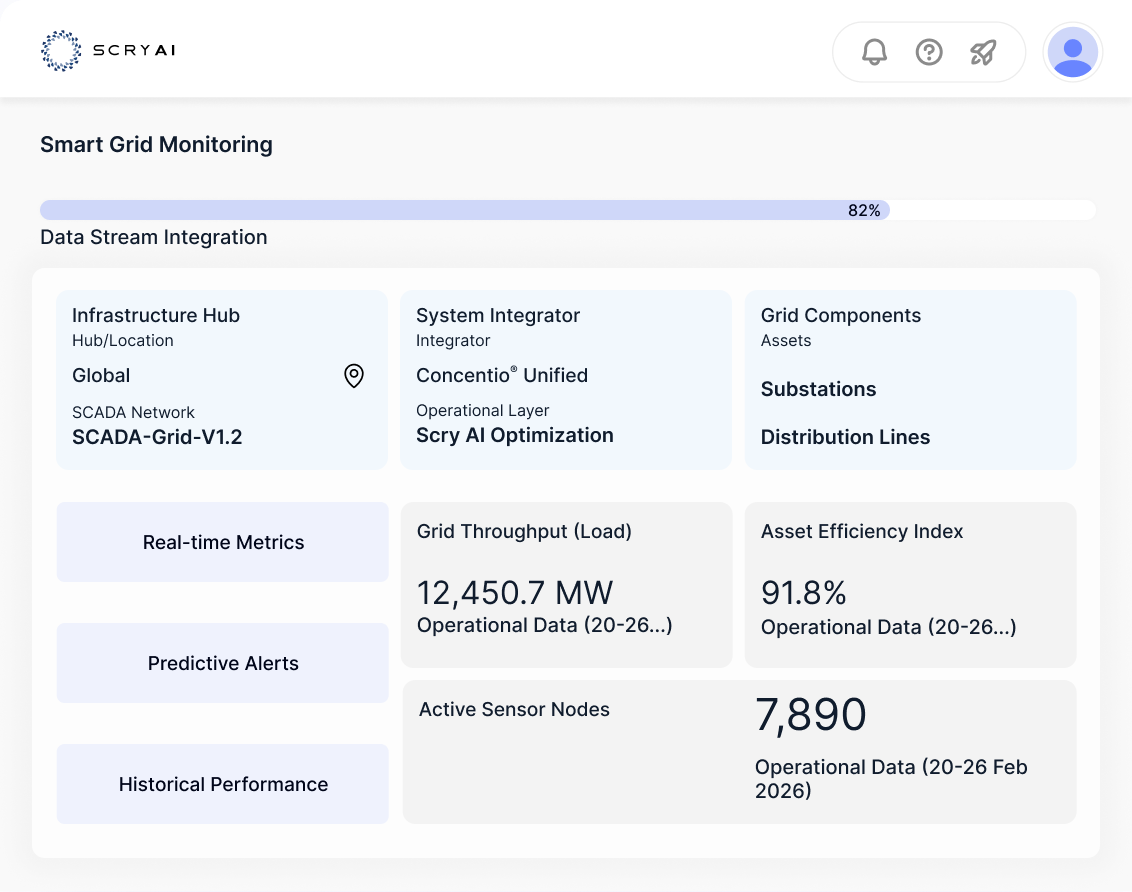
Built on Concentio®, Scry AI's smart grid intelligence solution unifies operational data and visual inspection feeds into a single AI, powered platform. It transforms grid monitoring from a reactive, manual process into a continuous, intelligent operation that detects risks early and enables proactive response.

  • Real, time grid monitoring

    Continuous visibility across grid nodes, feeders, substations, and distributed infrastructure assets from a centralized platform.

  • AI, driven fault and outage detection

    Early identification of faults, load anomalies, and outage risks with automated alerts before conditions escalate.

  • Historical load pattern analysis

    Deep analysis of consumption and load behavior for demand forecasting, capacity planning, and grid optimization.

  • Operational control room dashboards

    Real, time visualizations that give operators the situational awareness to make faster, better decisions.

  • Computer vision, based infrastructure inspection

    Automated analysis of transmission lines, pipelines, and solar assets using drone and camera imagery.

  • Automated defect detection

    AI identification of cracks, corrosion, equipment damage, and structural faults across diverse conditions.

  • Vegetation and thermal risk monitoring

    Detection of encroaching vegetation, hotspots, and thermal anomalies that threaten grid reliability.

  • Predictive maintenance intelligence

    Combines visual and operational data to anticipate maintenance needs before failures occur.

  • Enterprise and GIS integration

    Seamless delivery of AI insights into existing enterprise systems and GIS platforms via APIs.

Clients

We are trusted by enterprises globally.

Expert 1 Expert 2 Expert 3 Expert 4 Expert 5 Expert 6 Expert 7

See Your Grid Like Never Before

Transform grid monitoring from reactive inspections to real, time, AI, powered intelligence across your entire infrastructure.

Book a Demo

Insightful Resources

Discover how SCRY AI solutions bring accuracy and innovation in document processing, conversational AI, and IoT operations.

Frequently Asked Questions

1. What are smart grid monitoring solutions and how do they work?

Smart grid monitoring solutions use AI, IoT sensors, and computer vision to provide real, time visibility across grid infrastructure, transmission lines, substations, pipelines, and renewable assets. They detect faults, anomalies, and risks automatically, enabling faster response and proactive maintenance.

Traditional approaches rely on manual inspections and scheduled reviews, which are slow, labour, intensive, and reactive. Scry AI's solution delivers continuous, AI, driven monitoring that detects issues in real time, before they become outages or safety incidents.

Yes. The platform uses computer vision to analyze drone and camera imagery, automatically detecting defects like cracks, corrosion, vegetation encroachment, and thermal anomalies across transmission lines, pipelines, and solar assets.

By combining operational data (load patterns, fault history) with visual inspection data (defect detection, thermal monitoring), the solution identifies assets at risk of failure and recommends maintenance before problems escalate.

The solution supports power grids, transmission lines, substations, pipelines, solar farms, and other distributed infrastructure. It's designed for utilities, energy providers, and infrastructure operators managing large, scale, and geographically dispersed networks.