Accounts Reconciliation
 Financial Spreading
 Digital Archive
 SchematicIQ
 Loan Ops
 Docutwin
 Contract intelligence
 KYC/KYB
 Form Processing
 Investment Statements
 Enterprise Knowledge
Agent
Enterprise Knowledge
Agent Realtime Intelligence
 Customer Support 360
 Analytica
 CreditIQ
 City Intelligence
 Smart Utilities
 Connected Worker & Assets
 Drone Based Infra Monitoring
 SceneTrack







Key Takeaways
- Invoice fraud can involve genuine or fabricated documents.
- Payment-detail changes require independent verification.
- Email approval alone is not sufficient.
- Invoice matching exposes unsupported transactions.
- Behavioral anomalies can reveal hidden fraud.
- AI should support, not replace, financial controls.
- Immediate reporting improves the chance of recovery.
- Every fraud alert should produce an audit trail.
Invoice fraud rarely begins with an obviously fake document. It often starts with a legitimate vendor relationship, a convincing email, or a minor change to payment instructions. The invoice may contain accurate purchase information while directing funds to a fraudulent account.
Manual reviews struggle to identify these schemes when accounts payable teams process high invoice volumes across multiple entities, suppliers, and payment channels. Generative AI has made the problem more difficult by helping criminals produce realistic invoices, imitate business communication, and alter supporting documents quickly.
Effective invoice fraud detection requires more than checking whether an invoice looks authentic. Organizations must verify vendor identity, compare transactions with independent records, monitor behavioral patterns, and control every change that affects payment. This article explains the major risks, warning signs, detection methods, and invoice fraud prevention measures finance teams can apply.
What Is Invoice Fraud?
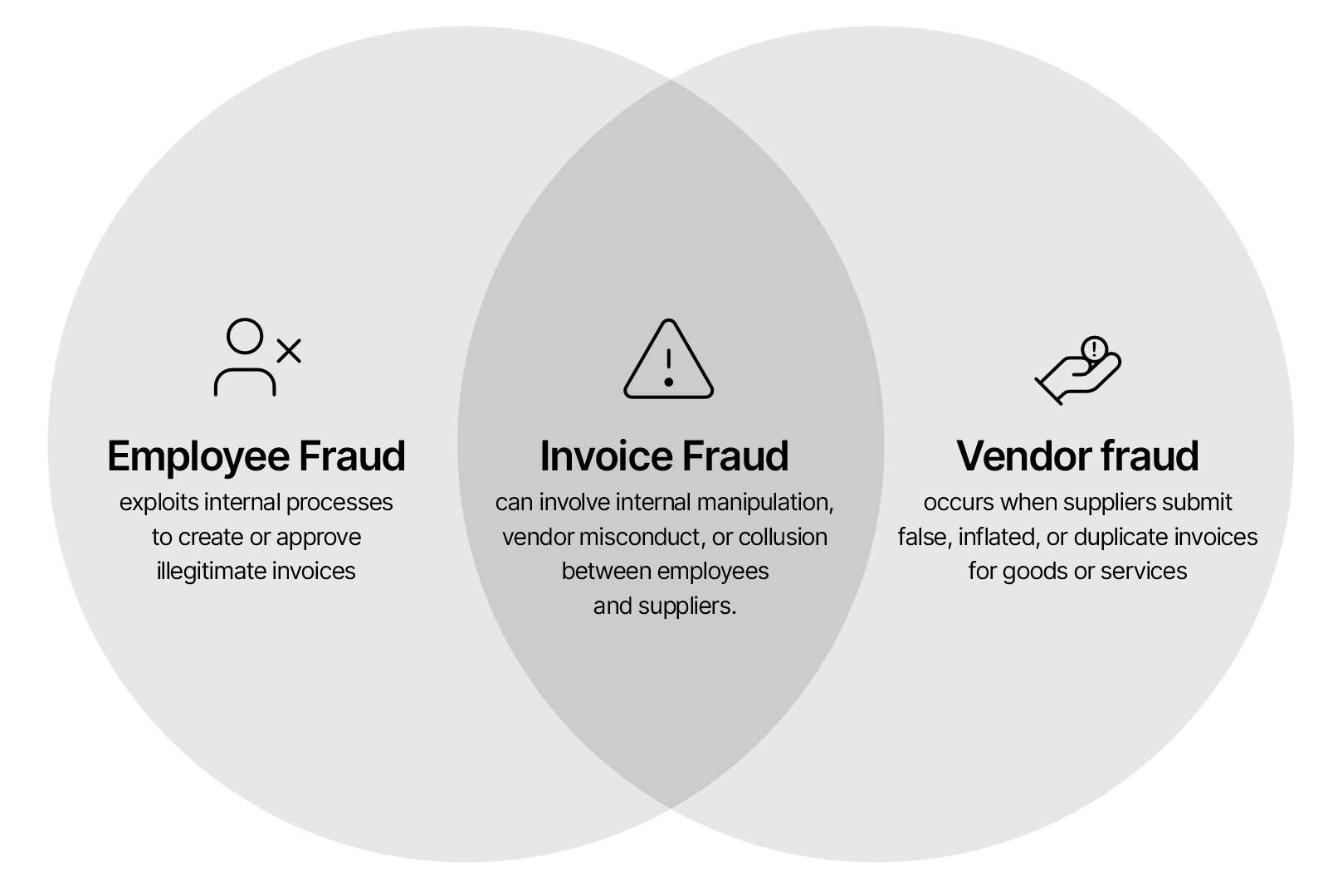
Invoice fraud is the intentional creation, alteration, duplication, or misuse of an invoice to obtain an unauthorized payment or financial benefit. The fraud may be committed by an external criminal, an employee, a supplier, or multiple parties working together.
Some schemes use entirely fabricated vendors and transactions. Others manipulate real invoices by changing bank information, quantities, prices, tax amounts, or payment terms. A more sophisticated attack may preserve every legitimate invoice field except the destination account. This makes the document appear consistent with the purchase while sending the payment to a criminal.
Invoice fraud is different from an invoice error. An error results from an accidental mistake, such as an incorrect quantity, duplicate upload, or calculation problem. Fraud involves deliberate deception. However, the same control system must initially detect both because intent may not be clear when the exception first appears.
Invoice fraud detection is the process of identifying these suspicious documents, transactions, vendor changes, and payment requests before funds are released. It combines document analysis, purchase-order matching, vendor verification, approval controls, payment monitoring, and investigation procedures.
Why Invoice Fraud Is Rising in the Age of AI
Invoice fraud has become easier to execute at scale. Generative AI can produce professional-looking invoices, payment notices, email messages, signatures, logos, and supporting documents with fewer visible inconsistencies. Criminals can also tailor messages using information collected from company websites, social media, compromised mailboxes, and previous vendor correspondence.
Remote work, decentralized approvals, shared inboxes, international vendors, and high invoice volumes create additional opportunities. When AP analysts must make rapid decisions across disconnected systems, a fraudulent request can appear to be an ordinary operational exception.
Two statistics illustrate the wider risk:
- The FBI’s Internet Crime Complaint Center recorded reported cybercrime losses of approximately $16.6 billion in 2024, a 33% increase from the previous year. These figures cover multiple types of internet-enabled crime, not invoice fraud alone, but deceptive business communications were among the methods contributing to the losses. Source: FBI Internet Crime Report announcement
- Business email compromise generated approximately $2.77 billion in reported losses across 21,442 complaints in 2024. BEC is directly relevant to invoice fraud because criminals frequently impersonate executives or suppliers to change payment instructions. Source: Nacha summary of the FBI IC3 report
AI has therefore changed both sides of the problem. It helps criminals create more convincing attacks, but it can also help finance teams compare large volumes of invoice, vendor, purchase, approval, and payment data in near real time.
Common Types of Invoice Fraud
Invoice fraud is not a single tactic. It spans a spectrum from crude forgery to sophisticated, multi-week social engineering campaigns. Understanding the specific mechanics of each type is the first step toward building controls that address the actual point of failure rather than a generic one.
1. Fake or Phantom Vendor Invoices
A fraudster creates an invoice for goods or services that were never ordered or delivered. The invoice may use a fictitious company, an inactive supplier, or a name designed to resemble a legitimate vendor.
Small, recurring amounts are particularly difficult to detect because they may remain below approval thresholds. Some schemes begin with low-value invoices to test whether an organization will pay without verification.
2. Duplicate Invoicing
The same invoice is submitted more than once to obtain multiple payments. The fraudster may alter the invoice number, date, formatting, currency, or supplier reference to avoid exact duplicate checks.
Duplicate invoicing may also involve submitting the same expense through different channels, such as email, a vendor portal, and an employee expense system. Detection must therefore compare normalized invoice data rather than relying only on identical files.
3. Altered or Modified Invoice Details
A genuine invoice is intercepted or copied and then modified. Common changes include:
- Bank account numbers
- Beneficiary names
- Invoice totals
- Quantities
- Tax amounts
- Currency codes
- Payment terms
- Remittance addresses
The remaining information may be accurate, allowing the invoice to pass a superficial review.
4. Business Email Compromise and Email Spoofing
In a business email compromise attack, a criminal gains access to or imitates the email account of an executive, employee, or supplier. The attacker then requests an urgent payment or provides new banking instructions.
The message may appear within an existing conversation after a mailbox has been compromised. Because the criminal can study previous correspondence, the language, timing, invoice references, and signature may all appear credible.
5. Overbilling and Bill Padding
A vendor deliberately charges more than the agreed price, bills for additional quantities, inflates labor hours, or adds unauthorized fees. Individual discrepancies may appear minor, but repeated overbilling can create substantial cumulative losses.
Detecting bill padding requires comparison with contracts, rate cards, purchase orders, receipts, milestones, and historical billing patterns.
6. Overpayment and Refund Scams
The fraudster claims that an invoice was accidentally overpaid and asks the organization to send a refund to a different account. In another variation, a manipulated invoice intentionally causes an overpayment, after which the fraudster requests that the excess be returned.
AP teams should verify the original payment, supplier balance, credit memo, and ownership of the refund account before returning funds.
7. Bank Account and Payment Detail Takeover
A criminal changes a legitimate supplier’s payment information in the vendor master record. Future invoices may be entirely genuine, but every approved payment is sent to the wrong account.
This type of fraud can continue undetected until the supplier reports overdue invoices. The highest-risk point is often the master-data change, not the invoice itself.
8. Insider and Employee Collusion Fraud
An employee may create a fictitious vendor, approve unsupported invoices, modify supplier data, split transactions to remain below authorization limits, or collaborate with an external supplier.
Insider fraud becomes easier when one person can create vendors, enter invoices, approve exceptions, and release payments. Access controls and segregation of duties are therefore central to prevention.
9. Advance Fee Fraud
A fraudster requests an upfront payment for goods, services, taxes, shipping, registration, or access to a commercial opportunity. After receiving the payment, the supposed supplier disappears or continues requesting additional fees.
The invoice may be supported by fabricated contracts, identities, websites, or delivery schedules. New vendors requesting advance payment should receive enhanced due diligence.
Steps to Take Immediately After Detecting Invoice Fraud
A rapid response can improve the likelihood of stopping or recovering a payment. Organizations should maintain a documented incident process so employees know whom to contact without waiting for routine approval channels.
1. Stop Payment and Notify the Bank
Contact the organization’s bank or payment provider immediately. Ask whether the payment can be stopped, recalled, frozen, or traced. Provide the amount, time, beneficiary details, transaction reference, and suspected fraud method.
Do not wait for the entire investigation to finish before contacting the bank. Fraudulent funds may be moved through several accounts within a short period.
Suspend pending payments to the affected beneficiary until the vendor identity and banking information have been reverified.
2. Report Internally and Preserve Evidence
Notify the designated finance, legal, compliance, cybersecurity, internal audit, and executive stakeholders according to the incident-response plan.
Preserve relevant evidence, including:
- Original invoice files
- Email headers and conversation threads
- Vendor-master change records
- Approval histories
- Login and access logs
- Call records
- Purchase orders and receiving documents
- Payment confirmations
- Screenshots and system alerts
Employees should not edit, rename, or overwrite the original evidence. Cybersecurity teams should also determine whether an email account, user credential, endpoint, or business application has been compromised.
The incident may need to be reported to law enforcement, regulators, insurers, or affected business partners. Requirements depend on the jurisdiction, industry, policy terms, and type of data involved.
3. Strengthen Controls to Prevent Recurrence
After containing the incident, conduct a root-cause review. Determine which identity, document, workflow, or payment control failed and whether the same weakness affects other suppliers or entities.
Corrective actions may include:
- Revalidating affected vendor records
- Resetting compromised credentials
- Removing unnecessary system access
- Introducing callback verification
- Revising approval thresholds
- Strengthening segregation of duties
- Expanding duplicate and anomaly checks
- Reviewing recent payments with similar characteristics
- Updating training with the actual behavior used in the attack
The review should produce assigned actions, owners, deadlines, and evidence that each control change has been implemented.
Real-World Invoice Fraud Cases and What They Reveal
Real cases demonstrate that invoice fraud does not depend on poor-quality documents or unknown suppliers.
In one major BEC scheme, a fraudster created a company with the same name as a genuine hardware manufacturer and sent deceptive payment instructions to two multinational technology companies. According to the U.S. Department of Justice, the victim companies transferred more than $120 million to accounts controlled by the offender. The scheme also used forged invoices, contracts, letters, and corporate stamps. Source: U.S. Department of Justice
In another case, Ubiquiti disclosed that criminal fraud involving employee impersonation and fraudulent requests resulted in transfers totaling $46.7 million to overseas accounts. The disclosure shows how apparent internal authority can influence payment decisions even when the request falls outside normal patterns. Source: Ubiquiti SEC filing
These cases reveal three important weaknesses:
- A familiar supplier name is not proof of identity.
- Authentic-looking documents are not proof of a valid transaction.
- Executive authority should not override independent payment controls.
Fraud prevention must validate the complete transaction, including the vendor, obligation, delivery evidence, authorization, bank account, and payment behavior.
Why Invoice Fraud Detection Often Fails in Multi-Entity and Cross-Border Structures
One gap that rarely gets addressed directly is how invoice fraud behaves differently once a company operates across multiple legal entities, currencies, or intercompany billing arrangements. In a single-entity business, an unusual invoice tends to stand out against a relatively simple set of expected vendors and amounts. In a multi-entity group, the same fraudulent invoice can hide inside the normal noise of intercompany recharges, currency conversion variances, and inter-subsidiary approvals that are rarely reconciled at the same level of scrutiny as external vendor spend.
Fraudsters who understand this structure sometimes route fraudulent invoices through a smaller subsidiary with weaker controls, knowing that consolidated reporting at the group level may not surface a discrepancy that would be obvious at a single-entity scale. Any invoice fraud detection program that treats every business unit as equally well controlled is leaving this specific blind spot open. Group finance teams should periodically test whether their smallest or newest entities carry the same verification standards as headquarters, because fraud consistently migrates toward the weakest control point in a corporate structure, not the strongest.
Red Flags and Warning Signs of Invoice Fraud
No single warning sign proves fraud. Several weak signals occurring together, however, can indicate that an invoice requires investigation.
1. Unusual or Unverified Vendor Information
Watch for newly created vendors, incomplete tax information, free email addresses, slight changes in company names, inconsistent addresses, or contact details that do not match the vendor master.
Other concerns include multiple unrelated suppliers sharing the same address, phone number, bank account, tax identifier, or employee contact.
2. Round-Figure or Inflated Invoice Amounts
Repeated round-number invoices can indicate estimated or fabricated charges, particularly when the underlying service should produce variable amounts. A transaction that is consistently just below an approval threshold may also suggest control avoidance.
The amount should be evaluated against the contract, purchase order, receipt, historical average, and expected frequency.
3. Mismatched Documentation and Purchase Orders
Differences between the invoice and supporting records may include:
- Missing or invalid purchase-order numbers
- Quantities exceeding received goods
- Prices outside contracted rates
- Unsupported shipping or handling charges
- Services billed before completion
- Duplicate receipt references
- Taxes inconsistent with the transaction
- Invoice dates outside the service period
A mismatch is not automatically fraud, but it should prevent straight-through payment until resolved.
4. Urgent or Rushed Payment Requests
Fraudsters frequently create urgency to reduce verification. They may claim that a supplier will stop delivery, an executive is unavailable, a discount will expire, or the transaction is confidential.
Urgency should increase the level of review. It should never justify bypassing approval or vendor-verification requirements.
5. Last-Minute Changes to Payment Details
Changes to bank accounts, payment methods, beneficiary names, currencies, or remittance destinations are high-risk events. Treat these requests as separate control events rather than ordinary invoice updates.
Verify the change through a previously established contact method. Do not call a number or follow a link contained only in the change request.
The Real Cost of Invoice Fraud Beyond the Financial Loss
The immediate loss is only one part of the impact. An invoice fraud incident can create operational, legal, commercial, and reputational consequences long after the payment occurs.
The wider costs can include:
- Investigation and legal expenses
- Cybersecurity remediation
- Insurance deductibles and premium increases
- Regulatory reporting and penalties
- Delayed financial close
- Restatement or correction of accounting records
- Supplier disputes
- Disrupted deliveries
- Employee time spent reviewing historical transactions
- Reduced confidence in financial controls
- Additional audit procedures
- Reputational damage with customers and partners
The accounting consequences can also be complex. A fraudulent payment may initially appear as a legitimate expense or asset. Finance teams must determine whether to reverse the entry, recognize a loss, record a recovery receivable, or disclose the incident. These decisions require coordination among accounting, legal, audit, insurance, and management teams.
Stop Suspicious Invoices Before They Reach Payment
Use AI-powered validation and matching to identify discrepancies, prioritize high-risk exceptions, and give reviewers the evidence needed to make informed decisions.
Book a free demoHow to Identify a Fake Invoice: A Step-by-Step Verification Process
A consistent verification sequence, applied to every invoice above a defined risk threshold, closes most of the gaps that fraudsters rely on.
1. Pause Before Acting on Urgent Requests
Do not process an invoice solely because the sender claims it is overdue, confidential, or executive-approved. Check whether the requested action follows the organization’s established procurement and payment process.
Escalate requests that ask employees to bypass controls, avoid contacting another team, or complete a payment outside normal working patterns.
2. Verify Directly with the Vendor
Use contact information already stored in an approved vendor record or obtained independently from a verified source. Confirm the invoice number, amount, bank details, and requested change.
For material changes, use dual verification. One employee can contact the supplier while another reviews the vendor record and supporting evidence.
3. Cross-Check Against Purchase Records
Compare the invoice with independent commercial records, including:
- Approved purchase order
- Contract or rate agreement
- Goods receipt
- Service confirmation
- Delivery record
- Previous invoices
- Vendor statement
- Budget or project authorization
The goal is to determine whether a valid obligation exists, not simply whether the invoice fields have been captured correctly.
The relationship between invoice receipt, validation, matching, approval, and payment is explained further in this guide to invoice processing in accounts payable.
4. Examine Formatting and Document Quality
Look for inconsistent fonts, low-resolution logos, irregular alignment, edited payment sections, incorrect legal names, unusual file properties, or language that differs from previous supplier invoices.
Formatting checks should not be treated as conclusive. Modern editing and generative AI systems can create polished documents, while genuine suppliers may legitimately change invoice templates.
5. Review Billing Patterns for Anomalies
Compare the invoice with historical vendor and transaction behavior. Relevant questions include:
- Is the amount unusually high?
- Is the invoice arriving at an unexpected time?
- Has the payment frequency changed?
- Is this a new currency or bank location?
- Has the supplier reused an invoice number?
- Is the expense assigned to an unusual cost center?
- Is the approver different from the normal approver?
- Were the vendor record and invoice changed close together?
A document may look valid in isolation while appearing highly abnormal within its transaction history.
The Role of AI and Data Analytics in Invoice Fraud Detection
AI can examine a larger set of relationships than a manual reviewer can consistently evaluate. It can compare invoice content with vendor records, purchase orders, receipts, contracts, payment histories, and approval behavior before an invoice is released.
1. Anomaly Detection and Pattern Recognition
Anomaly models identify transactions that differ from established patterns. Signals may include:
- Unusual invoice amounts
- New supplier-bank combinations
- Repeated rounded values
- Changes in billing frequency
- Invoices submitted at unusual times
- New payment destinations
- Similar documents from unrelated vendors
- Transactions just below approval limits
- Unusual approver or cost-center combinations
- Multiple suppliers sharing identity attributes
The system should provide the reason for each alert. A risk score without supporting evidence makes investigation slower and can reduce user confidence.
2. Pre-Configured Rules Engines
Rules engines apply deterministic controls based on organizational policy. Examples include blocking an invoice when:
- The supplier is inactive
- A purchase order is missing
- The invoice exceeds the remaining PO balance
- The bank account was recently changed
- The invoice number already exists
- The tax identifier does not match the vendor
- Required receiving evidence is absent
- The approver lacks the necessary authority
Rules provide consistency and explainability. Machine-learning models can complement them by detecting patterns that were not explicitly programmed.
3. AI as Both a Fraud Tool and a Defense Mechanism
Criminals can use AI to write credible messages, imitate communication styles, fabricate documents, and produce multiple invoice variations. Visual authenticity is therefore becoming a weaker measure of trust.
AI invoice systems with real-time fraud detection can respond by evaluating the transaction as data rather than judging the document only by appearance. They can analyze document content, historical behavior, vendor identity, payment changes, approval sequences, and supporting records together.
Human review remains necessary for material or ambiguous exceptions. AI should prioritize risk, present evidence, and maintain decision records rather than make unsupported accusations of fraud.
Why Identity, Transaction, and Behavior Signals Must Be Evaluated Together
A strong invoice fraud detection model evaluates three connected layers:
- Identity: Is the supplier, employee, approver, and bank account who or what the record claims?
- Transaction: Is the invoice supported by a valid purchase, delivery, contract, and authorization?
- Behavior: Does the request follow expected patterns for this vendor, entity, approver, and payment method?
Checking only one layer creates blind spots. A genuine vendor may have a compromised mailbox. A valid purchase may be paired with a fraudulent account. A correctly formatted invoice may contain an unusual amount or approval route.
The combined approach also improves alert quality. Instead of flagging every high-value invoice, the system can prioritize an invoice that is high value, uses recently changed banking information, comes from a new email domain, and is routed to an unusual approver.
This contextual model is more useful than treating invoice fraud as a document-authentication problem alone.
Invoice Fraud Prevention: Best Practices
Prevention works best as a layered system rather than a single control, since no individual safeguard is effective against every fraud type described above.
1. Strong Internal Controls and Segregation of Duties
Separate the authority to create vendors, modify payment details, enter invoices, approve transactions, and release payments. No employee should control the complete process.
Access should be role-based, reviewed periodically, and removed promptly when responsibilities change. Privileged actions should produce tamper-resistant logs.
2. Purchase Order and Invoice Matching
Match invoices with purchase orders, receipts, service confirmations, contracts, or other independent records. The appropriate matching method depends on the transaction.
Organizations may use:
- Two-way matching for invoice and purchase-order comparison
- Three-way matching when receiving evidence is available
- Contract-based validation for recurring services
- Milestone validation for project invoices
- Additional checks for vendor, tax, budget, payment, and historical data
Matching tolerances should be documented and adjusted according to risk. Repeated discrepancies within tolerance should still be monitored because fraudsters may deliberately remain below review thresholds.
3. Multi-Factor Authentication and Secure Communication Channels
Require multi-factor authentication for email, ERP, procurement, vendor-management, and payment systems. Protect privileged accounts with stronger access controls and monitoring.
Sensitive changes should occur through authenticated systems rather than unstructured email. Encrypt data in transit and restrict the ability to export vendor and payment information.
4. Invoice Submission Portals
A controlled vendor portal reduces reliance on email attachments and creates a consistent record of invoice submission. It can authenticate suppliers, validate mandatory fields, restrict duplicate submissions, and separate invoice intake from bank-detail maintenance.
Portal access alone does not prove a transaction is legitimate. Account takeover remains possible, so device, access, behavior, and change events must also be monitored.
5. Dual Approvals and Verification Protocols
Use dual approval for high-value payments, new suppliers, advance payments, manual transactions, and bank-detail changes. The second reviewer must perform an independent check rather than simply repeat the first approval.
Verification procedures should define:
- Which events require confirmation
- Which contact source must be used
- Who may authorize exceptions
- What evidence must be recorded
- When a payment must be placed on hold
6. Employee Training Focused on Behavior, Not Just Awareness
Generic warnings about suspicious emails are insufficient. Training should show employees what to do when a request creates pressure, invokes authority, changes payment details, or asks them to bypass normal controls.
Run scenario-based exercises involving:
- Executive impersonation
- Supplier account changes
- Altered invoice attachments
- Confidential acquisition payments
- Urgent refunds
- Requests sent from compromised vendor accounts
Employees should be able to report suspicious activity quickly without fearing criticism for delaying a payment.
How AP Automation Reduces Invoice Fraud Risk
AP automation creates a controlled path from invoice receipt to payment. It captures documents centrally, validates invoice data, compares transactions with supporting records, routes exceptions to authorized reviewers, and preserves an audit trail.
A well-designed automated process can:
- Detect exact and near-duplicate invoices
- Validate vendor identity and status
- Compare invoice data with POs and receipts
- Apply approval limits consistently
- Restrict unauthorized master-data changes
- Identify unusual payment behavior
- Route high-risk invoices for review
- Record every approval, override, and correction
- Prevent incomplete invoices from reaching payment
- Monitor recurring exceptions across suppliers
Automation must be configured around actual risk. Automating a weak approval process can move fraudulent invoices faster. Controls should be designed first, embedded in the workflow, tested regularly, and monitored for overrides.
Scry AI’s automated invoice processing software uses AI-driven data capture, validation, matching, and exception handling to help finance teams evaluate invoices against business records before payment. This gives reviewers structured evidence for investigating discrepancies while preserving control over final decisions.
Conclusion
Invoice fraud detection cannot depend on whether an invoice looks genuine. Modern schemes can combine accurate purchase information, familiar supplier identities, compromised communication channels, and professionally altered documents. The decisive question is whether the complete transaction can be independently verified.
Organizations can reduce exposure by separating duties, controlling vendor changes, matching invoices with supporting records, monitoring unusual behavior, securing communication channels, and escalating high-risk transactions before payment. AI strengthens these controls when it connects document, vendor, purchase, approval, and payment data and explains why a transaction requires review.
Collatio by Scry AI helps accounts payable teams capture invoice data, validate transactions, detect discrepancies, and route exceptions through controlled workflows. The result is faster invoice processing with stronger evidence at every review point.
Strengthen Invoice Fraud Controls Before Payment
See how Collatio helps finance teams validate invoices, detect suspicious activity, and route exceptions through controlled AP workflows.