Accounts Reconciliation
 Financial Spreading
 Digital Archive
 SchematicIQ
 Loan Ops
 Docutwin
 Contract intelligence
 KYC/KYB
 Form Processing
 Investment Statements
 Enterprise Knowledge
Agent
Enterprise Knowledge
Agent Realtime Intelligence
 Customer Support 360
 Analytica
 CreditIQ
 City Intelligence
 Smart Utilities
 Connected Worker & Assets
 Drone Based Infra Monitoring
 SceneTrack







Key Takeaways
- An AP policy standardizes invoice processing, approvals, payments, exceptions, and documentation.
- It strengthens payment controls, audit readiness, vendor management, and financial reporting accuracy.
- Clear approval limits, segregation of duties, vendor checks, and invoice matching reduce AP risk.
- Special cases like rush payments, non-PO invoices, subscriptions, disputes, and write-offs need defined rules.
- Regular training, policy reviews, audits, and AP metrics help keep the policy effective.
- AP automation helps enforce policy rules through matching, approvals, duplicate checks, audit trails, and payment controls.
Accounts payable teams often manage invoices, approvals, vendor records, payment schedules, and exceptions across disconnected workflows. Without a formal AP policy, teams may rely on informal approvals, inconsistent invoice validation, unclear authorization rules, and undocumented exceptions.
These gaps can increase the risk of duplicate payments, vendor disputes, delayed approvals, weak audit trails, compliance issues, and inaccurate financial reporting.
A well-structured accounts payable policy solves this by creating a formal control framework for invoice processing, approval authority, payment execution, dispute resolution, record retention, and compliance monitoring. For growing organizations, it supports scalable AP operations, stronger internal controls, and a more reliable financial close.
What Is an Accounts Payable Policy?
An accounts payable policy is a formal document that defines how a company manages supplier invoices, payment approvals, vendor records, payment execution, exception handling, documentation, and related financial controls.
It sets the rules for the full invoice-to-payment cycle. This includes how invoices are received, how vendor information is verified, who approves payments, how invoices are matched to purchase orders, when payments are scheduled, and how AP records are retained for audit and reporting purposes.
A well-written AP policy should answer questions such as:
- Which invoices require purchase orders?
- Who can approve invoices and up to what amount?
- What documents are required before payment?
- How should duplicate invoices or disputed charges be handled?
- Which payment methods are allowed?
- How often should vendor records be reviewed?
- What evidence must be retained for audit purposes?
Who Uses an Accounts Payable Policy?
An AP policy extends beyond the accounts payable function. It applies to every team involved in purchasing, invoice approvals, vendor management, tax documentation, payment controls, and financial reporting.
Typical users include:
- Accounts payable teams that process, validate, code, approve, and pay invoices.
- Procurement teams that create purchase orders and manage vendor relationships.
- Department managers who approve expenses and confirm goods or services received.
- Finance and accounting teams that manage accruals, reconciliations, reporting, and close activities.
- Tax teams that review vendor documentation, tax forms, withholding rules, and reporting obligations.
- Legal teams that review contract terms, supplier agreements, and dispute procedures.
- Internal audit and compliance teams that test controls and review policy adherence.
The policy should be written in a way that each group understands its role, approval responsibility, and documentation requirement.
How an AP Policy Differs from AP Processes and Procedures
An accounts payable policy defines the rules. AP procedures explain the steps used to follow those rules.
For example, a policy may state that all invoices above a certain amount require department head approval. The procedure explains how that approval is requested, where it is recorded, what system is used, and what happens if the approver does not respond.
In simple terms:
| Area | Meaning | Example |
| AP Policy | Defines the rule | Invoices above $10,000 require finance director approval |
| AP Procedure | Explains the steps | AP routes the invoice through the approval workflow and tracks approval evidence |
| AP Process | Shows the workflow | Invoice receipt, validation, matching, approval, payment, posting, reconciliation |
The policy should stay stable enough to support governance, while procedures may change as systems, teams, and workflows change.
How an Accounts Payable Policy Fits into the AP Workflow
The AP policy acts as the control layer across the full accounts payable workflow. It guides what should happen at each stage and defines who is accountable.
A typical AP workflow includes:
- Invoice receipt
- Vendor and invoice validation
- Purchase order or receiving match
- General ledger coding
- Approval routing
- Exception resolution
- Payment scheduling
- Payment execution
- Accounting system posting
- AP reconciliation and record retention
The policy should connect directly to these stages. This helps employees understand that AP policy is not just a finance document. It is a working control framework for daily invoice and payment activity.
Why Are Accounts Payable Policies and Procedures Important?
Accounts payable policies and procedures help standardize payment operations, reduce transaction risk, strengthen audit readiness, and improve visibility into organizational spend.
Without a defined policy, AP decisions often rely on individual discretion. This may be manageable for low invoice volumes, but it becomes increasingly risky as vendor counts, legal entities, approval layers, payment methods, and transaction complexity grow.
1. Maintaining Consistency Across AP Operations
A clear AP policy helps teams process invoices the same way across departments, locations, entities, and business units.
Consistency matters as small differences in invoice handling can create large downstream issues. One team may approve invoices by email, another may approve them verbally, while another may require purchase order matching. These gaps make it harder to monitor controls, track liabilities, and prepare accurate reports.
A standardized policy helps define:
- Required invoice fields
- Supporting document requirements
- Approval routing rules
- Payment timing expectations
- Exception handling steps
- Record retention rules
2. Strengthening Financial Controls and Spending Visibility
An accounts payable policy strengthens financial controls by defining who can approve spending, what evidence is required, and how payments are authorized.
It also improves spending visibility. When invoices are coded consistently, matched correctly, and approved through defined workflows, finance teams can better analyze spend by vendor, department, cost center, project, location, and category.
A strong policy should connect AP activity to broader finance goals such as:
- Cash flow planning
- Budget control
- Working capital management
- Month-end close accuracy
- Vendor spend analysis
- Payment forecasting
- Audit preparation
3. Preventing Fraud, Duplicate Payments, and Unauthorized Spending
Weak AP controls can create opportunities for duplicate payments, fake vendors, inflated invoices, payment diversion, and unauthorized purchases.
An AP policy helps reduce these risks by requiring:
- Vendor verification before payment
- Segregation of duties
- Approval limits based on role and amount
- Purchase order matching where applicable
- Duplicate invoice checks
- Bank account change validation
- Supporting documents for non-PO invoices
- Exception review before payment release
The need for stronger AP controls is significant. ACFE estimates that organizations lose 5% of revenue each year to fraud, making approval controls, vendor validation, and payment authorization critical parts of AP governance. The policy should clearly state that no single employee should control vendor creation, invoice approval, payment authorization, and bank account changes without review.
4. Supporting Regulatory Compliance and Audit Readiness
Accounts payable affects tax reporting, vendor documentation, financial statements, internal controls, and audit evidence. A policy helps companies maintain records that can be reviewed and tested.
The policy should define:
- Required vendor tax forms
- Invoice documentation standards
- Record retention periods
- Approval evidence requirements
- Payment authorization records
- Reconciliation procedures
- Audit trail expectations
5. Improving Vendor Relationships and Payment Reliability
Vendors expect predictable payment behavior. A clear AP policy helps vendors understand invoice submission requirements, payment timelines, dispute resolution steps, and documentation standards.
This reduces back-and-forth communication and lowers the risk of missed discounts, late payment penalties, service disruptions, and vendor dissatisfaction.
For example, the policy may specify that invoices must include a valid purchase order number, the supplier’s legal name, the invoice date, tax details, payment terms, and remittance information. When vendors know these requirements upfront, invoice exceptions decrease.
6. Reducing the Risks of Informal AP Practices
Informal AP practices often develop when employees try to move quickly. Examples include approving invoices through chat messages, paying vendors before validation, bypassing purchase orders, or creating vendors without proper review.
These practices may seem efficient in the moment, but they create long-term control issues.
An AP policy reduces these risks by defining what is allowed, what is prohibited, and how exceptions must be approved. It gives AP teams the authority to reject incomplete invoices, pause suspicious payments, and escalate policy violations.
What Should an Accounts Payable Policy Include?
An accounts payable policy should include the rules, responsibilities, controls, documentation requirements, and review procedures that govern the complete invoice-to-payment cycle.
The policy should be practical enough for daily use and detailed enough to support finance controls, audits, and compliance reviews.
1. Policy Purpose, Scope, and Objectives
The policy should begin with a purpose statement. This explains why the policy exists and what it is meant to control. The scope should define which entities, departments, employees, vendors, invoice types, and payment categories are covered.
A strong purpose statement may cover:
- Accurate and timely invoice processing
- Controlled vendor payments
- Prevention of unauthorized spending
- Support for financial reporting
- Compliance with tax and accounting requirements
- Consistent treatment of invoices, exceptions, and payments
2. Policy Ownership and Departmental Responsibilities
The policy should assign ownership clearly. Usually, the finance or accounting department owns the AP policy, while procurement, tax, legal, operations, and business departments share responsibility for specific activities.
Common responsibilities include:
- Finance: AP governance, payment controls, reconciliations, reporting, and policy updates.
- AP team: Invoice processing, validation, coding, approval routing, exception tracking, and payment preparation.
- Procurement: Purchase orders, supplier onboarding support, contract alignment, and procurement compliance.
- Department heads: Invoice review, goods or service confirmation, and spending approval.
- Tax: Vendor tax documentation and reporting requirements.
- Legal: Contract terms, dispute clauses, and high-risk vendor arrangements.
- Internal audit: Control testing and policy compliance review.
3. Segregation of Duties and Authorization Limits
Segregation of duties is one of the most important AP controls. The policy should prevent a single person from controlling multiple high-risk stages of payment.
For example:
- The employee who creates a vendor should not approve payments to that vendor.
- The employee who approves an invoice should not be the only person releasing payment.
- The employee who changes vendor bank details should not process the next payment without review.
Authorization limits should be documented by role, department, amount, and payment type.
4. Purchase Order and Procurement Requirements
The policy should define when purchase orders are required and when exceptions are allowed.
It should cover:
- PO requirements by spend category
- Approval requirements before purchase commitment
- Rules for blanket purchase orders
- Treatment of contract-based invoices
- Requirements for receiving documents
- Handling of non-PO invoices
- Consequences for repeated PO bypasses
5. Vendor Onboarding and Master Data Controls
Vendor master data is one of the highest-risk areas in AP. The policy should define how vendors are created, reviewed, updated, and deactivated.
It should include controls for:
- Vendor identity verification
- Tax documentation collection
- Bank account validation
- Duplicate vendor checks
- Sanction or restricted-party screening where applicable
- Approval of new vendors
- Review of vendor bank account changes
- Deactivation of inactive vendors
Vendor record changes should always leave an audit trail showing who requested, reviewed, approved, and completed the change.
6. Invoice Receipt, Validation, and Coding Standards
The policy should define approved invoice receipt channels. This may include a dedicated AP email inbox, supplier portal, electronic invoice exchange, or approved document intake system. Coding standards should define how invoices are assigned to general ledger accounts, cost centers, departments, projects, locations, and entities.
Invoice validation rules should specify required fields such as:
- Supplier legal name
- Invoice number
- Invoice date
- Purchase order number, if applicable
- Description of goods or services
- Tax amount and tax registration details
- Payment terms
- Currency
- Remittance details
- Total invoice amount
7. Invoice Matching and Approval Requirements
The policy should state when two-way or three-way matching is required.
- Two-way matching compares the invoice with the purchase order.
- Three-way matching compares the invoice with the purchase order and receiving document.
The policy should also define matching tolerances. For example, small differences in freight, tax, quantity, or unit price may be allowed within defined thresholds. Differences outside those thresholds should require review and approval.
Approval requirements should be based on invoice amount, department, vendor type, expense category, and risk level.
8. Dispute, Discrepancy, and Exception Handling
Invoice exceptions should not be handled informally. The policy should define how disputes and discrepancies are recorded, assigned, escalated, and resolved. The policy should also define who can approve payment after an exception is resolved.
Common exceptions include:
- Price mismatch
- Quantity mismatch
- Missing purchase order
- Missing receiving confirmation
- Incorrect tax
- Duplicate invoice
- Invalid vendor details
- Contract rate mismatch
- Goods not received
- Services not completed
9. Payment Terms, Methods, and Scheduling Rules
The policy should define approved payment methods and scheduling rules.
The policy should specify when each method is allowed. For example, wires may require additional approval because they carry higher risk and are harder to recover once released.
Payment scheduling rules should align with vendor terms, cash flow plans, discount opportunities, and internal payment runs.
Common payment methods include:
- ACH
- Wire transfer
- Check
- Virtual card
- Corporate card
- International transfer
10. Early Payment Discount Guidelines
Early payment discounts can reduce costs, but only when they are managed carefully.
The policy should define:
- Who can approve early payments
- Which discount terms qualify
- How discounts are calculated
- Whether discounts override normal payment schedules
- How missed discounts are tracked
- How discounts are reported to finance leadership
11. Tax Documentation and Reporting Requirements
The AP policy should define tax documentation requirements before vendors are paid. Requirements vary by country, vendor type, payment category, and reporting obligation. AP should coordinate with the tax team when vendor type, geography, or payment category creates additional reporting requirements.
This section may cover:
- Tax identification forms
- Withholding tax documentation
- GST, VAT, or sales tax information
- Tax exemption certificates
- Year-end vendor reporting
- Cross-border tax review
- Invoice tax validation
12. Write-Off and Unclaimed Payment Procedures
The policy should explain how small balances, expired liabilities, stale checks, vendor credits, and unclaimed payments are reviewed.
Write-off procedures should define:
- Eligible balance types
- Review frequency
- Approval authority
- Documentation required
- Accounting treatment
- Reporting requirements
- Treatment of unclaimed property where applicable
13. Record Retention and Audit Trail Requirements
The policy should specify which AP records must be retained and for how long. Retention periods may vary by jurisdiction, tax rule, contract requirement, and industry.
Records may include:
- Invoices
- Purchase orders
- Receiving documents
- Contracts
- Approval logs
- Payment confirmations
- Vendor tax forms
- Bank account validation records
- Exception notes
- Reconciliation evidence
- Policy approvals and version history
14. Account Reconciliation and Financial Reporting
Accounts payable records must reconcile with the general ledger and financial statements. The policy should define reconciliation frequency, ownership, review standards, and documentation requirements. Clear reconciliation rules help finance teams avoid misstated liabilities and close delays.
This section should cover:
- AP subledger to general ledger reconciliation
- Vendor statement reconciliation
- Accrued liability review
- Aged payable review
- Unapplied credit review
- Payment clearing account review
- Month-end cutoff procedures
15. Risk Control Matrix and Performance Metrics
A strong AP policy should include a control view of the process. This is often missing in generic AP policies.
A risk control matrix links AP risks to specific controls, owners, evidence, and review frequency.
| AP Risk | Control | Owner | Evidence |
| Duplicate payment | Duplicate invoice check before payment | AP team | Exception report |
| Unauthorized payment | Approval matrix by amount and role | Finance | Approval log |
| Fake vendor | Vendor onboarding verification | Procurement and AP | Vendor setup checklist |
| Incorrect GL coding | Coding review for high-value invoices | Accounting | Coding approval record |
| Payment fraud | Bank change validation | AP manager | Bank change approval trail |
The policy should also define AP performance indicators such as invoice cycle time, exception rate, duplicate payment rate, approval delay, early payment discount capture, on-time payment rate, and unresolved vendor disputes.
16. Policy Review and Version Control
The policy should not remain static for years. It should be reviewed at a defined interval and updated when business conditions, systems, regulations, or risks change.
Version control should include:
- Policy owner
- Effective date
- Review date
- Approved changes
- Approver name and role
- Summary of revisions
- Superseded versions
Core Accounts Payable Procedures from Invoice Receipt to Payment
Accounts payable procedures convert policy rules into daily operating steps. They should be clear enough that AP staff, approvers, auditors, and new employees can understand how invoices move from receipt to payment.
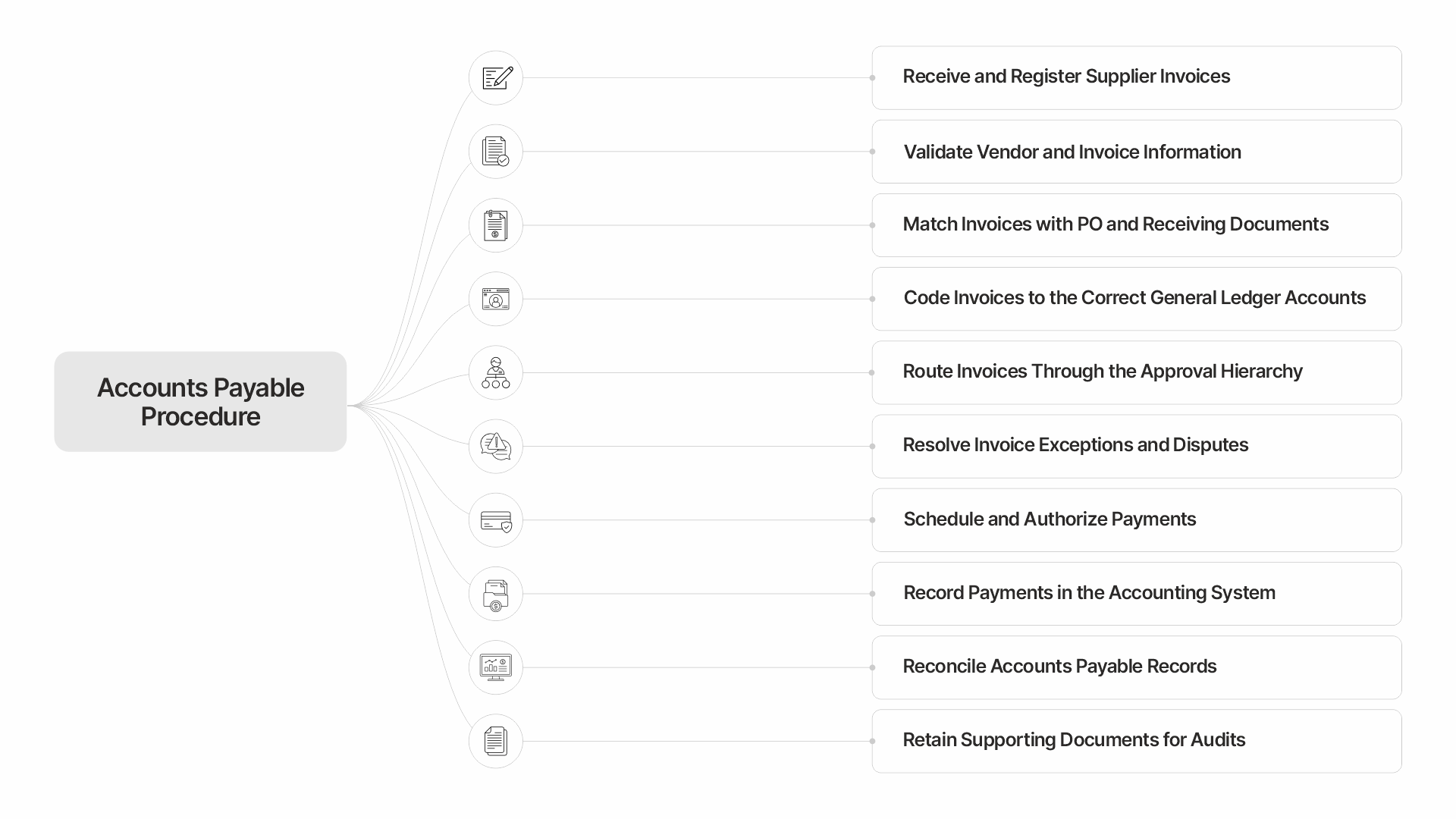
1. Receive and Register Supplier Invoices
All supplier invoices should be received through approved channels. Invoices sent to personal inboxes, informal chats, or unauthorized channels increase the risk of delays and missed controls.
Once received, invoices should be logged with basic details such as supplier name, invoice number, invoice date, amount, currency, purchase order number, receipt date, and processing status.
2. Validate Vendor and Invoice Information
Before an invoice is approved for payment, AP should confirm that the vendor exists in the approved vendor master and that invoice details are complete. Any invoice with missing or suspicious information should be placed on hold until resolved.
Validation should include:
- Vendor name and address
- Invoice number and date
- Bank or remittance information
- Tax details
- Currency
- Payment terms
- PO number, if applicable
- Invoice total and line-item details
3. Match Invoices with Purchase Orders and Receiving Documents
For PO-based invoices, AP should match invoice details with the purchase order and receiving documents. Invoices outside tolerance should be routed for review before approval.
Matching should verify:
- Vendor name
- PO number
- Item description
- Quantity
- Unit price
- Tax
- Freight or additional charges
- Goods receipt or service confirmation
4. Code Invoices to the Correct General Ledger Accounts
Invoice coding should follow the company’s chart of accounts and cost allocation rules. Incorrect coding can affect department budgets, tax reporting, financial statements, and management reporting.
Coding rules should define how invoices are assigned to:
- GL accounts
- Cost centers
- Departments
- Projects
- Locations
- Legal entities
- Expense categories
5. Route Invoices Through the Approval Hierarchy
Invoices should be routed according to the approval matrix. Approval should be based on amount, department, expense type, legal entity, and policy requirements.
The procedure should define what happens when:
- An approver is unavailable
- Approval is delayed
- The invoice is disputed
- The invoice exceeds authority limits
- A higher-level approval is required
Approval evidence should be captured in a system or documented workflow, not stored only in email threads.
6. Resolve Invoice Exceptions and Disputes
Exceptions should be logged and assigned to the correct owner. AP should not release payment until the issue is resolved and approved. This gives finance teams visibility into recurring issues, such as vendors submitting invoices without purchase orders or departments delaying approvals.
The procedure should define:
- Exception category
- Responsible owner
- Required supporting documents
- Escalation path
- Timeframe for resolution
- Approval required after resolution
7. Schedule and Authorize Payments
Approved invoices should be scheduled according to vendor terms, payment runs, cash flow requirements, and discount opportunities. High-value payments should require additional authorization.
Before payment release, AP should confirm:
- Invoice approval is complete
- Vendor bank details are verified
- Payment amount is correct
- Duplicate checks are complete
- Payment method is approved
- Supporting documents are attached
8. Record Payments in the Accounting System
Once payment is executed, it should be recorded in the accounting or ERP system. Payment records should include transaction date, amount, vendor, invoice number, payment method, bank account, and reference number.
Accurate payment posting supports cash reporting, bank reconciliation, vendor statements, and month-end close.
9. Reconcile Accounts Payable Records
AP records should be reconciled regularly to confirm that liabilities, payments, credits, and vendor balances are accurate.
Reconciliations may include:
- AP subledger to general ledger
- Vendor statements
- Accrued expenses
- Payment clearing accounts
- Open invoice reports
- Aged payables
- Unapplied credits
10. Retain Supporting Documents for Audits
Every invoice should have enough documentation to prove why it was paid, who approved it, and how it was recorded.
Supporting documents may include invoices, purchase orders, receipts, contracts, approvals, exception notes, payment confirmations, and reconciliation records.
How to Create an Accounts Payable Policy and Procedures Manual
Creating an AP policy and procedures manual requires more than documenting existing steps. The goal is to identify risks, define controls, remove unclear practices, and create a policy that employees can follow in real work conditions.
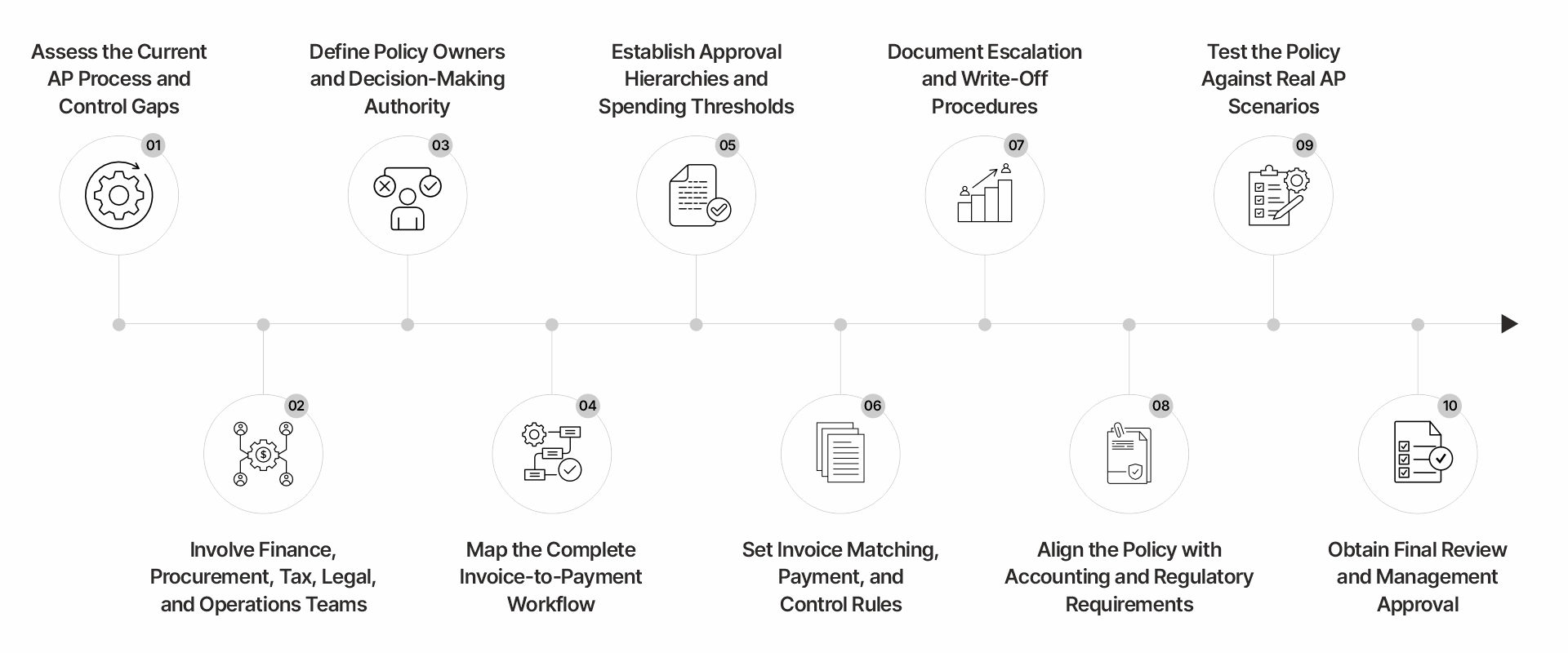
Step 1: Assess the Current AP Process and Control Gaps
Start by reviewing how invoices and payments are handled today. This review helps identify where policy rules are missing, unclear, or ignored.
Evaluate:
- Invoice intake channels
- Vendor onboarding steps
- Approval delays
- Duplicate payment history
- Non-PO invoice volume
- Manual workarounds
- Payment exception trends
- Vendor data quality
- Reconciliation issues
- Audit findings
Step 2: Involve Finance, Procurement, Tax, Legal, and Operations Teams
AP policy affects multiple functions. Finance may own the policy, but other teams help define practical rules.
For example, procurement should help define PO requirements. Tax should define documentation needs. Legal should review contract-related payment terms. Operations should confirm receiving and service validation steps.
Cross-functional input helps prevent a policy that looks good on paper but fails in daily use.
Step 3: Define Policy Owners and Decision-Making Authority
The manual should name the policy owner and define who has authority to approve updates, exceptions, payment releases, write-offs, and vendor changes.
Clear decision rights reduce delays and prevent employees from escalating every exception to the wrong person.
Step 4: Map the Complete Invoice-to-Payment Workflow
Create a workflow map that shows each step from invoice receipt to payment and reconciliation. This workflow map should be included in the manual or linked from it.
The map should show:
- Process step
- Responsible role
- System used
- Required documents
- Control point
- Exception path
- Approval requirement
- Output or evidence created
Step 5: Establish Approval Hierarchies and Spending Thresholds
Approval thresholds should reflect the company’s risk appetite, budget structure, and organizational hierarchy. Approval authority should be reviewed regularly as roles, departments, and budgets change.
The approval matrix should define:
- Approval limits by role
- Department approval requirements
- Finance approval requirements
- Executive approval thresholds
- Special approval for high-risk payments
- Delegation rules
- Temporary approver rules
Step 6: Set Invoice Matching, Payment, and Control Rules
The policy manual should define matching rules, payment rules, and control checks in practical detail. These rules should be specific enough to reduce interpretation gaps.
For example:
- PO invoices require two-way or three-way matching.
- Non-PO invoices require business justification and department approval.
- Vendor bank changes require independent verification.
- Invoices above a certain amount require finance review.
- Payments are released only during approved payment runs.
- Duplicate invoice checks must occur before payment.
Step 7: Document Escalation and Write-Off Procedures
The manual should explain how unresolved invoices, disputed amounts, old balances, vendor credits, and write-offs are handled.
Escalation procedures should define who is notified, when escalation occurs, and what documentation is required.
Write-off procedures should specify approval authority, accounting treatment, and supporting evidence.
Step 8: Align the Policy with Accounting and Regulatory Requirements
The AP policy should align with the company’s accounting policies, tax obligations, internal control framework, procurement policy, contract review process, and financial reporting requirements.
This alignment prevents conflicts between departments. For example, procurement may approve a vendor contract with payment terms that AP cannot support, or AP may process tax-sensitive payments without tax review.
Step 9: Test the Policy Against Real AP Scenarios
Before final approval, test the policy against real invoice scenarios. Testing reveals whether the policy is clear, complete, and usable.
Use examples such as:
- PO invoice with price variance
- Non-PO invoice from a new vendor
- Urgent payment request
- Vendor bank account change
- Duplicate invoice submission
- International vendor payment
- Subscription renewal
- Employee reimbursement
- Old vendor credit
- Disputed service invoice
Step 10: Obtain Final Review and Management Approval
The final policy should be reviewed by finance leadership, procurement, tax, legal, operations, and internal audit where applicable.
Management approval gives the policy authority. Employees should know that the policy is not optional and that exceptions must be documented.
How Should an AP Policy Address Special Payment Situations?
Special payment situations create higher risk because they often fall outside standard invoice workflows. A good AP policy should define how these cases are handled before they occur.
Rush and Emergency Payments
Rush payments should be limited to valid business needs, such as critical service restoration, contractual deadline risk, or urgent operational requirements. The policy should require written business justification, department approval, finance approval, vendor validation, payment method approval, and post-payment documentation review before the transaction is completed. Rush payments should also be tracked separately so finance can identify departments or vendors that frequently bypass standard payment timelines.
Employee Reimbursements and Expense Reports
Employee reimbursements should be governed by clear documentation and approval rules. The AP policy should align with the company’s travel and expense policy and define eligible expenses, receipt requirements, submission deadlines, approval authority, reimbursement timelines, taxable reimbursement treatment, handling of missing receipts, and prohibited expenses. This ensures employee payments are processed consistently and supported by proper evidence.
Recurring Payments and Subscriptions
Recurring payments require periodic review because they can continue even after a service is no longer needed. The policy should assign a contract or subscription owner, track renewal dates, require periodic usage reviews, mandate approval before renewal, define cancellation procedures, validate price increases, and review inactive subscriptions. These controls help prevent spend leakage from unused, duplicate, or forgotten subscriptions.
International Vendors and Foreign Currency Payments
International payments may involve foreign exchange exposure, tax withholding, bank fees, sanctions screening, and regulatory documentation. The policy should define approved payment methods, currency conversion rules, exchange rate sources, cross-border tax review requirements, required banking information, additional approval requirements, and documentation for fees or withholding. Payments involving high-risk jurisdictions or unusual payment instructions should require additional review before release.
Non-PO and One-Time Vendor Invoices
Non-PO invoices are common, but they carry higher control risk because they are not tied to a pre-approved purchase order.
The policy should define when non-PO invoices are allowed. For example, utilities, legal fees, rent, subscriptions, emergency repairs, and certain professional services may be permitted.
One-time vendors should still go through basic validation before payment.
Duplicate, Incorrect, and Disputed Invoices
Duplicate or incorrect invoices should be placed on hold. The policy should define how AP identifies, records, and resolves these cases.
AP should check for duplicate invoice numbers, matching amounts, repeated bank details, duplicate vendor records, and similar invoice dates.
Disputed invoices should not be paid until the responsible department confirms resolution.
Expired Liabilities and Accounts Payable Write-Offs
Old AP balances, stale checks, and unclaimed payments should be reviewed periodically to keep AP records accurate and current. The policy should define the review frequency, aging thresholds, investigation owner, vendor confirmation requirements, write-off approval limits, accounting treatment, and procedures for handling unclaimed payments. This helps maintain clean AP records and supports accurate liability reporting.
Accounts Payable Policy Example and Customizable Template
The following accounts payable policy example can be customized based on company size, industry, system setup, approval structure, and regulatory environment.
Sample Purpose and Scope Statement
Purpose:
This accounts payable policy establishes the rules for receiving, validating, approving, recording, paying, reconciling, and retaining supplier invoices and related payment documents. The policy is intended to support accurate financial reporting, controlled vendor payments, timely invoice processing, and compliance with company approval and documentation requirements.
Scope:
This policy applies to all employees, departments, business units, and legal entities involved in supplier purchases, invoice approvals, vendor payments, employee reimbursements, and accounts payable recordkeeping.
Sample Roles and Responsibilities Matrix
| Role | Responsibility |
| Accounts Payable | Receives invoices, validates details, routes approvals, prepares payments, retains documents |
| Procurement | Manages purchase orders, vendor onboarding support, and supplier documentation |
| Department Approver | Confirms goods or services received and approves valid expenses |
| Finance Manager | Reviews high-value invoices, payment runs, exceptions, and reconciliations |
| Tax Team | Reviews vendor tax documentation and reporting requirements |
| Legal Team | Reviews contract-related payment disputes and supplier terms |
| Internal Audit | Tests AP controls and policy compliance |
Sample Approval and Authorization Matrix
| Invoice Amount | Required Approval |
| Up to $2,500 | Department manager |
| $2,501 to $10,000 | Department head |
| $10,001 to $50,000 | Department head and finance manager |
| Above $50,000 | Finance director or CFO |
| Rush payments | Department head and finance approval |
| Vendor bank change | AP manager and finance review |
Approval limits should be adjusted based on the organization’s size, risk profile, and authority structure.
Sample Invoice Processing Rules
All supplier invoices must be submitted through approved invoice channels. Invoices must include the vendor name, invoice number, invoice date, purchase order number where applicable, description of goods or services, tax details, payment terms, and total amount.
PO-based invoices must be matched against purchase orders and receiving documents before payment. Non-PO invoices require department approval and business justification.
Incomplete invoices will be returned to the vendor or placed on hold until missing information is received.
Sample Payment Policy and Schedule
Payments will be processed according to agreed vendor payment terms and company payment run schedules. Payment methods must be approved by finance.
Payment runs may be scheduled weekly, biweekly, or according to cash management requirements. High-value payments, international payments, and rush payments require additional review before release.
Early payments may be approved when they capture a valid discount or prevent business disruption.
Sample Exception and Write-Off Guidelines
Invoice exceptions must be documented and assigned to the appropriate owner. AP may not release payment for invoices with unresolved discrepancies unless finance approves an exception.
Small balances, stale checks, old credits, and expired liabilities must be reviewed periodically. Write-offs require approval based on the authorization matrix and must be supported by documentation.
Sample Record Retention Requirements
The company must retain AP records according to legal, tax, audit, and internal reporting requirements.
Retained records may include:
- Supplier invoices
- Purchase orders
- Receiving documents
- Contracts
- Approval records
- Payment confirmations
- Vendor tax documentation
- Exception notes
- Reconciliation records
- Write-off approvals
- Sample Policy Review Schedule
This policy should be reviewed at least annually or sooner if there are changes in systems, regulations, business structure, payment methods, audit findings, fraud incidents, or control requirements.
All updates must be documented with version number, effective date, summary of changes, policy owner, and management approval.
Apply AP Policy Consistently with Collatio's Account Reconciliation Solution
Approval rules, thresholds, and exception paths enforced on every invoice processed.
Book a free demoHow AP Automation Strengthens Policy Compliance
AP automation strengthens policy compliance by applying approval rules, matching logic, duplicate checks, payment controls, and audit trails consistently across invoice workflows.
Manual AP processes depend heavily on employee memory and follow-up. Automated AP workflows can embed policy rules directly into invoice handling, so exceptions are flagged before payment instead of discovered after the fact.
1. Enforcing Approval Limits and Segregation of Duties
AP automation can route invoices based on approval limits, department, cost center, amount, and invoice type. It can also prevent the same person from performing conflicting activities.
For example, a user who creates a vendor record may be restricted from approving the first payment to that vendor. This helps enforce segregation of duties without relying only on manual review.
2. Automating Two-Way and Three-Way Invoice Matching
Automated matching compares invoice data with purchase orders, goods receipts, contracts, and other supporting records.
This helps identify:
- Price mismatches
- Quantity differences
- Missing receiving documents
- Duplicate invoice numbers
- Invalid purchase orders
- Tax discrepancies
- Vendor mismatches
Invoices that meet matching rules can move forward, while exceptions are routed for review.
3. Detecting Duplicate Invoices and Suspicious Payments
Duplicate payments can occur when invoices are submitted with slightly different formats, invoice numbers, vendor names, or amounts.
Automation can compare invoice attributes across current and historical records to flag potential duplicates before payment.
Suspicious payment indicators may include:
- New vendor bank details
- Unusual payment amount
- Invoice submitted outside normal pattern
- Duplicate supplier records
- Payment request from an unapproved channel
- Rush payment request without documentation
4. Standardizing Invoice Coding and Exception Routing
Automation can suggest or apply coding based on vendor, PO, expense category, department, entity, and historical invoice patterns. This reduces coding variation and supports cleaner reporting.
Exception routing also becomes more consistent. Instead of AP manually deciding who should handle each issue, the system can route tax issues to tax, receiving issues to operations, and PO mismatches to procurement.
5. Maintaining Complete Approval and Payment Audit Trails
A strong AP automation setup captures every major invoice action, including receipt, extraction, validation, matching, approval, exception handling, payment release, and posting.
This gives finance and audit teams clear evidence of:
- Who approved the invoice
- When approval occurred
- What exceptions were raised
- How issues were resolved
- Who authorized payment
- Which documents supported the transaction
6. Supporting Tax Validation and Secure Payment Controls
AP automation can support vendor tax documentation checks, invoice tax validation, and secure payment workflows.
It can also enforce controls around vendor bank changes, payment approvals, and user permissions. This is especially useful for companies with multiple entities, high invoice volume, international vendors, or complex tax rules.
7. Integrating AP Policies with ERP and Accounting Systems
AP policy compliance improves when invoice workflows connect with ERP and accounting systems. Integration reduces duplicate data entry and keeps vendor, invoice, payment, and accounting records aligned.
A well-integrated AP setup can connect invoice approvals, GL coding, payment status, vendor records, and audit evidence in one controlled workflow.
8. Balancing Automated Controls with Human Oversight
Automation should support AP decision-making rather than replace financial oversight. It should enforce standardized policy rules while giving finance teams the control to review exceptions, unusual payment requests, vendor disputes, and high-risk transactions.
An effective AP control framework combines system-driven validations with human review for decisions that require context, judgment, and risk assessment.
How to Implement and Communicate an Accounts Payable Policy
An AP policy can only be effective when employees and vendors clearly understand how to follow it. Successful implementation depends on clear communication, role-based training, easy access to policy documents, and consistent adoption across all relevant departments.
1. Roll Out the Policy Across Relevant Departments
The policy should be rolled out to all departments involved in spending, approvals, procurement, vendor management, and payment requests.
Finance should explain why the policy matters, what is changing, and how employees should follow it.
2. Train Employees on AP Rules and Responsibilities
Training should be role-specific. Department approvers do not need the same level of detail as AP processors, but they do need to understand invoice review, approval timelines, documentation requirements, and escalation rules.
Training should cover:
- Approval responsibilities
- PO requirements
- Invoice submission rules
- Exception handling
- Rush payment rules
- Expense documentation
- Policy violation consequences
3. Make Policy Documents and Process Flowcharts Accessible
The policy, procedures, approval matrix, vendor requirements, and process flowcharts should be easy to access.
Employees should not have to search through old emails or shared folders to find the latest policy version.
4. Communicate Invoice and Payment Requirements to Vendors
Vendors should receive clear instructions on invoice submission and payment requirements.
Vendor communication should include:
- Approved invoice submission channel
- Required invoice fields
- PO number requirements
- Payment terms
- Tax documentation requirements
- Contact details for invoice questions
- Dispute resolution process
Clear vendor instructions reduce invoice exceptions and payment delays.
5. Establish Channels for Policy Questions and Updates
Employees should know where to ask AP policy questions. This may be a finance email inbox, AP helpdesk, shared knowledge base, or internal ticketing workflow.
Questions and recurring issues should be tracked because they may reveal unclear policy language or training gaps.
6. Track Employee Acknowledgement and Training Completion
Employees involved in approvals, procurement, and AP processing should acknowledge that they have read and understood the policy.
Training completion records help support internal control reviews and audit evidence.
How to Monitor and Update an Accounts Payable Policy
An accounts payable policy should be monitored continuously and reviewed periodically. Business processes, systems, vendor risks, regulations, and payment methods change over time.
1. Track Accounts Payable Performance Indicators
AP performance indicators show whether the policy is working in practice.
Useful metrics include:
- Invoice processing cycle time
- Invoice exception rate
- Duplicate payment rate
- On-time payment rate
- Early payment discount capture
- Approval delay rate
- Number of invoices on hold
- Vendor dispute volume
- AP aging trends
- Payment error rate
- Vendor master change volume
These metrics help finance teams identify control gaps and process bottlenecks.
2. Conduct Periodic Internal AP Audits
Internal AP audits should test whether policy rules are being followed.
Audit testing may include:
- Approval compliance
- Vendor setup controls
- Duplicate payment checks
- Invoice matching evidence
- Payment authorization records
- Tax documentation
- Write-off approvals
- Segregation of duties
- Record retention
The audit should identify root causes, not just individual errors.
3. Report and Investigate Policy Violations
Policy violations should be tracked and investigated. Examples include unauthorized approvals, repeated PO bypasses, incomplete invoice documentation, unapproved vendor changes, or payments released outside policy.
The policy should define how violations are reported, who reviews them, and what corrective actions may apply.
4. Identify Warning Signs That the Policy Needs Revision
The policy may need revision when AP teams repeatedly work around it or when exceptions become routine.
Warning signs include:
- Frequent rush payments
- Rising invoice exceptions
- Delayed approvals
- Vendor complaints
- Recurring duplicate invoices
- High non-PO invoice volume
- Poor vendor data quality
- Audit findings
- New payment risks
- System changes that make current procedures outdated
5. Gather Feedback from Employees and Vendors
Employees and vendors can identify practical issues that may not appear in audit reports.
Finance teams should gather feedback from AP staff, department approvers, procurement teams, and vendors to understand where the policy is unclear or difficult to follow.
6. Define Events That Trigger an Immediate Policy Review
Some events should trigger immediate review instead of waiting for the annual policy update.
Examples include:
- ERP or AP system change
- New legal entity
- Merger or acquisition
- Fraud incident
- Significant audit finding
- New tax requirement
- Change in payment methods
- Expansion into new countries
- Major vendor onboarding change
7. Maintain a Record of Policy Changes and Approvals
Every policy update should be documented. This includes what changed, why it changed, who approved it, and when the change became effective.
This avoids confusion and supports audit transparency.
Best Practices for an Effective Accounts Payable Policy
An effective AP policy should be clear, practical, controlled, and aligned with the way the organization actually operates.
1. Keep Instructions Clear, Practical, and Role-Specific
Avoid vague language such as “obtain appropriate approval” or “review invoice carefully.” Define exactly what approval is required and what review means.
Role-specific instructions help employees understand their responsibilities without reading unnecessary detail.
2. Remove Unnecessary Approval and Processing Steps
Too many approval layers can delay payments and encourage workarounds. The policy should control risk without slowing every invoice unnecessarily.
Low-risk, low-value invoices may follow a simpler path, while high-risk invoices require additional review.
3. Standardize Controls Without Delaying Payments
Controls should prevent errors and fraud, but they should not create avoidable payment delays.
For example, approval limits, matching tolerances, and exception routing should be defined clearly so invoices do not sit unresolved because no one knows who should act.
4. Assign Clear Accountability for Every AP Activity
Every AP activity should have an owner. This includes vendor setup, invoice validation, approval, exception resolution, payment authorization, reconciliation, and policy updates.
Clear ownership reduces delays and makes control testing easier.
5. Review Vendor Records and AP Accounts Regularly
Vendor records should be reviewed for duplicates, inactive vendors, missing tax information, and unauthorized changes.
AP accounts should also be reviewed for old balances, unapplied credits, stale payments, and reconciliation differences.
6. Use AP Data to Identify Control Gaps
AP data can reveal issues that policy documents alone cannot show.
For example:
- High exception rates may indicate poor vendor instructions.
- Frequent rush payments may indicate weak purchasing discipline.
- Repeated coding corrections may indicate unclear GL coding rules.
- High non-PO invoice volume may indicate procurement policy gaps.
7. Align Policy Requirements with Actual System Capabilities
The policy should reflect what the company’s AP, ERP, procurement, and payment systems can actually support.
If the policy requires automated approval logs, but approvals happen through email, the organization either needs to change the system setup or revise the procedure.
A policy that cannot be executed reliably will not support control.
Common Accounts Payable Policy Mistakes to Avoid
Many AP policies fail because they are too generic, too vague, or disconnected from real workflows.
Using Generic Rules That Do Not Reflect Actual Workflows
Generic templates may miss company-specific risks such as international vendors, multiple entities, non-PO invoice volume, project-based accounting, or industry-specific tax requirements.
The policy should reflect actual invoice types, systems, approval structures, and business risks.
Failing to Define Approval Authority
Approval authority should be specific. The policy should state who can approve what, up to which amount, and under which conditions.
Without clear approval authority, invoices may be approved by employees who do not have budget ownership or financial authority.
Ignoring Non-Standard Payment Scenarios
Rush payments, one-time vendors, subscriptions, international transfers, employee reimbursements, and disputed invoices need clear rules.
If the policy ignores these situations, employees will create informal workarounds.
Allowing One Employee to Control Multiple Payment Stages
Giving one employee control over vendor creation, invoice approval, payment setup, and payment release creates serious control risk.
Segregation of duties should be built into both policy and system permissions.
Leaving Vendor Master Data Changes Uncontrolled
Vendor bank changes, address updates, tax details, and contact changes should require review.
Uncontrolled vendor master changes can lead to payment fraud, duplicate vendors, tax errors, and reporting issues.
Failing to Train Employees on Policy Requirements
A policy is only useful if employees understand it. Finance should train AP staff, approvers, procurement teams, and employees who submit payment requests.
Training should be repeated when the policy changes.
Continuing to Use Outdated Procedures
AP procedures should change when systems, regulations, vendors, payment methods, or internal controls change.
Outdated procedures create confusion and may cause employees to follow steps that no longer match current systems.
Final Thoughts
An accounts payable policy gives finance teams a structured framework to control payments, reduce risk, support audits, and maintain reliable vendor relationships. The most effective policies reflect real AP workflows, approval hierarchies, tax requirements, system capabilities, exception handling rules, and documentation standards.
For organizations managing high invoice volumes, complex approvals, and growing vendor risk, policy enforcement becomes easier with automation. Scry AI’s Collatio AP Automation helps finance teams apply invoice matching rules, approval controls, duplicate payment checks, tax validation, audit trails, and secure payment workflows across the invoice-to-payment process.
Book a demo with Scry AI to see how Collatio AP Automation can help you standardize AP policy compliance and strengthen payment controls.