Book a Demo

Process All Your B/L Documents Faster and More Accurately with AI-Driven Bill of Lading Software

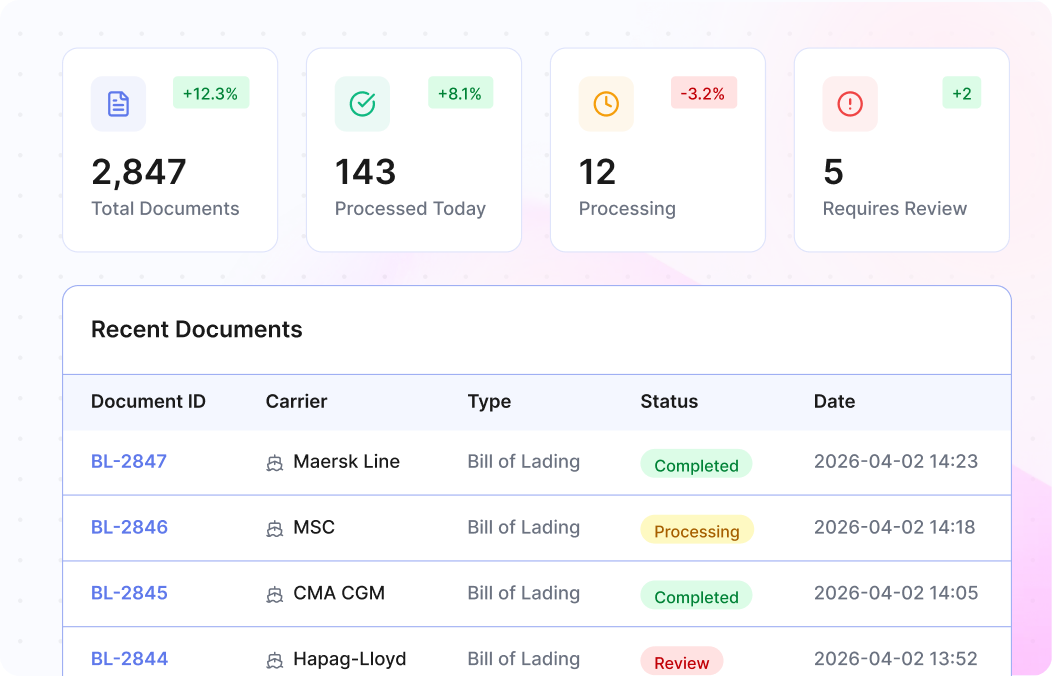
Evaluate Bills of Lading and automatically extract key shipment details, including goods description, shipper and consignee information, ports of departure and arrival, carrier details, and transport terms. Digitize, structure, and validate B/L data across maritime and freight transport to support faster customs clearance and facilitate trade financing.

Book a Demo
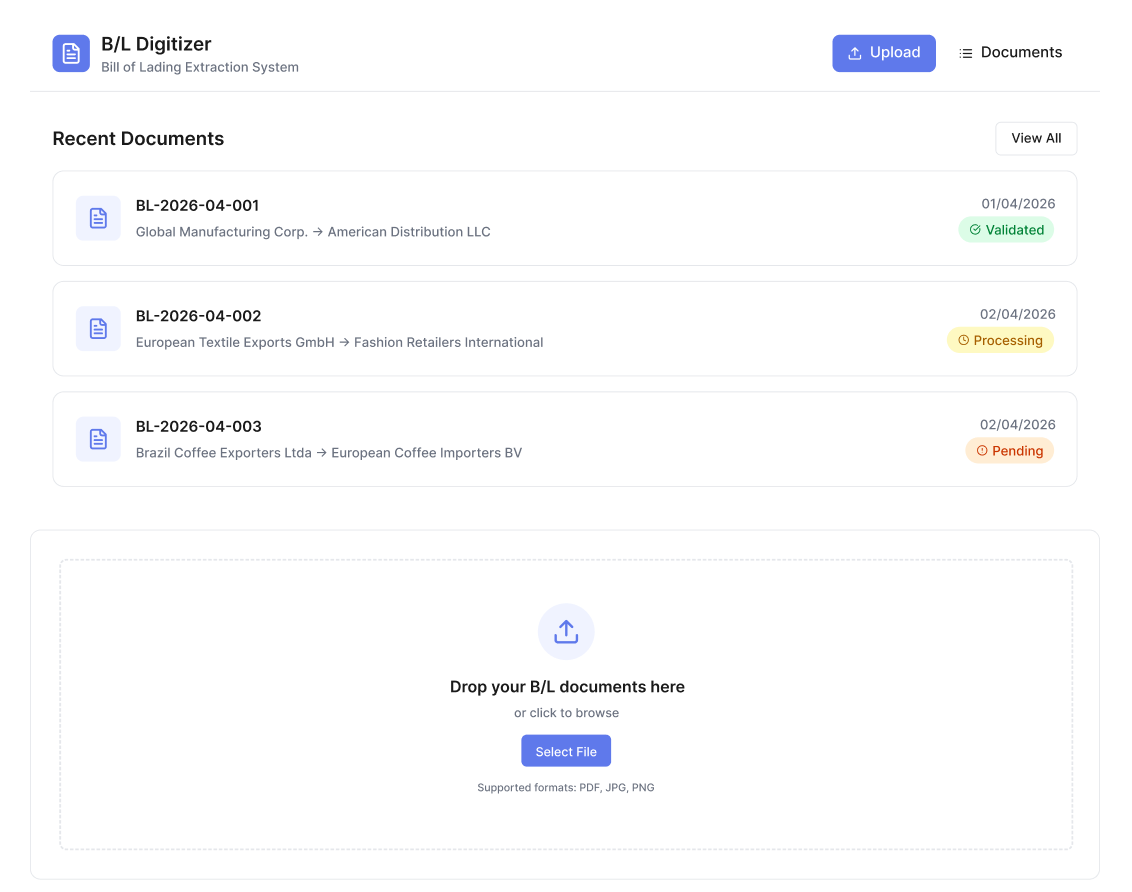
Automated Form Processing Software Powered by AI

Where Bill of Lading Workflows Break Down in Modern Logistics

Despite the critical role of Bills of Lading in global trade, most are still exchanged in physical form, while some organizations use electronic Bills of Lading (eBL) software to facilitate automation. Even so, these conventional approaches cannot fully resolve the complexity involved in processing shipping documentation, often leading to operational challenges that can cause significant delays and add considerable costs to shipments.

  • Unable to Process Varied Formats

    Conventional eBL systems fail to interpret fields when document formats change due to their reliance on basic OCR technologies and rigid template-based processing.

  • Inconsistent & Erroneous Outputs

    Systems process eBLs without contextual understanding and often misread non-standardized fields, descriptions, and carrier-specific formats, resulting in inconsistent data outputs.

  • Fraud and Tampering Hide in Plain Sight

    Traditional digital B/L workflows lack mechanisms to detect unauthorized edits, duplicate originals, or counterfeit shipping documents.

  • Data Breach and Compliance Risks

What is Collatio Bills of Lading?

Collatio Bills of Lading is Scry AI’s trade document intelligence platform built to process, validate, and digitize Bills of Lading across international trade operations. It extracts key shipment details, including shipper and consignee information, cargo descriptions, container numbers, shipment dates, freight terms, ports, and carrier data directly from the document. The platform reconciles this information against related cargo and shipping records and converts it into structured data that can be integrated with logistics systems such as TMS, ERP, and customs applications. Collatio ensures accurate Bill of Lading processing for customs compliance, clearance, and financial settlement.

Intelligence Built Into Every Step of the BOL Lifecycle

Collatio’s Bill of Lading software equips logistics and trade teams with AI-powered document intelligence to process bills of lading with greater speed, accuracy, and operational visibility.

AI-Powered OCR and Intelligent Data Extraction

Universal Document Ingestion

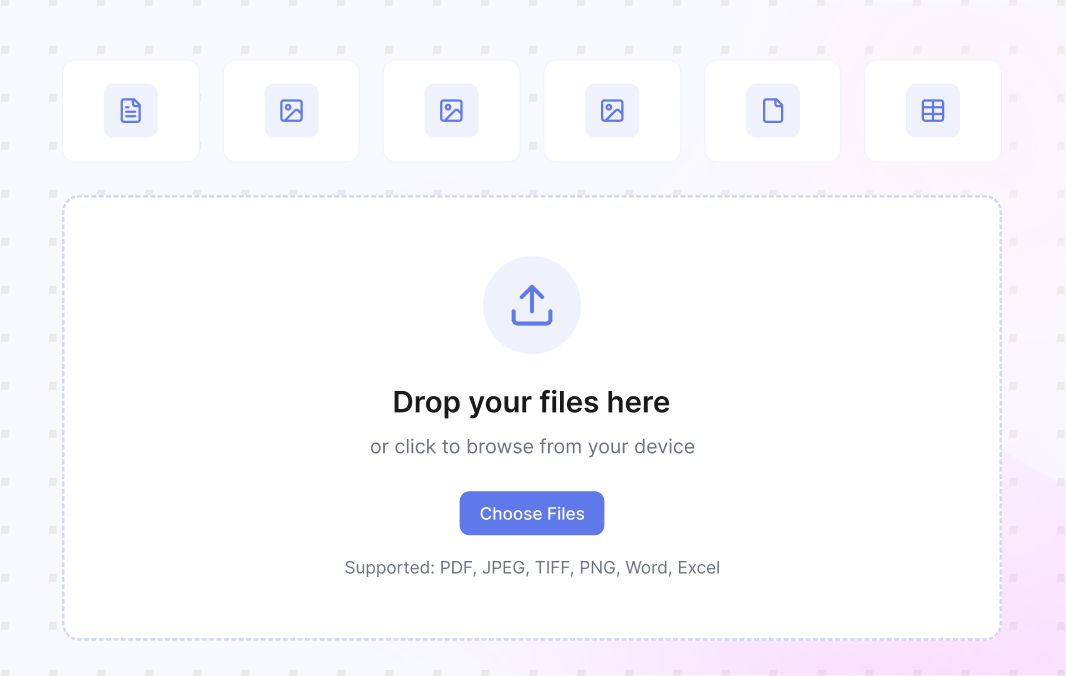
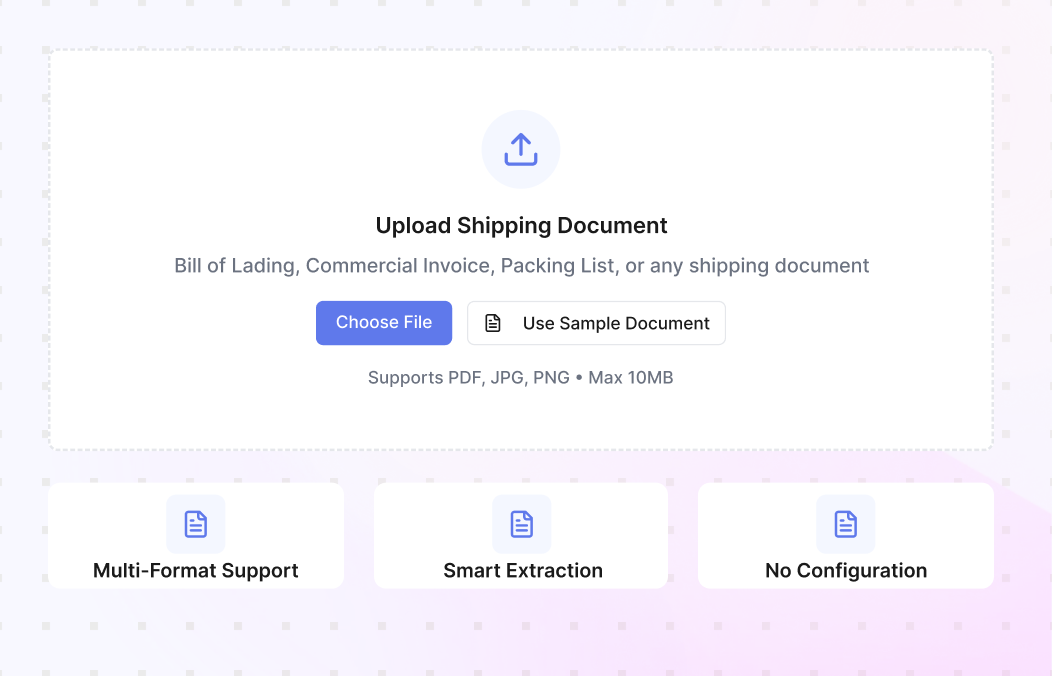
Collatio ingests bills of lading from any carrier across a wide range of formats, including PDFs, scanned images, email attachments, and API feeds. Each document is digitized, so paper scans, email files, and carrier-specific layouts become standardized digital records without manual preparation. Logistics teams can onboard new carrier B/L documents instantly and process them as they arrive, regardless of layout or format.

Context-Aware, Template-Free Layout Understanding

AI-Powered Field Extraction

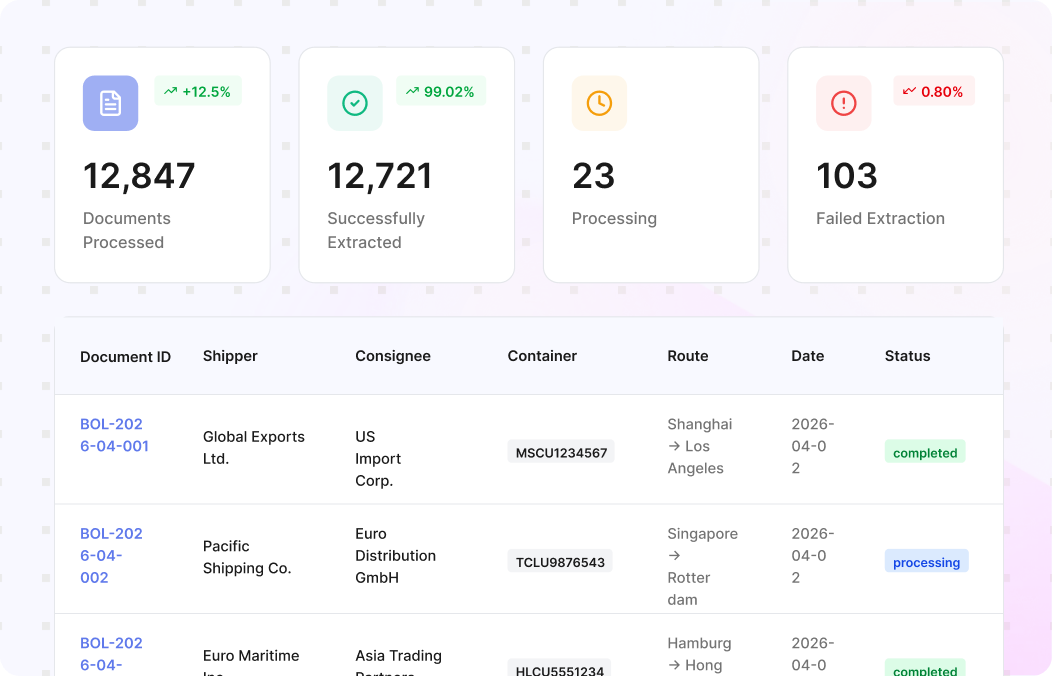
The platform applies advanced OCR and natural language processing to identify and capture key bill of lading fields with high accuracy. It interprets the document’s semantic structure and contextual relationships, enabling accurate field recognition even when layouts vary across carriers. Shipper and consignee details, container numbers, cargo descriptions, seal identifiers, voyage data, and port information are automatically extracted and structured for downstream systems. Collatio processes documents across multiple languages and adapts to regional formats and carrier-specific layouts.

Custom Form Onboarding & Reconstruction

Intelligent Document Reconciliation

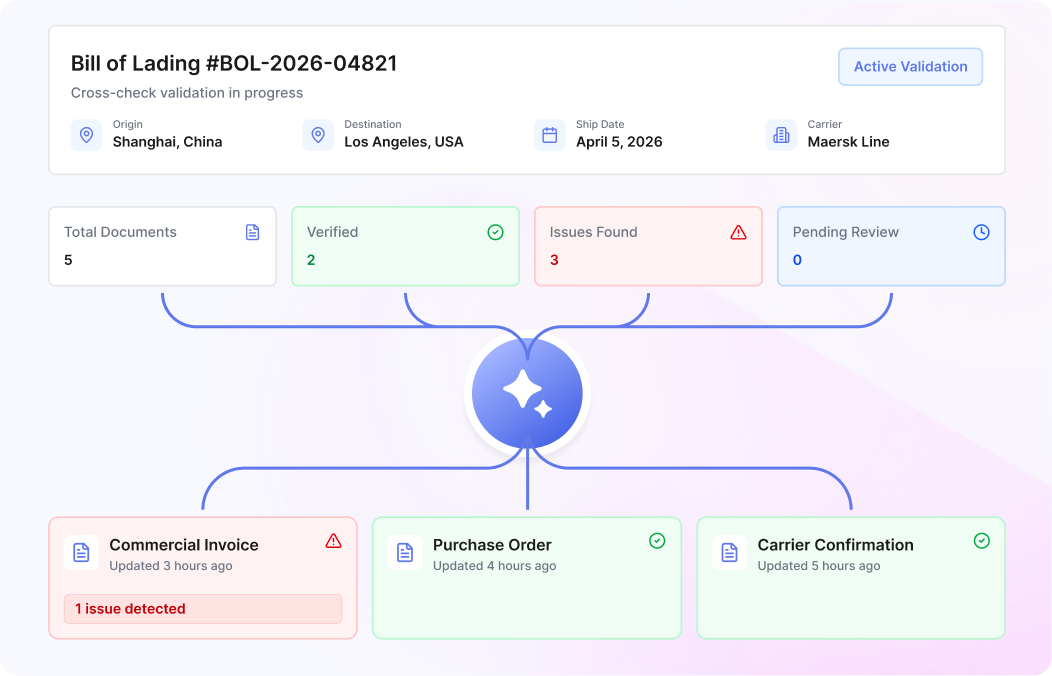
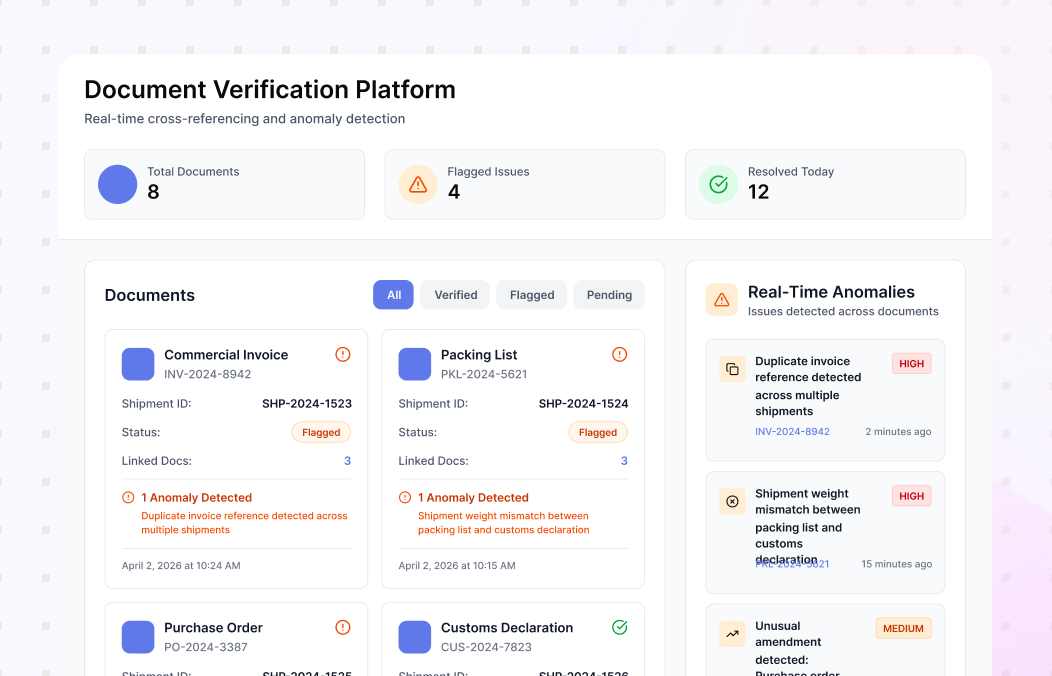
Bill of lading data is automatically cross-checked against related trade and logistics documents such as packing lists, commercial invoices, purchase orders, customs declarations, and carrier confirmations. Our BOL software highlights inconsistencies early in the workflow, allowing teams to resolve issues before shipments move through customs, ports, or distribution networks.

Automated Validation, Verification, and Anomaly Detection

Built-In Document Integrity and Fraud Detection

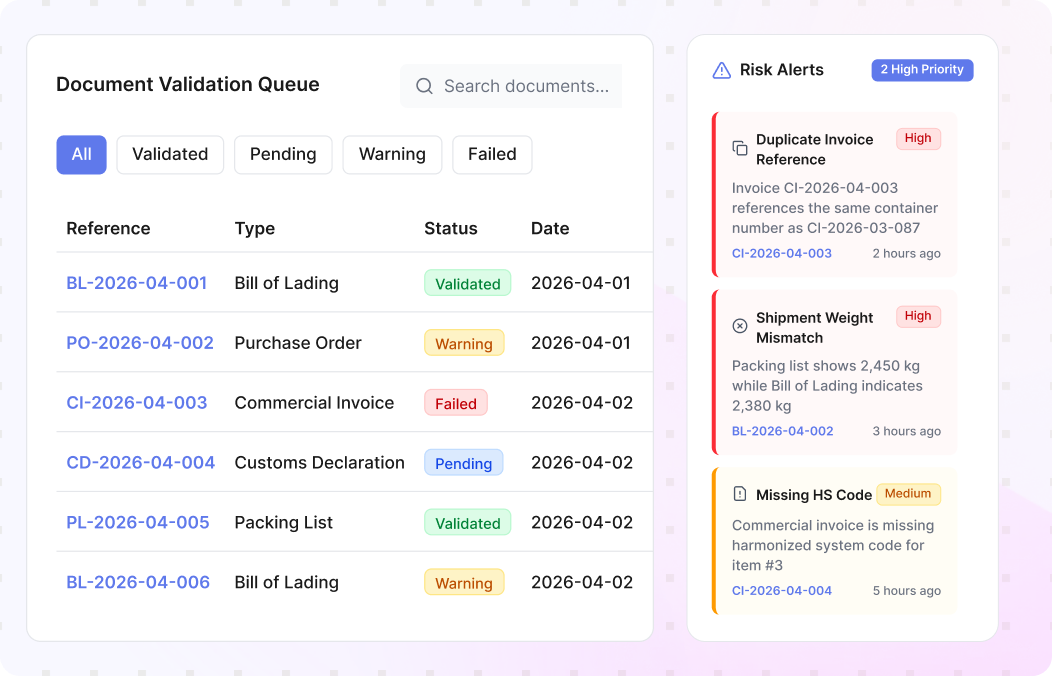
Each document undergoes automated validation through configurable business rules and consistency checks against packing lists, purchase orders, commercial invoices, customs declarations, and related documents. The platform also analyzes document data to detect duplicate references, conflicting shipment details, missing fields, or unusual amendments. These controls help teams identify potential risks early and maintain confidence in trade documentation accuracy.

Secure Centralized Management and Enterprise Integration

Human-Guided Exception Management

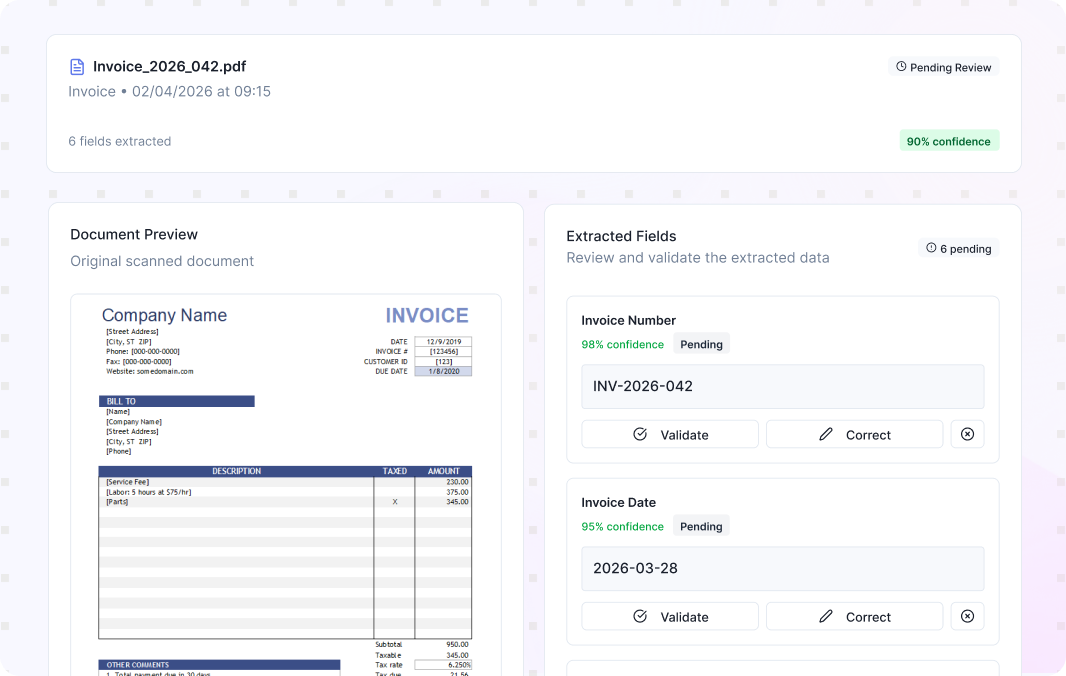
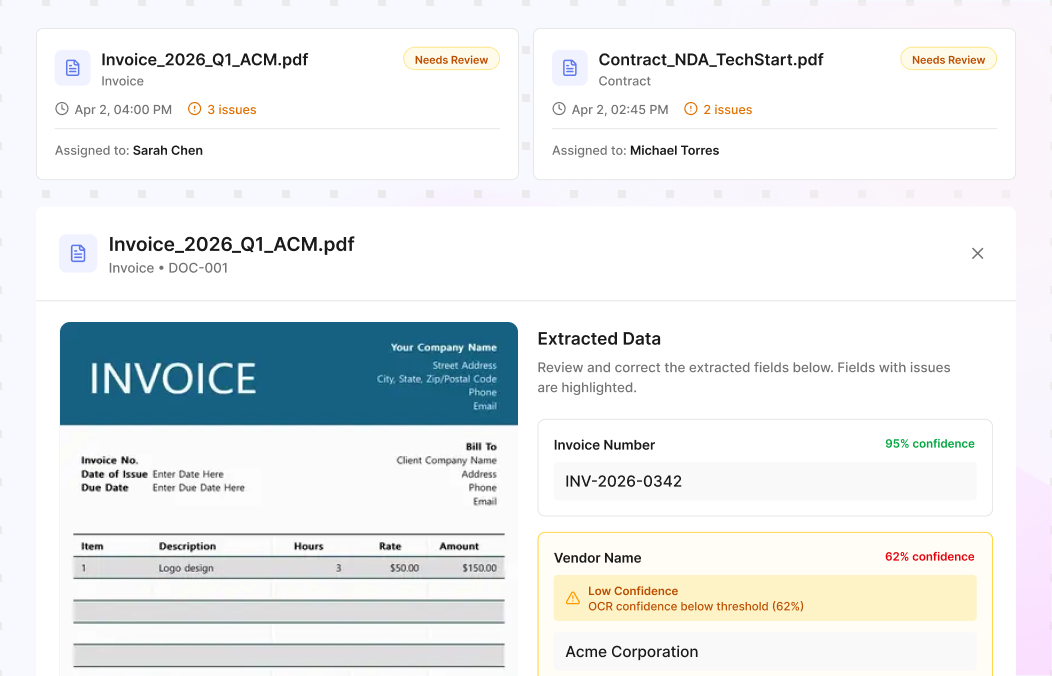
When the system encounters uncertain fields or complex document variations, Collatio routes them for human-in-the-loop review through its validation framework. Teams receive the complete document context, along with extracted data, so they can validate, correct, or approve fields efficiently. Once validated, the data moves forward to downstream systems, while routine document extraction continues through automated processing.

Secure Centralized Management and Enterprise Integration

System Integration and Audit Visibility

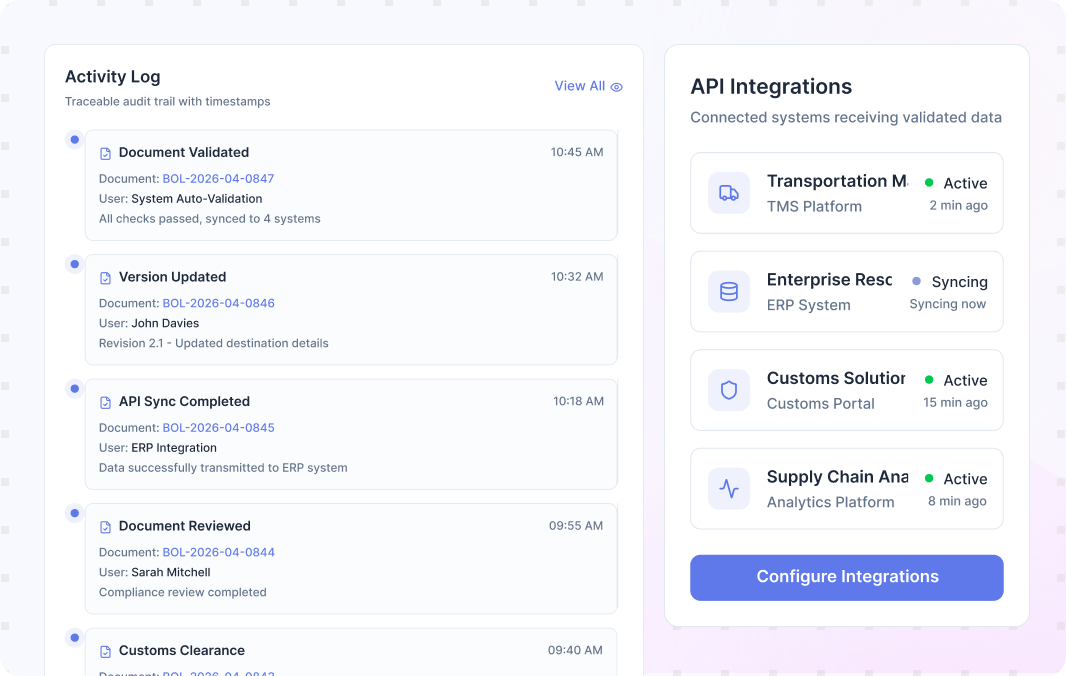
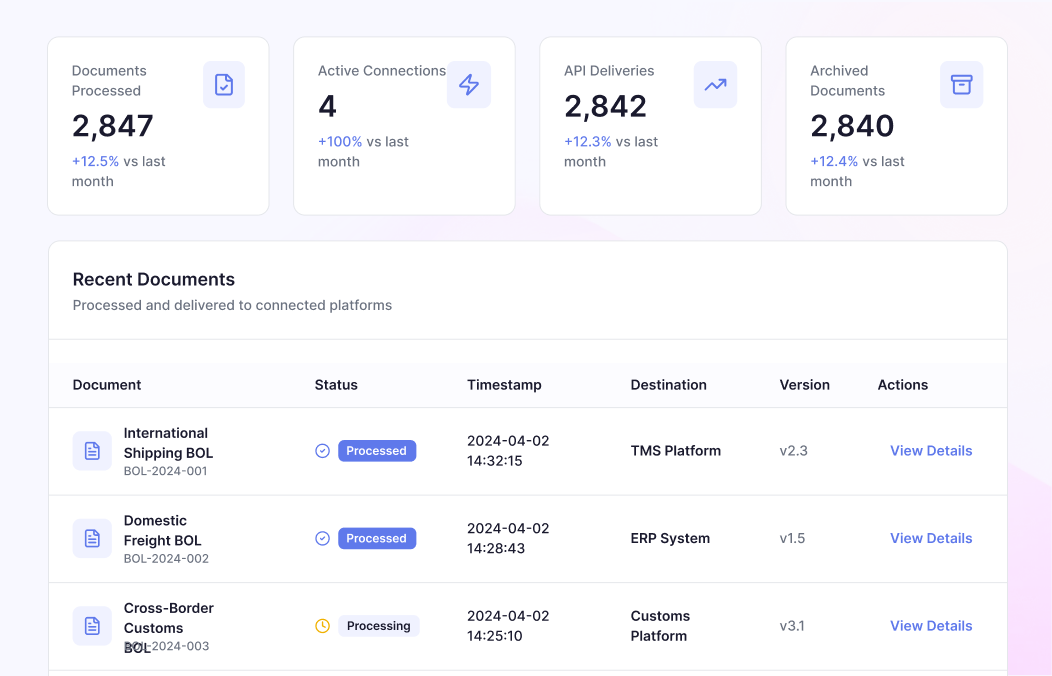
Validated bill of lading data flows directly into transportation management systems, ERP platforms, customs solutions, and other supply chain applications through secure APIs. Every document action is logged with timestamps, version history, and traceable activity records. Organizations gain a transparent processing trail that supports compliance, operational oversight, and audit readiness.

Operational Benchmarks in Automated BOL Processing

Collatio delivers measurable gains in document accuracy, processing speed, and operational efficiency for enterprise bill of lading workflows.

0% +

extraction accuracy on bill of lading documents, even across varied formats and layouts

0% +

reduction in manual effort via Intelligent Document Processing (IDP)

0x

faster processing and turnaround times for shipping documentation

0%

drop in compliance errors, with automated validation identifying discrepancies early

How Collatio Orchestrates Bill of Lading Workflows for Modern Logistics

Capture Documents From Any Source

The Collatio BOL platform captures bills of lading from multiple channels, such as email attachments, shared folders, scanners, carrier portals, or API feeds. The platform supports formats including PDF, JPEG, TIFF, PNG, Word, and Excel files. Images undergo automated preprocessing that corrects skew, reduces noise, and improves clarity, so even low-quality port scans remain suitable for accurate document interpretation.

Capture Forms From Any Source

Classify, Parse, and Extract With AI Precision

The platform identifies the document type and interprets its structure through OCR, natural language processing, and layout analysis. Collatio extracts critical shipment data, including shipper and consignee details, container numbers, cargo descriptions, seal identifiers, voyage information, freight terms, and port details. The system recognizes carrier-specific layouts and regional document formats without the need for template configuration.

Enhance and Organize Documents for Faster Processing

Validate Against Business Logic and Linked Documents

Extracted data is automatically cross-referenced against configured business rules and linked documents, including packing lists, purchase orders, commercial invoices, and customs declarations. The platform also evaluates the data for anomalies such as duplicate references, inconsistent shipment details, or unusual amendments. Discrepancies are flagged in real time, which gives teams clear visibility to resolve issues before shipment release.

Extract Data from Complex Forms with Contextual Intelligence

Route Exceptions to Human Review

Documents that pass all validation checks flow straight through to your systems automatically. Those with low-confidence fields, anomalies, or flagged discrepancies are routed to the appropriate team member for human-in-the-loop review with full document context. Teams can review discrepancies and extracted data to confirm, correct, or approve fields for faster resolution with confidence.

Validate Accuracy with Automated, Rules-Based Checks

Push Structured Data Into Your Systems and Archive

Validated BOL data is delivered to your TMS, ERP, customs platform, or data warehouse through secure API connections in your required format. Every processed document is simultaneously archived with version history and a timestamped audit trail, which supports compliance and reliable document retrieval.

Integrate Clean Data into Downstream Systems with Full Audit Control

What Documents Do We Handle?

Collatio processes a wide range of trade and freight documentation alongside bills of lading. This ensures shipment workflows remain connected across related document types.

Audit-Ready by Design, Compliant by Default

Collatio embeds enterprise compliance, data protection, and governance controls directly into every Bill of Lading workflow so teams remain audit-ready at all times.

  • Data Security Framework

    SOC 2 Type II and ISO 27001 certified security with encryption, role-based access, MFA, and configurable data residency options.

    SOC 2 & ISO 27001-Aligned Controls
  • Document Processing Audit Trails

    Time-stamped processing logs track document ingestion, extraction, validation, and review across every BOL workflow.

    PII & Financial Data Protection
  • Multi-Jurisdiction Trade Compliance

    Configurable validation rules detect incomplete HS codes, incorrect freight terms, and missing details before submission to customs authorities.

    Regulatory & Audit Support

Clients

We are trusted by enterprises globally.

Collatio Seamlessly Integrates with Your Stack

Connect with your existing enterprise platforms through APIs and direct data exchange, keeping your workflows intact and your teams in sync.

Extract, Validate, and Manage Every BOL Document with AI Precision Using Collatio

Don’t let a misread BOL delay another shipment.

Book a Demo

Recent Articles

  • Prepaid Expenses on Balance Sheet: Accounting Explained

    Prepaid Expenses on the Balance Sheet: How They Are Recorded and Reconciled

    Author Profile Picture
    Arpita Pandey
    Apr 23, 2026
  • Corporate Credit Card Reconciliation Guide

    Corporate Credit Card Reconciliation: Process and Best Practices

    Author Profile Picture
    Arpita Pandey
    Apr 22, 2026
  • Payroll Reconciliation

    What Is Payroll Reconciliation and Why Does It Matter?

    Author Profile Picture
    Arpita Pandey
    Apr 21, 2026
  • Payment Reconciliation

    What Is Payment Reconciliation? Process, Automation, and Key Use Cases

    Author Profile Picture
    Arpita Pandey
    Apr 16, 2026
  • Revenue Reconciliation

    Revenue Reconciliation Explained: Meaning, Process, Examples, and Automation

    Author Profile Picture
    Arpita Pandey
    Apr 16, 2026
  • Treasury Reconciliation

    Understanding Treasury Reconciliation: Process and Practices

    Author Profile Picture
    Arpita Pandey
    Apr 16, 2026
  • Insightful Resources

    Discover how SCRY AI solutions bring accuracy and innovation in document processing, conversational AI, and IoT operations.

    Frequently Asked Questions

    Digital bill of lading software automates the capture, validation, and transfer of shipment data from BOLs into operational systems. It reduces manual review effort, standardizes carrier formats, and streamlines data flow across logistics, customs, and trade workflows.

    Carriers issue bills of lading in varied layouts, structures, and file formats. Collatio BOL platform interprets layout patterns, table structures, and contextual cues to locate and extract key shipment data across documents without template configuration. This approach allows enterprises to standardize carrier documents within a single BOL software platform while maintaining consistent extraction accuracy.

    Organizations can typically begin automated bill of lading processing within a few weeks. Pre-trained AI models reduce setup effort, and API connectors enable quick integration with TMS, ERP, and logistics platforms. Teams can start with a pilot deployment, validate results on live documents, and expand automation gradually across additional carriers and document volumes.

    Our electronic bill of lading software can easily integrate with transportation and enterprise systems through secure APIs and configurable connectors. Extracted BOL data can be delivered directly into ERP, TMS, customs platforms, or internal logistics applications such as SAP, Oracle, and Microsoft Dynamics. These integrations support organizations that operate bill of lading tracking software and require consistent shipment data across operational systems.

    Collatio applies configurable validation rules and maintains traceable workflow records throughout the document review and approval process. The platform identifies missing shipment fields, inconsistent cargo details, and duplicate references across related trade documents. This supports governance and operational transparency across electronic bill of lading workflows.