Book a Demo

AI Decision Support That Turns Production Complexity into Margin Advantage

Manufacturing operations with multi-stage production lines face a relentless optimization puzzle. Every scheduling choice, every trim pattern, every transition sequence creates ripple effects across throughput, cost, waste, and delivery commitments. Scry AI's AI decision support solution, built on Concentio®, gives production teams the intelligence to evaluate thousands of feasible scenarios in real time, balancing competing objectives and turning operational complexity into measurable margin gains.

Book a Demo
Investment Analytics Software Built for Real-Time Investment Intelligence

The Hidden Margin Erosion in Multi-Stage Production

In complex manufacturing environments, decisions are never isolated. A scheduling choice on the first machine affects downstream finishing operations. A trim pattern that minimizes waste on one run may create transition inefficiencies on the next. Inventory buffers, logistics constraints, and customer delivery windows add further layers of interdependency.

Without advanced decision intelligence, production planners are forced to optimize locally rather than holistically. They make choices that look reasonable in isolation but leave significant value on the table when viewed across the entire production chain. Trim losses accumulate. Transition inefficiencies compound. And margins erode quietly, hidden inside operational decisions that no one has the visibility to challenge.

As product complexity grows and customer expectations tighten, the gap between what planners can evaluate manually and what optimal performance requires continues to widen. The result is not just inefficiency but a structural constraint on profitability that traditional planning tools cannot address.

How Production Planning Still Works Today

Most manufacturing environments continue to rely on planning approaches that were designed for simpler times, creating blind spots and missed optimization opportunities across the value chain.

1
Siloed planning decisions
Production stages are planned independently, with limited coordination across machines, finishing operations, and logistics.
2
Heavy reliance on manual scheduling
Planners depend on experience, spreadsheets, and legacy tools that cannot evaluate the full solution space.
3
Limited multi-objective optimization
Systems optimize for one variable at a time, unable to simultaneously balance cost, quality, waste, and service levels.
4
Suboptimal transition sequencing
Changeovers are scheduled based on convenience rather than optimization, leading to higher transition losses.
5
Elevated trim and material waste
Non-optimized cutting and production patterns leave significant material value on the cutting room floor.
6
Reactive rather than proactive planning
Planners respond to problems after they occur rather than anticipating and preventing them.

Scry AI's Artificial Intelligence Decision Support System for Production and Margin Optimization

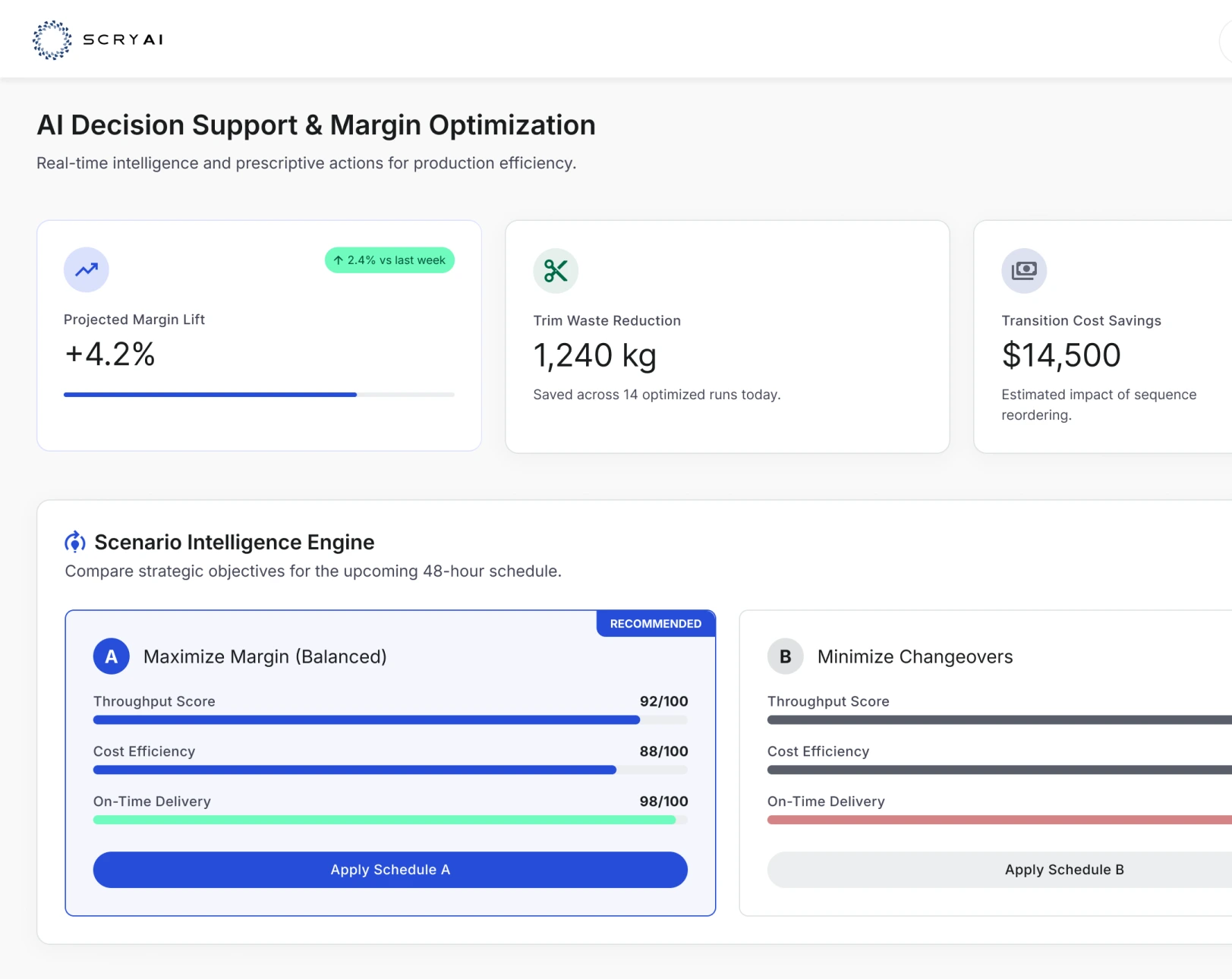
Built on Concentio®, Scry AI's decision intelligence platform transforms production planning from a siloed, manual exercise into an AI-powered, multi-objective optimization engine. It evaluates thousands of feasible production scenarios, identifies optimal patterns, and delivers recommendations that maximize margin across the entire value chain.

  • Multi-objective optimization

    Simultaneously balances throughput, cost, waste, delivery commitments, and quality targets across production stages.

  • AI-driven scheduling intelligence

    Evaluates thousands of feasible production schedules and trim patterns to identify the optimal path forward.

  • End-to-end coordination

    Aligns decisions across machines, finishing operations, inventory, and logistics for holistic optimization.

  • Trim loss minimization

    Identifies optimal cutting and production patterns that reduce material waste and maximize yield.

  • What-if simulation and scenario analysis

    Enables planners to evaluate trade-offs and test alternative strategies before committing to execution.

  • Human-in-the-loop decisioning

    Keeps planners in control, allowing them to review, refine, and approve AI-generated recommendations.

Clients

We are trusted by enterprises globally.

Expert 1 Expert 2 Expert 3 Expert 4 Expert 5 Expert 6 Expert 7

Stop Leaving Margin on the Production Floor

Transform production planning from reactive scheduling into AI-powered optimization that maximizes throughput and minimizes waste.

Book a Demo

Insightful Resources

Discover how SCRY AI solutions bring accuracy and innovation in document processing, conversational AI, and IoT operations.

FAQs

1. What is an AI decision support system in manufacturing?

An AI decision support system in manufacturing uses machine learning and advanced analytics to analyze production data, evaluate thousands of scheduling and optimization scenarios, and recommend decisions that improve throughput, reduce waste, and maximize margins. It augments human expertise with data-driven intelligence.

Traditional planning tools rely on static rules, manual inputs, and single-objective optimization. AI decision support systems learn from operational data, evaluate multiple objectives simultaneously, and continuously improve recommendations based on outcomes. They handle complexity and interdependencies that legacy tools cannot address.

Yes. AI decision support systems analyze cutting patterns, production sequences, and material constraints to identify configurations that minimize trim loss and material waste. By evaluating far more options than human planners can consider, they consistently find better solutions.

Scry AI's solution integrates with your existing planning workflows and systems. It provides AI-generated recommendations that planners can review, adjust, and approve before execution. The goal is to enhance human decision-making, not replace it.

Industries with complex, multi-stage production processes see the greatest impact. This includes paper and packaging, metals, chemicals, food and beverage, textiles, and discrete manufacturing. Any environment where scheduling, trim optimization, and transition sequencing affect margins can benefit from AI decision intelligence.