Book a Demo

Payslip Parsing with AI‑Powered OCR for Automated Payroll Data Extraction & Verification

Extracts payslip data across multiple formats and jurisdictions at scale while eliminating manual effort. Cross-checks employee payroll data through configured validation checks. Delivers verified data as structured, decision-ready intelligence to support faster and more accurate HR and payroll operations.

Book a Demo
Automated Form Processing Software Powered by AI

Why Payslip Processing Remains a Bottleneck

Despite widespread adoption of document intelligence solutions, payslip data extraction and parsing are still among the most challenging and error-prone processes. This is due to inherent systemic limitations in traditional systems that struggle with complex document variations.

  • Fragmented and Format Dependent

    Payslip records remain scattered across internal repositories and exist in multiple formats, including PDFs, scanned files, XML, and JSON. Template-dependent systems struggle with these variations.

  • Inconsistent Field Interpretation

    Traditional payroll systems rely on basic OCR for text extraction and fail to account for document context. This leads to incorrect interpretation of payroll fields and inconsistent datasets.

  • Highly Manual with Limited Scalability

    The captured data is often erroneous, which requires teams to review each payslip line by line to ensure correct field extraction. As employee or applicant volumes grow, this approach becomes difficult to sustain.

  • Data Breach and Compliance Risks

What is Collatio Payslip Processing?

Collatio Payslip Processing is a Scry AI document intelligence platform that automatically classifies, extracts, and reconciles payslip data at enterprise scale. It uses advanced optical character recognition, machine learning, and natural language processing to interpret various payslip formats and identify key payroll fields such as earnings, deductions, tax components, net salary, employer details, and employee identifiers. The platform enforces configured validation rules to reconcile and verify income data and ensure accuracy across extracted values. The validated payroll data is then converted into structured datasets that support payroll audits, income verification workflows, lending decisions, compliance reporting, and HR operations.

AI-Driven Intelligence for Accurate Payslip Processing at Enterprise Scale

Collatio Payslip Processing uses domain-trained, high-precision AI and ML technologies to analyze and transform payslip documents into actionable insights.

AI-Powered OCR and Intelligent Data Extraction

Omni-Channel and Format-Agnostic Capture

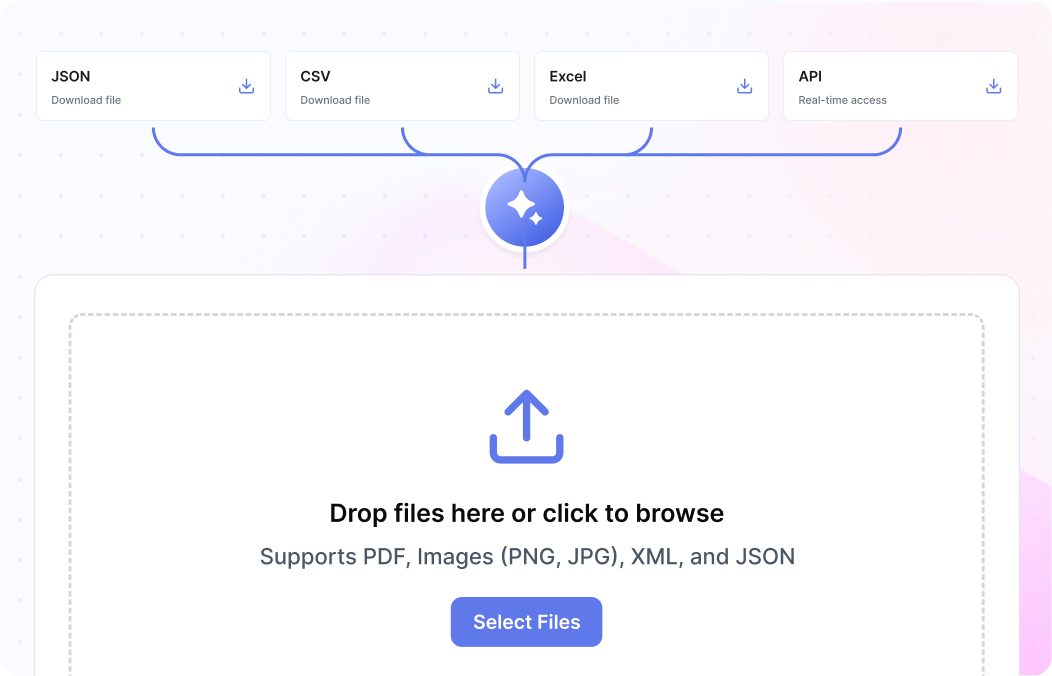
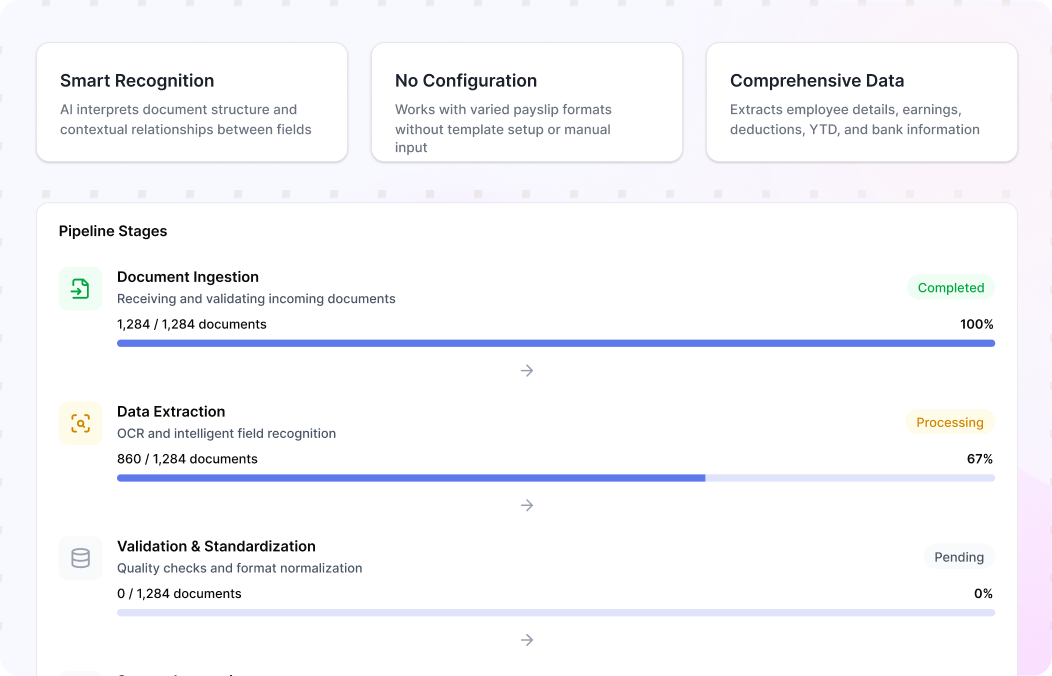
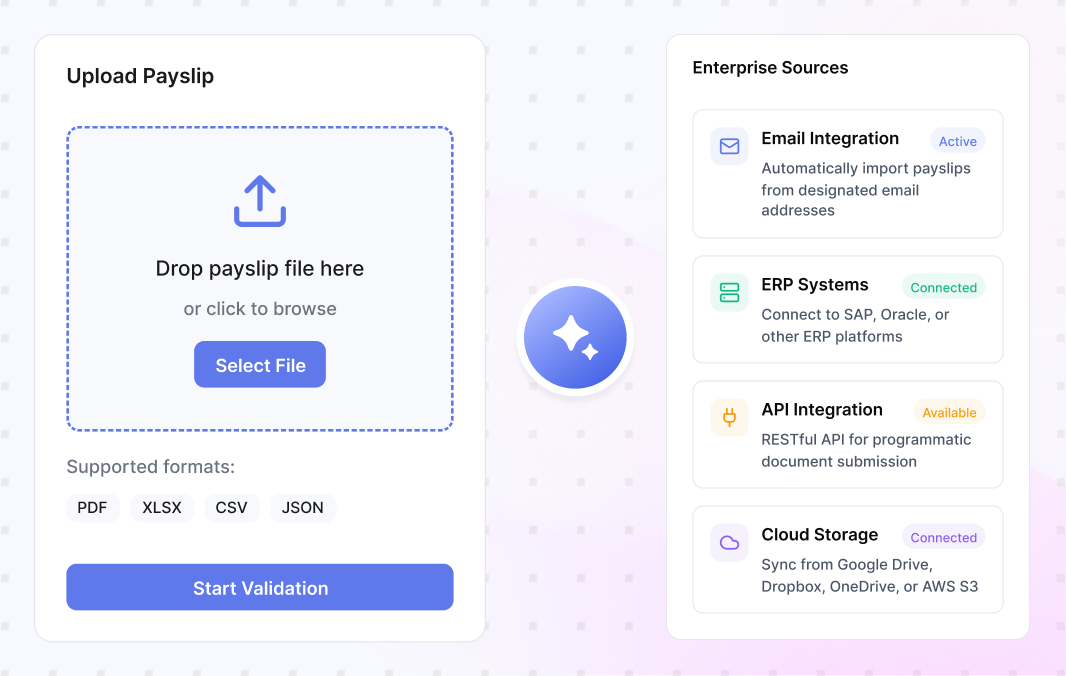
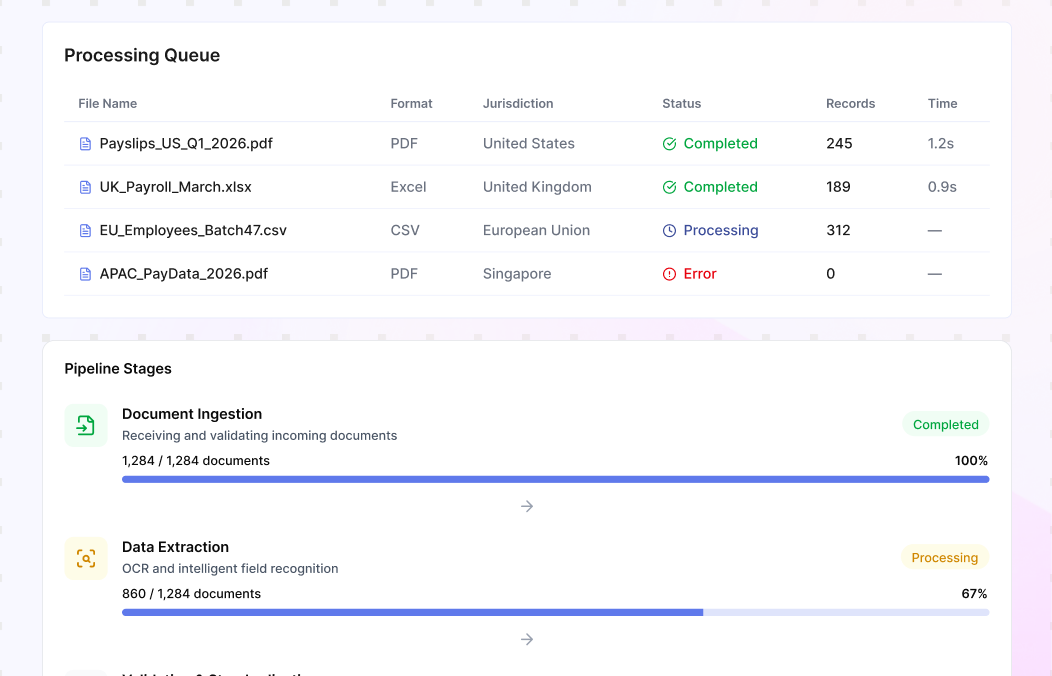
Collatio Payslip Processing ingests payslip documents from enterprise sources such as email, ERP systems, API integrations, and cloud storage platforms. It supports a wide range of file formats, including PDF, images, XML, and JSON, across varied layouts. The system can also read and capture both structured and unstructured data within payslips, including tables, nested sections, headers, images, and handwritten inputs. Each document then moves through a unified processing pipeline that standardizes inputs for downstream systems.

Context-Aware, Template-Free Layout Understanding

AI-Powered OCR Extraction

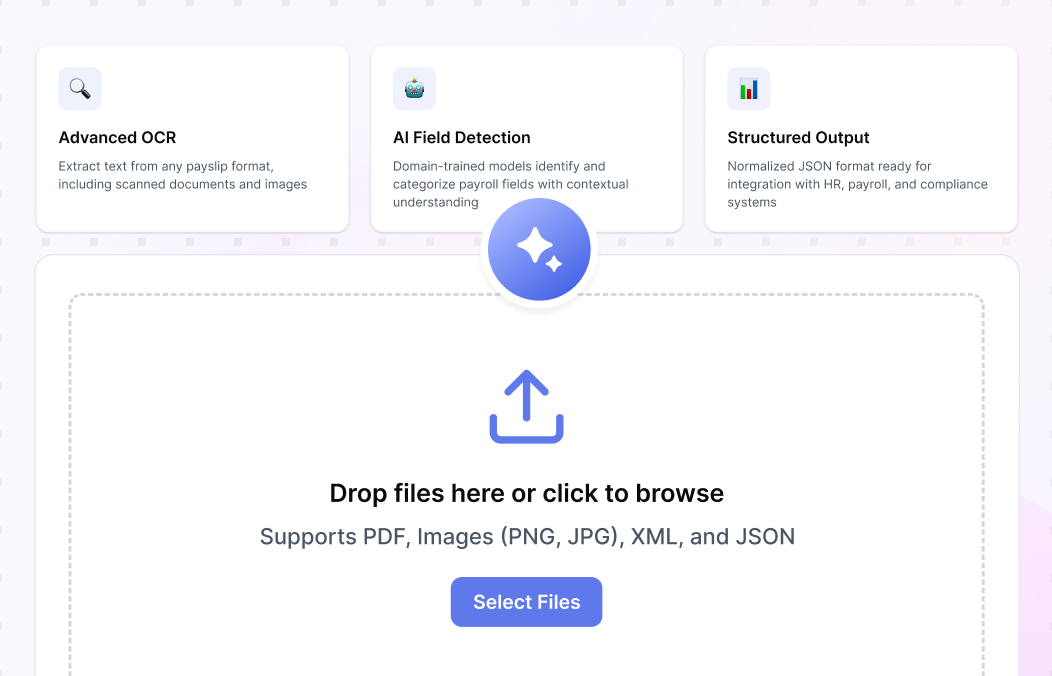
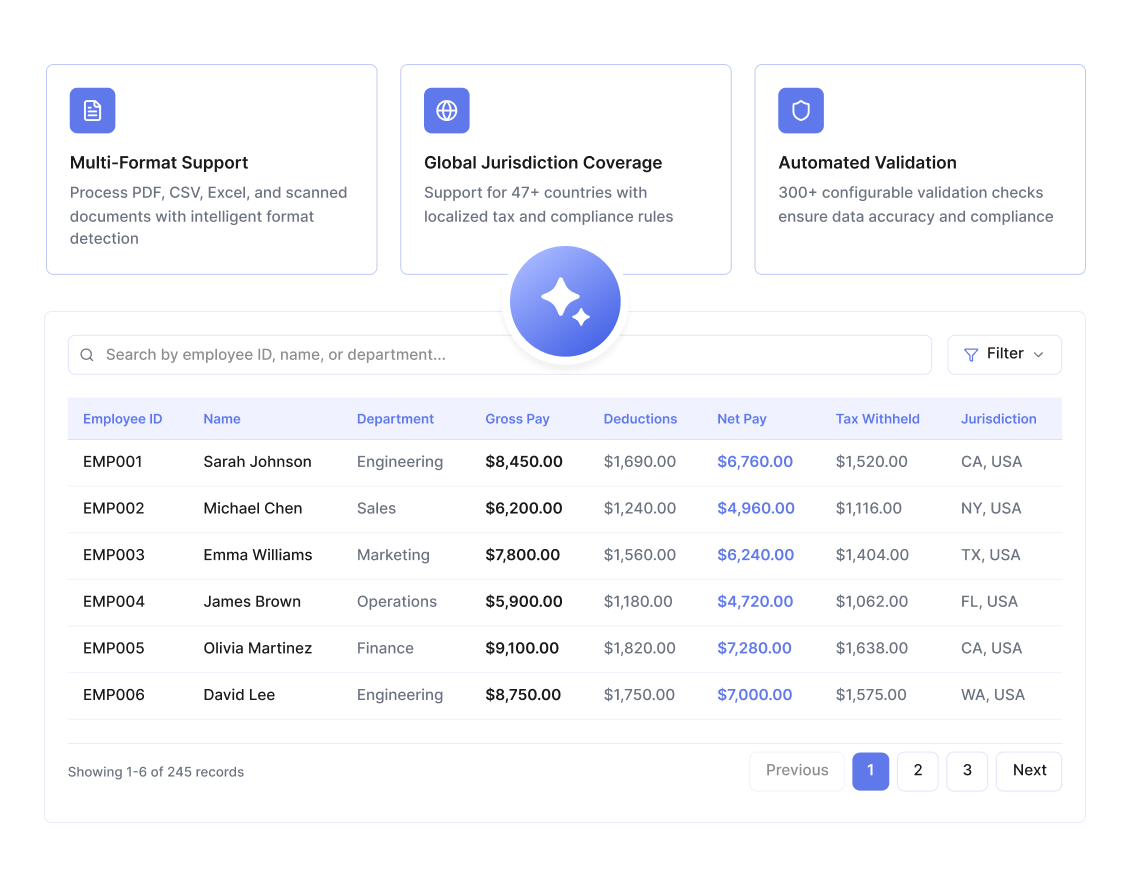
AI-powered Optical Character Recognition identifies and extracts key details from payslips, including employee ID, employee name, pay period, gross pay, net pay, deductions such as PF, tax, and insurance, year-to-date earnings, & bank details. The system interprets document structure and contextual relationships between fields to ensure accurate mapping of payroll components such as basic salary, HRA, allowances, employer registration details, department, and designation. This enables reliable data extraction without template configuration or manual input, while supporting consistent output across varied payslip formats.

Custom Form Onboarding & Reconstruction

Cross-Document Reconciliation

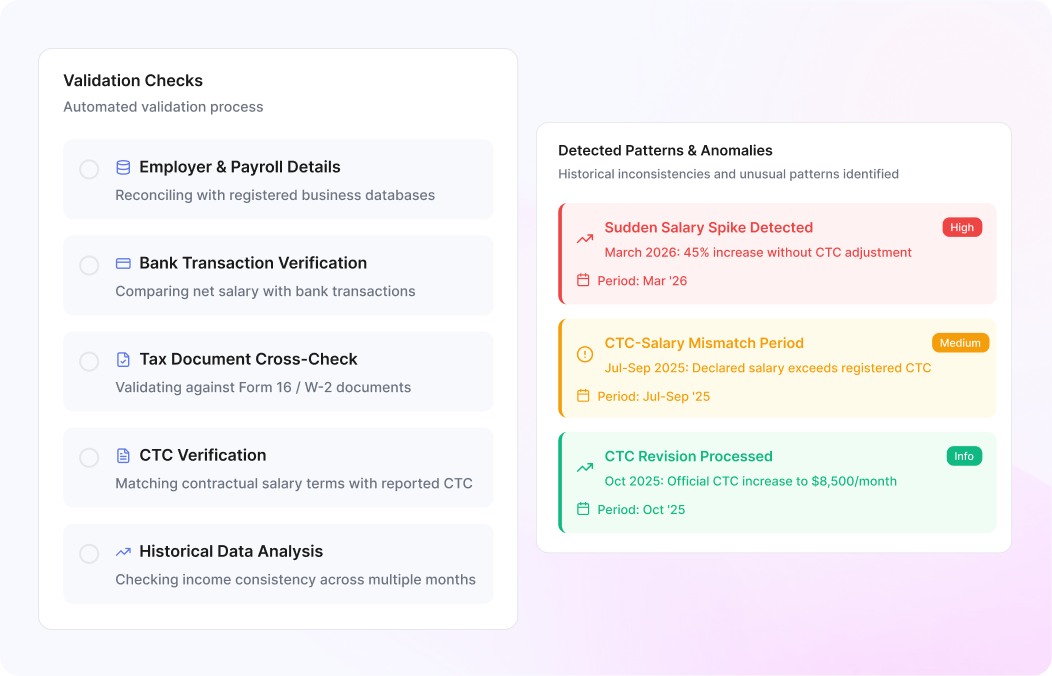
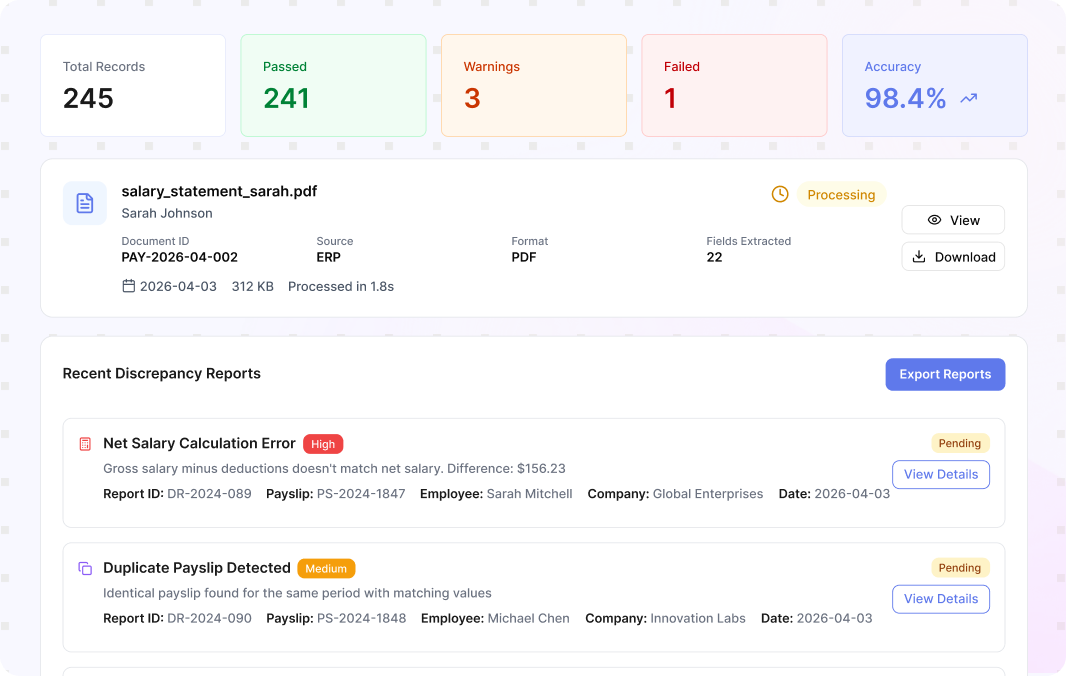
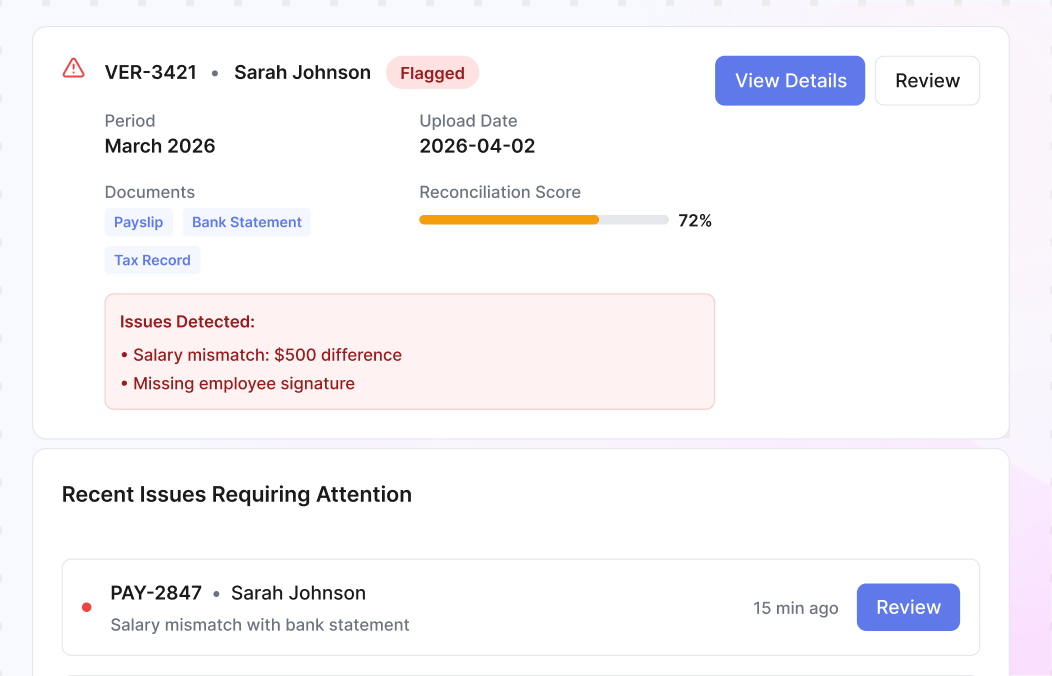
Collatio Payslip Processing validates payslip data through automated checks to ensure consistency across income, salary credits, and employment records. To do this, it reconciles employer and payroll details with registered business databases, compares net salary with corresponding bank transactions, and cross-checks declared values with Form 16, W-2, or equivalent tax documents. Contractual salary terms are verified against reported CTC, while historical data across multiple months helps identify income inconsistencies and unusual patterns. The system flags discrepancies such as duplicate payslips, calculation errors, incorrect tax or deduction values, altered salary details, and mismatched employee information in real time.

Automated Validation, Verification, and Anomaly Detection

Exception Handling, Human-in-the-Loop, & Approvals

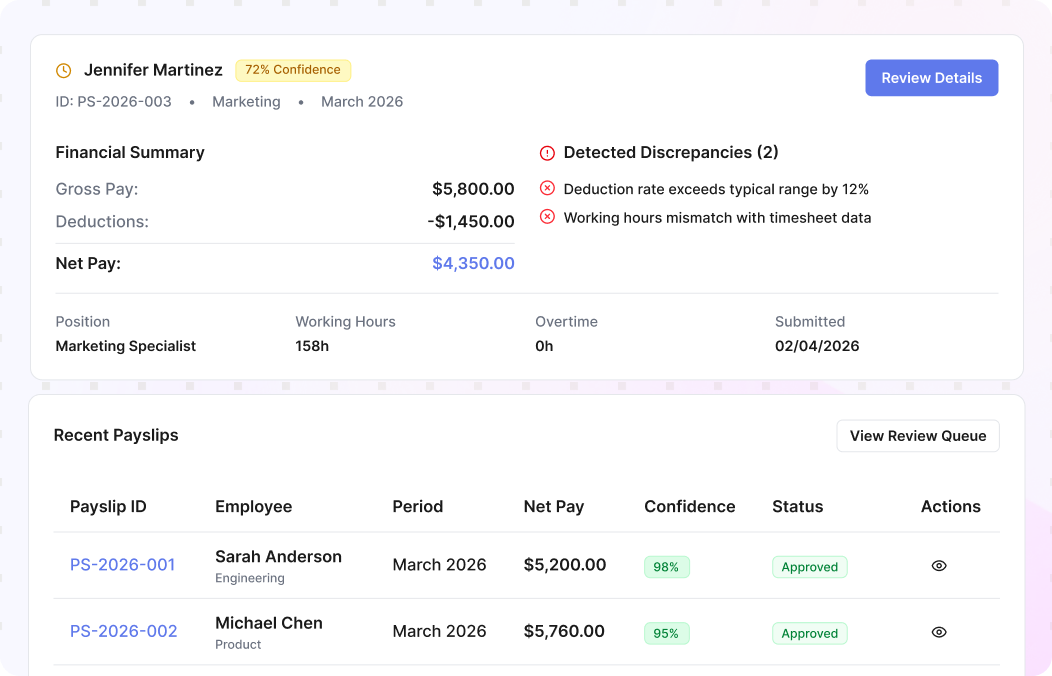
Payslips that meet predefined confidence thresholds are automatically approved and forwarded to downstream systems for further processing. Cases with low confidence scores or detected discrepancies are routed to designated reviewers, along with full contextual data, for human-in-the-loop validation. Reviewers assess each flagged case against defined business rules, resolving exceptions to ensure data accuracy and completeness. The platform provides granular control over the workflow, enabling teams to configure approval thresholds, define validation criteria, and audit decisions at every stage.

Secure Centralized Management and Enterprise Integration

Structured Output, Audit Control, & ERP Integration

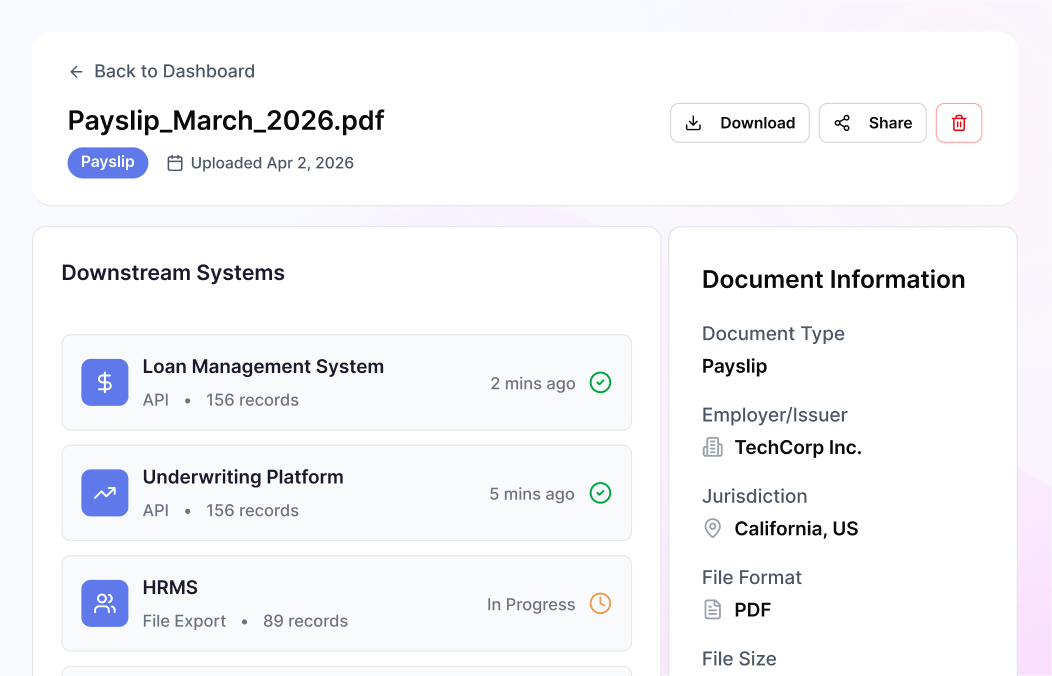
After validation and review, the platform delivers outputs in configurable formats such as JSON or CSV, aligned with downstream system requirements. This decision-ready data can be integrated directly with HRMS, ERP, LMS, and underwriting workflows via APIs. Moreover, the system maintains a complete, time-stamped audit trail for each payslip, capturing edits, approvals, and discrepancies to ensure audit readiness at all times. The automated workflow eliminates re-keying and enables teams to work with accurate, validated data.

Operational Impact Across Payroll Document Workflows

Collatio Payslip Processing provides significant ROI and operational benefits for enterprises processing high volumes of payroll documents. It accelerates verification, minimizes manual intervention, and improves data accuracy across HR, payroll, and lending workflows.

0%

field extraction accuracy across diverse payslip formats

0x

faster document processing powered by AI-driven automation

0%

reduction in analyst effort for payslip review and validation workflows

0%

quicker onboarding for income-verified employees and contractors

How Collatio Extracts, Interprets, and Structures Payroll Data

Multi-Channel Document Intake

The platform ingests payslips from a wide range of sources, including auto-forwarded emails, Google Drive, AWS S3, SFTP folders, REST APIs, and direct uploads from loan management systems, HRMS platforms, or internal business applications. It supports multiple file formats, including PDF, JPG, PNG, TIFF, Excel, CSV, and digitally signed documents.

Capture Forms From Any Source

Document Recognition and Sorting

Collatio automatically identifies document types and distinguishes payslips from bank statements, tax documents, employment contracts, and other supporting records. The platform classifies, sorts, and organizes documents based on employer format, jurisdiction, and layout variations to enable reliable extraction and efficient retrieval across high-volume payroll and income verification workflows. It also applies preprocessing techniques such as denoising, deskewing, orientation correction, and image enhancement to improve document quality.

Enhance and Organize Documents for Faster Processing

Intelligent Payroll Data Extraction

AI-powered Optical Character Recognition and domain-trained NLP models extract payroll data from payslips with high field-level accuracy. The system processes both text and document context to derive employee details, employer information, pay period, earnings components, deductions, gross pay, net pay, and other relevant payroll fields. It interprets the meaning of each field within the document structure, enabling consistent output across varied layouts, labels, and salary formats used by different employers and regions. The extracted data is structured and normalized for downstream review, validation, and integration into HR, payroll, lending, and compliance systems.

Extract Data from Complex Forms with Contextual Intelligence

Cross-Document Validation and Exception Handling

The platform verifies extracted payslip data against related documents such as bank statements, tax records, employee declarations, and employment contracts. It reconciles key data points across sources to detect inconsistencies, such as mismatched salary figures, duplicate submissions, altered information, and missing fields. It also enables configurable automated checks that align with business policies and regulatory requirements, thereby strengthening data accuracy and helping identify potential fraud indicators. Records that do not meet defined validation criteria or raise exceptions are routed to designated users through a human-in-the-loop workflow for review and resolution.

Validate Accuracy with Automated, Rules-Based Checks

Structured Output for Downstream Workflows

Validated payslip data is delivered in a structured format and transferred to downstream systems, such as loan management systems, underwriting platforms, HRMS, payroll systems, and internal decisioning tools, via APIs or file-based exports. Each output includes a complete audit trail with source references, validation status, and edit history, which supports traceability, governance, and compliance requirements across operational workflows.

Integrate Clean Data into Downstream Systems with Full Audit Control

What Documents Do We Handle?

Collatio Payslip Processing supports a comprehensive range of documents used in income verification and employment validation. It works across formats such as PDF, JPG, PNG, TIFF, XLSX, CSV, DOCX, e-signed PDFs, and scanned images.

Compliant Infrastructure and Audit-Ready Governance

Collatio embeds security, compliance, and audit controls across the payslip processing lifecycle to ensure data protection, traceability, and alignment with enterprise governance requirements.

  • Enterprise Security Standards

    Aligned with widely adopted frameworks such as SOC 2 and ISO 27001 to support enterprise security and governance requirements.

    SOC 2 & ISO 27001-Aligned Controls
  • Audit-Ready Processing

    Detailed logs and source-level traceability provide a clear record of extraction, validation, review, and data movement for audit and compliance teams.

    PII & Financial Data Protection
  • Privacy and Access Controls

    End-to-end encryption and role-based access controls ensure that sensitive payroll data remains protected and accessible only to authorized users.

    Regulatory & Audit Support

Clients

We are trusted by enterprises globally.

Collatio Seamlessly Integrates with Your Stack

Connect with your existing enterprise platforms through APIs and direct data exchange, keeping your workflows intact and your teams in sync.

Automate Payslip Processing with Collatio

Transform unstructured payslips into validated, structured payroll data that enables faster income verification, accurate underwriting, and confident decision-making.

Book a Demo

Recent Articles

  • Prepaid Expenses on Balance Sheet: Accounting Explained

    Prepaid Expenses on the Balance Sheet: How They Are Recorded and Reconciled

    Author Profile Picture
    Arpita Pandey
    Apr 23, 2026
  • Corporate Credit Card Reconciliation Guide

    Corporate Credit Card Reconciliation: Process and Best Practices

    Author Profile Picture
    Arpita Pandey
    Apr 22, 2026
  • Payroll Reconciliation

    What Is Payroll Reconciliation and Why Does It Matter?

    Author Profile Picture
    Arpita Pandey
    Apr 21, 2026
  • Payment Reconciliation

    What Is Payment Reconciliation? Process, Automation, and Key Use Cases

    Author Profile Picture
    Arpita Pandey
    Apr 16, 2026
  • Revenue Reconciliation

    Revenue Reconciliation Explained: Meaning, Process, Examples, and Automation

    Author Profile Picture
    Arpita Pandey
    Apr 16, 2026
  • Treasury Reconciliation

    Understanding Treasury Reconciliation: Process and Practices

    Author Profile Picture
    Arpita Pandey
    Apr 16, 2026
  • Insightful Resources

    Discover how SCRY AI solutions bring accuracy and innovation in document processing, conversational AI, and IoT operations.

    Frequently Asked Questions

    Find answers to common questions about payslip processing, integration, accuracy, and data security.

    Payslip processing refers to the structured workflow that organizations use to extract, validate, and standardize payroll data from employee payslips for use across HR, payroll, and finance systems. Collatio automates this entire workflow through AI-powered Payslip data extraction, which reduces manual effort, improves accuracy, and enhances processing efficiency. It extracts key payroll data such as earnings, deductions, taxes, gross pay, and leave balances, and delivers the output in a structured format for integration with payroll, HRIS, and accounting systems.

    Yes. Collatio supports a wide range of payslip formats across employers, geographies, and payroll systems, including PDFs, scanned images, and digitally signed documents. It does not require template configuration for each new layout, enabling scalable payslip parsing across large, diverse document volumes.

    Yes. Extracted payslip data is converted into structured formats such as JSON or CSV and can be exported to enterprise systems, including HR systems, payroll platforms, loan management systems, and verification workflows, via APIs. This enables consistent and accurate data flow across hiring, onboarding, and lending processes without manual re-entry.

    Yes. Payroll data is processed within secure environments that use encryption in transit and at rest, along with strict role‑based access controls and secure infrastructure. Collatio aligns with enterprise‑grade security standards, enabling organisations to meet internal policies and regulatory requirements for handling sensitive employee and financial information.

    Collatio uses AI-driven Optical Character Recognition and domain-trained AI models for Payslip parsing and Payslip data extraction. It interprets field values within their contextual structure to ensure accurate extraction across varied payslip formats. The extracted data is validated against linked datasets to detect discrepancies, inconsistencies, and anomalies. Flagged cases are routed through a human-in-the-loop review process for resolution. This closed-loop approach improves accuracy over time and reduces manual errors across payroll processing workflows.