Book a Demo

W2 & W9 Forms Processing Software to Automate Tax Reporting & Simplify Compliance

Extract, validate, and manage W-2 and W-9 data with AI automation to reduce manual errors, strengthen IRS audit readiness, and scale high-volume tax form processing end-to-end.

Book a Demo
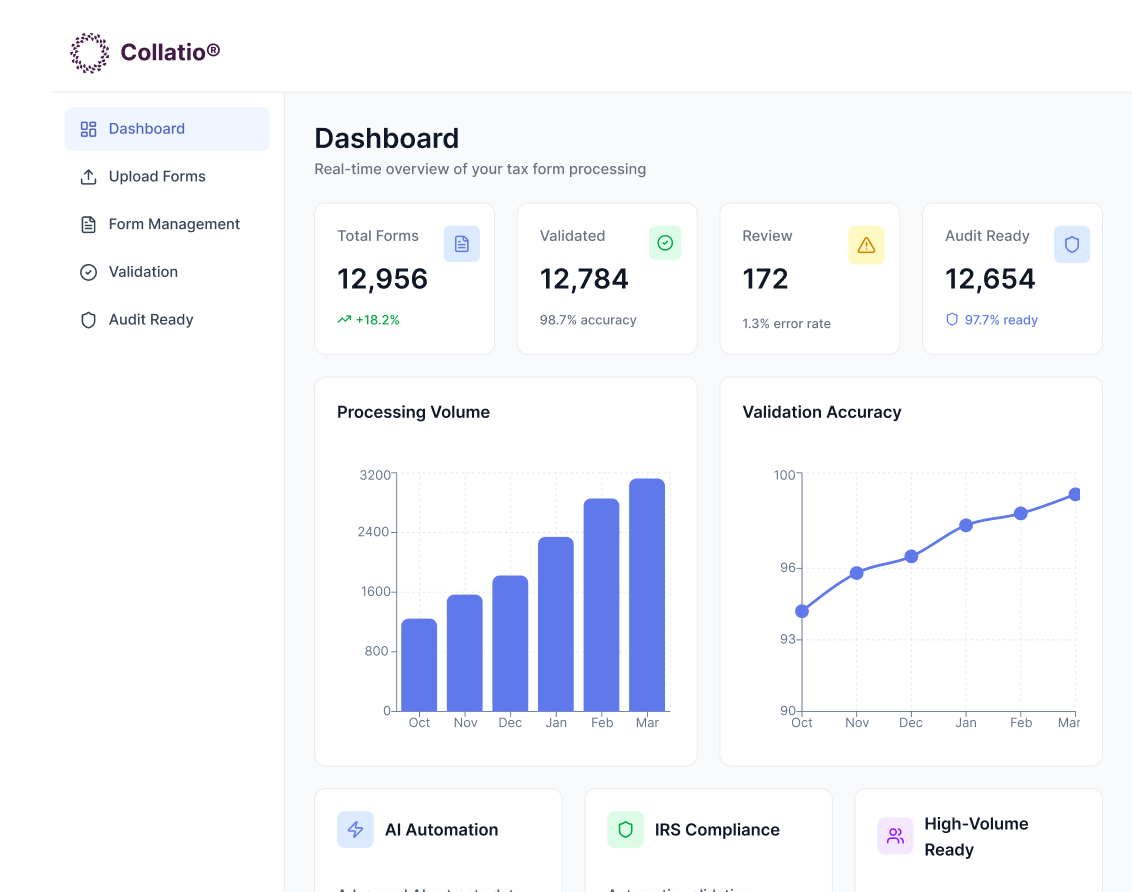
Automated Form Processing Software Powered by AI

The Hidden Friction in Tax Form Automation

Most W-2 and W-9 automation software still relies on rule-based processing, which introduces systemic limitations.

  • Different Formats & Poor Data Quality

    Legacy systems struggle with varied layouts, multi-page packets, low-quality scans, and handwritten entries, resulting in inconsistent field-level data.

  • Unreliable Validation Process

    Critical details such as TINs, signatures, form versions, and totals are not matched accurately, which allows discrepancies to pass through.

  • Disconnected Workflows & Manual Reliance

    Output does not integrate directly into payroll, AP, or ERP systems; therefore, teams have to manually key in data repeatedly.

  • Data Breach and Compliance Risks

What is Collatio W2 & W9 Forms Processing?

Collatio W2 & W9 Forms Processing is Scry AI’s platform that automatically ingests, classifies, extracts, and validates W-2 and W-9 tax forms at scale. It uses AI-powered OCR, pattern recognition, intelligent reconciliation, and compliance rules to accurately capture data across formats and flag discrepancies early. Clean, standardized outputs are then pushed into your downstream workflows for payroll, vendor onboarding, lending, and compliance reporting.

Modern Infrastructure for Intelligent Tax Processing

Collatio enables straight-through W2 and W9 processing at scale by making it fast, accurate, and AI-driven.

AI-Powered OCR and Intelligent Data Extraction

Format-Agnostic Document Intake

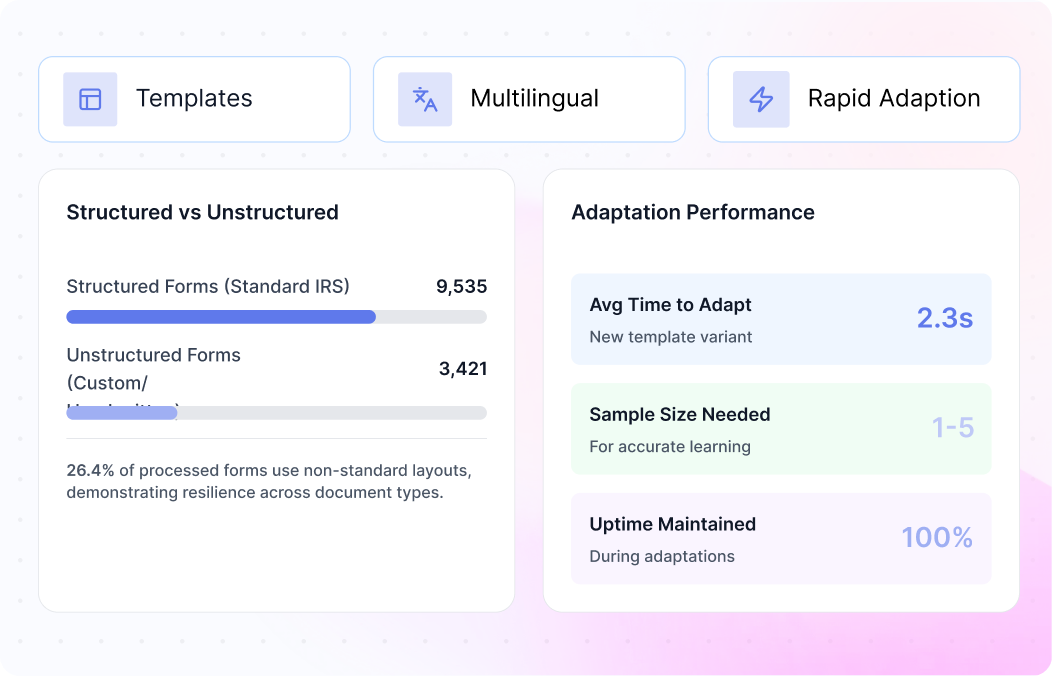
Processing remains resilient across evolving templates, multiple languages, and both structured and unstructured layouts without dependence on rigid form designs. New variants and layout changes adapt quickly from a small sample set, so intake remains uninterrupted as document formats and sources evolve.

Context-Aware, Template-Free Layout Understanding

High-Fidelity W2/W9 Data Extraction

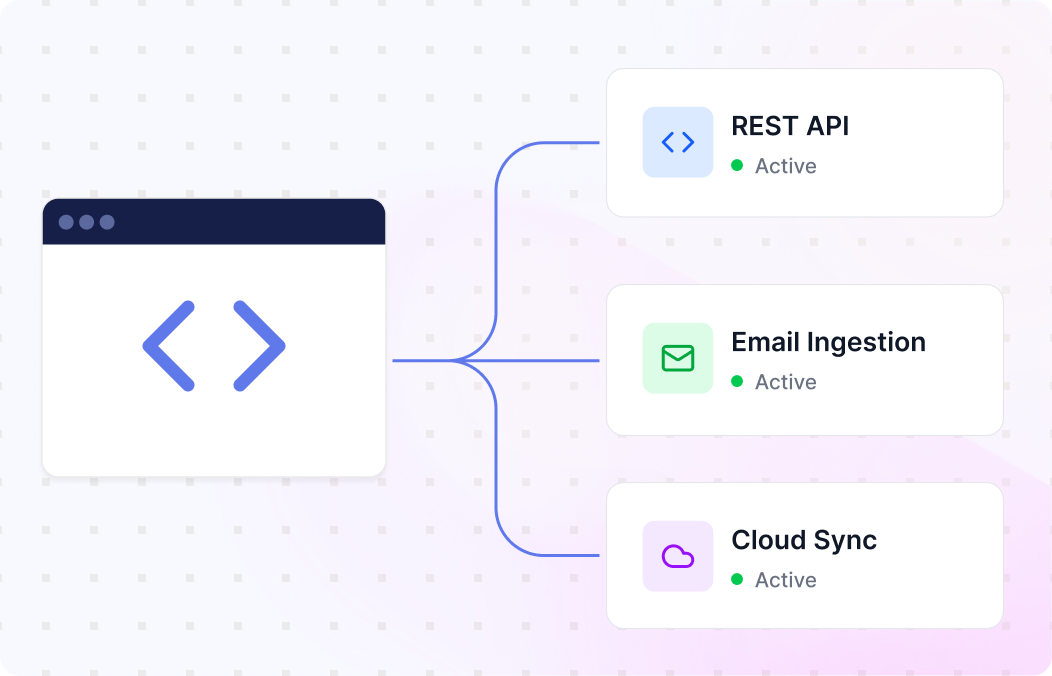
Key payer and payee details, SSNs and EINs, addresses, tax classifications, and wage and withholding boxes are captured and interpreted as clean key-value pairs. Enterprise-grade form models trained on standard W-2 and W-9 field schemas support high-volume, ready-to-run extraction via APIs, email ingestion, and cloud sync.

Custom Form Onboarding & Reconstruction

Layout-Aware AI Form Reconstruction

W2 and W9 documents are reconstructed into structured, form-accurate representations across PDFs, scans, photos, and multi-page files. Each line item, box, and section is preserved with positional context, maintaining relationships between payer details, payee information, identifiers, and wage or withholding fields. This form-level reconstruction retains the original semantics of every field and delivers outputs that systems can trust without manual remapping.

Automated Validation, Verification, and Anomaly Detection

Automated Data Validation and Reconciliation

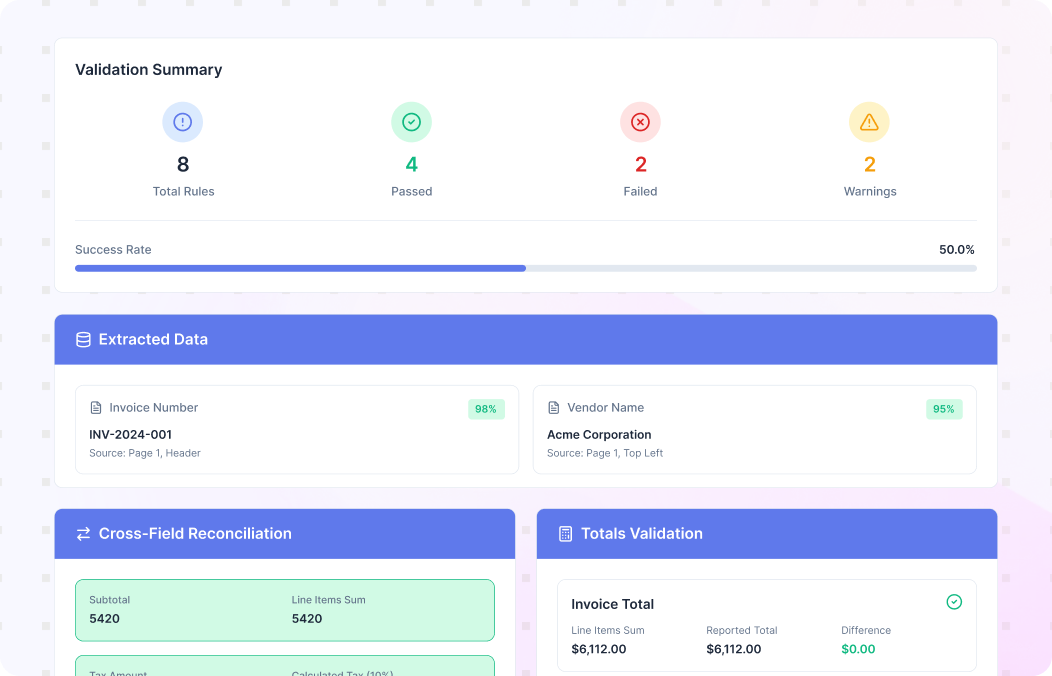
Required-field rules, format checks, cross-field consistency logic, and totals validation are applied alongside advanced reconciliation of extracted data. Values are compared across related fields, totals are matched against line items, and missing or conflicting data points are surfaced through clear exception signals.

Secure Centralized Management and Enterprise Integration

Compliance and Anomaly Detection

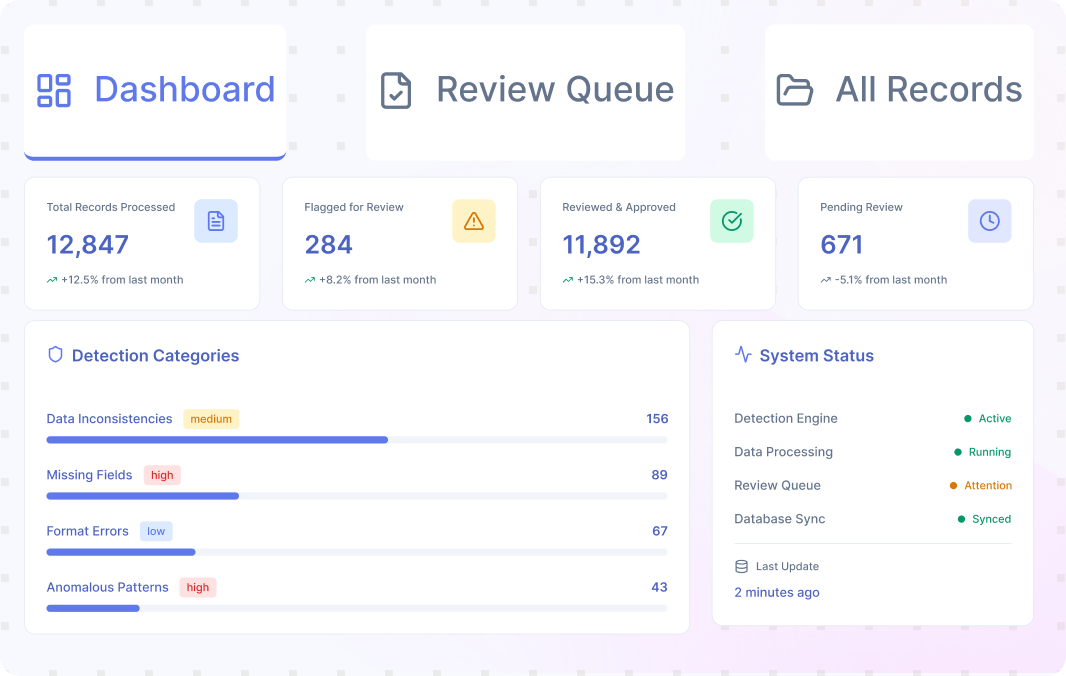
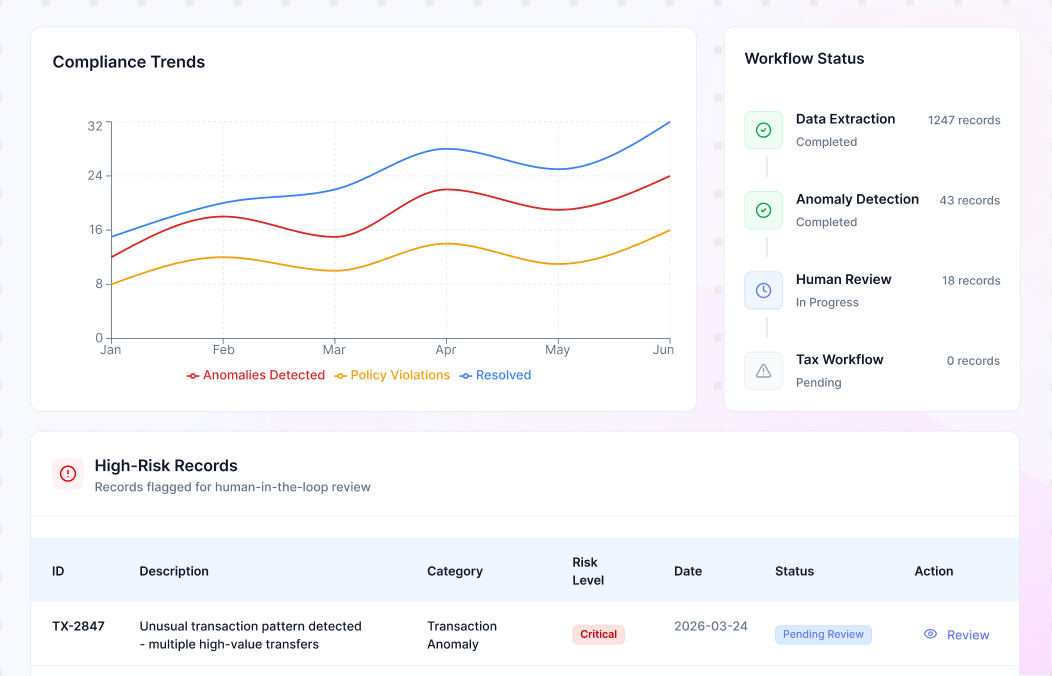
Compliance coverage extends beyond basic checks through automated detection of inconsistencies, data errors, and anomalous patterns within extracted records. Any discrepancies or irregularities are flagged and routed for human-in-the-loop review to ensure accuracy and compliance across onboarding and reporting processes.

Secure Centralized Management and Enterprise Integration

Process Orchestration, Monitoring, and System Integration

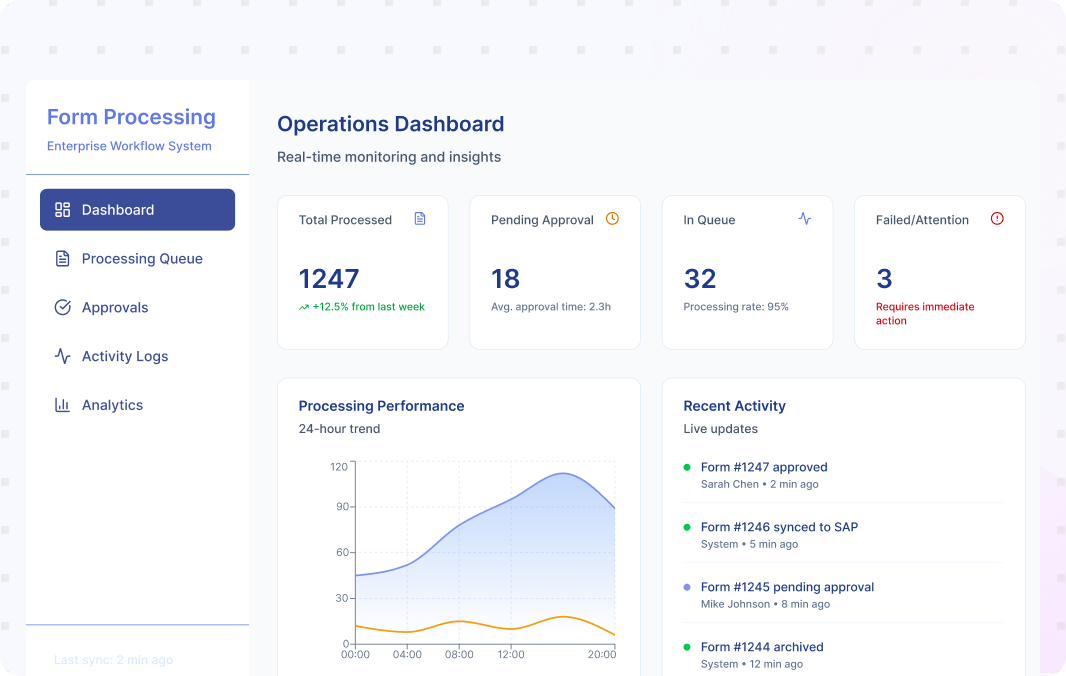
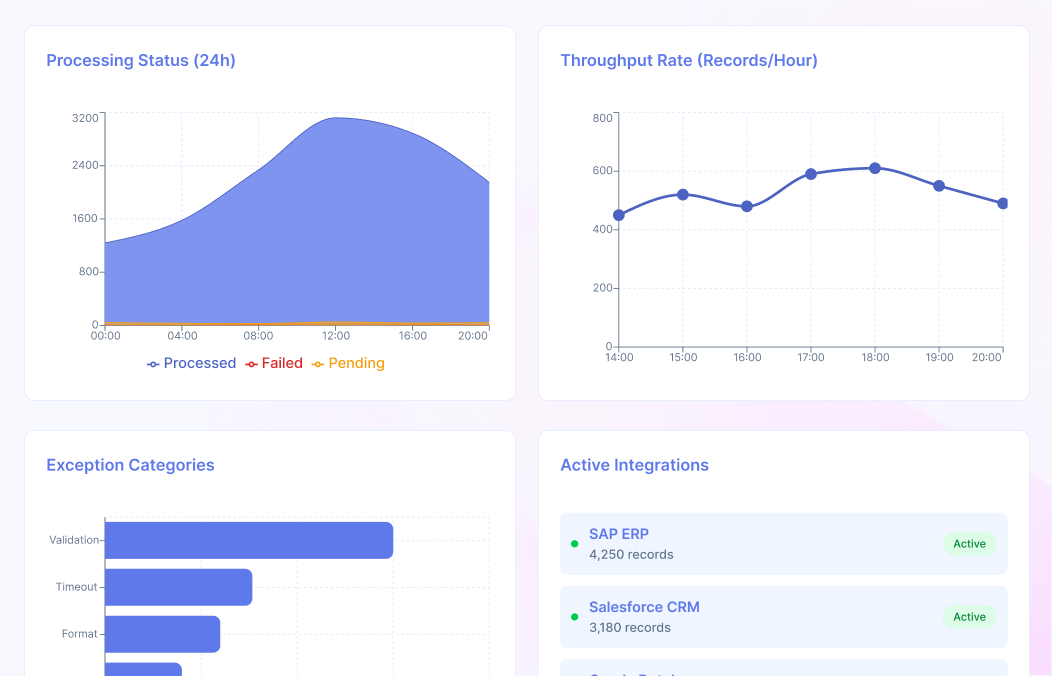
Processed forms move through approvals and archival steps while verified data syncs into existing enterprise systems through APIs and workflow integrations. Alongside this orchestration, real-time dashboards and detailed logs provide operational visibility, performance insights, and traceability across the entire processing pipeline.

Proven Results, Measured in Real Outcomes

Organizations deploying Collatio for W-2 and W-9 processing realize significant gains in data accuracy, cycle time, and audit readiness, even during high-volume filing windows.

0%

Data Extraction Accuracy

0%

Faster Processing Time

0%

Reduction in Manual Processing Costs

0%

Compliance Accuracy

How Collatio Drives End-to-End Tax Form Automation

Document Intake & Form Recognition

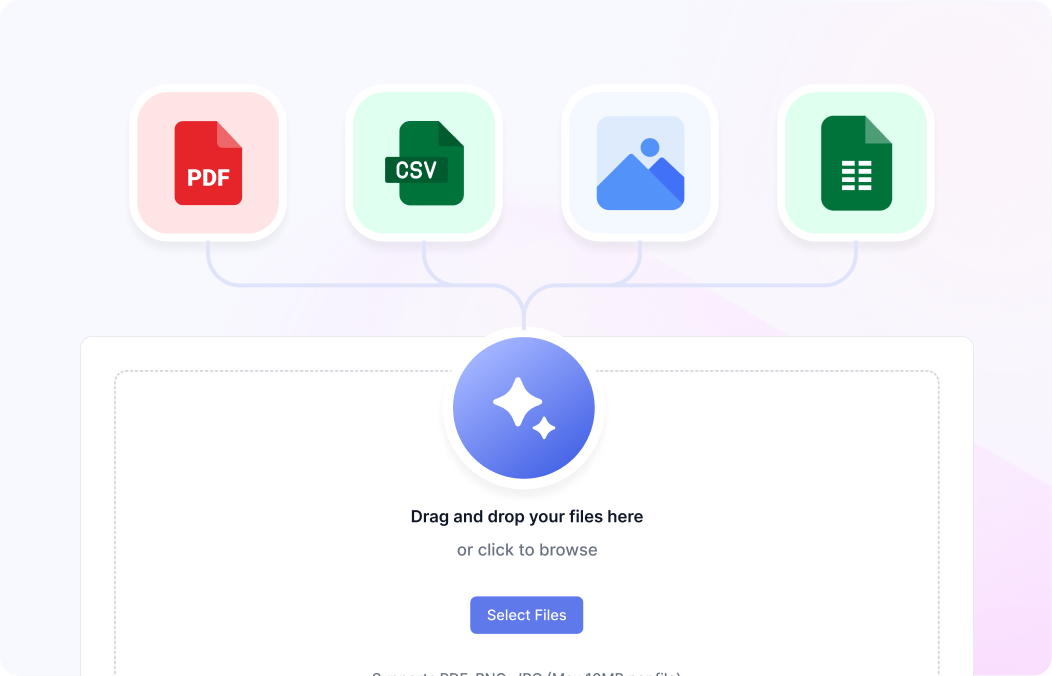
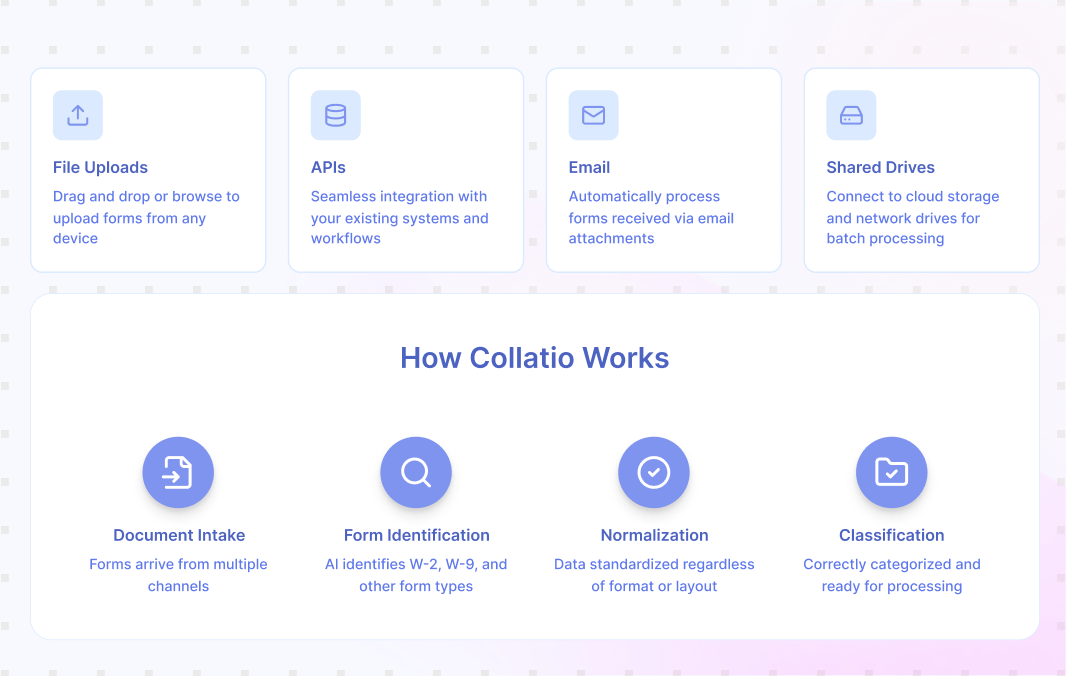
Forms enter the system from multiple intake channels, including file uploads, APIs, email, and shared drives. As documents arrive, Collatio identifies form types and normalizes them so that W-2 and W-9 submissions are correctly classified from the start, even when formats, layouts, or sources vary.

Capture Forms From Any Source

Content Understanding & Field Structuring

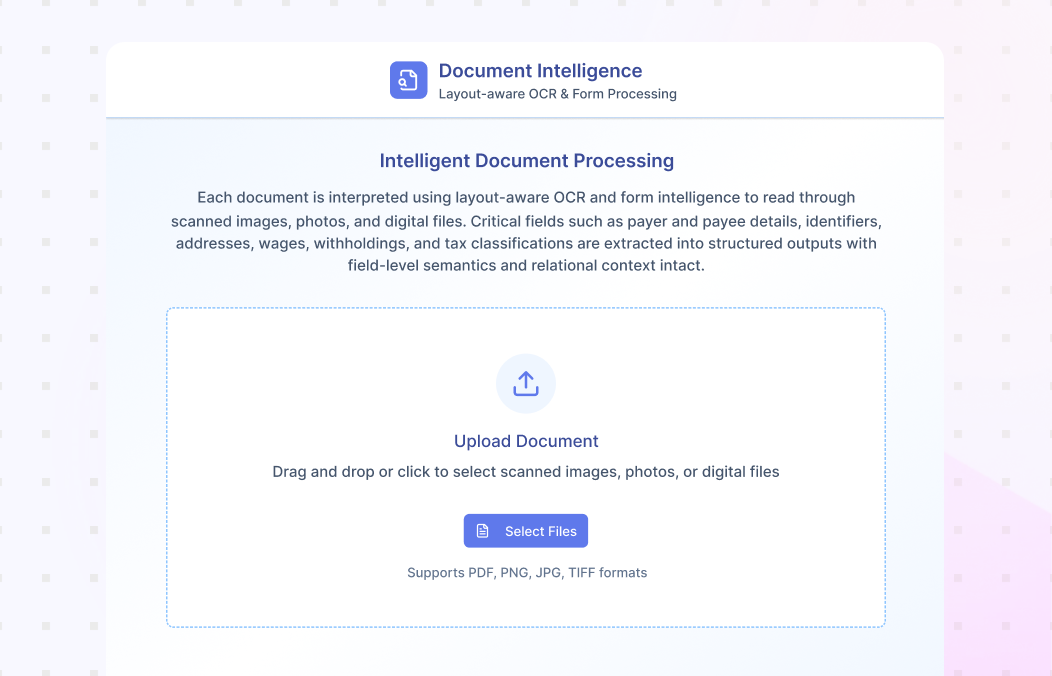
Each document is interpreted using layout-aware OCR and form intelligence to read through scanned images, photos, and digital files. Critical fields such as payer and payee details, identifiers, addresses, wages, withholdings, and tax classifications are extracted into structured outputs with field-level semantics and relational context intact.

Enhance and Organize Documents for Faster Processing

Data Quality Checks & Verification

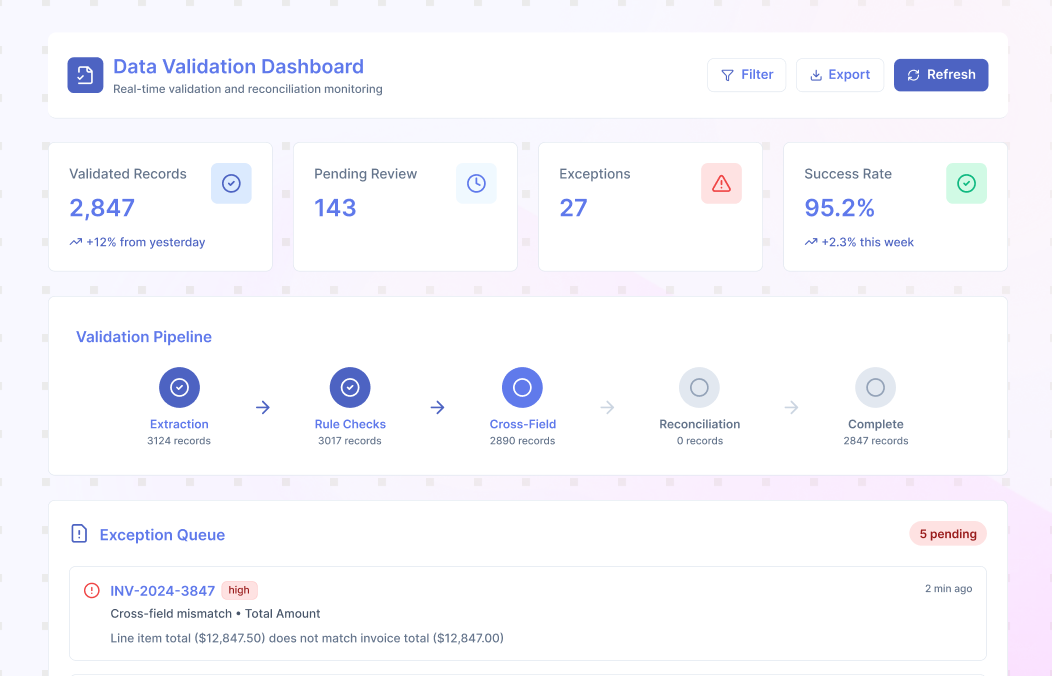
Extracted values undergo rule-based checks, cross-field validation, and reconciliation logic before moving forward. Totals are matched against line items, related fields are compared for consistency, and entries that meet validation criteria advance automatically. Meanwhile, incomplete or conflicting data points surface as exceptions, allowing teams to review only the records that require attention.

Extract Data from Complex Forms with Contextual Intelligence

Governance and Risk Controls

Built-in compliance controls evaluate extracted data for anomalies, policy violations, and reporting risks. Irregular patterns and high-risk records are flagged early, which creates clear checkpoints for human-in-the-loop review and addresses issues before they impact downstream tax or regulatory workflows.

Validate Accuracy with Automated, Rules-Based Checks

Operational Visibility & System Orchestration

Once validated, structured data flows into existing enterprise systems through APIs and workflow integrations. Operational dashboards and detailed logs provide visibility into processing status, exception rates, and throughput, while securely archived records support audits, reporting, and traceability.

Integrate Clean Data into Downstream Systems with Full Audit Control

What Documents Do We Handle?

Collatio processes tax forms across structured, semi-structured, and unstructured formats, including scanned copies, photographed forms, PDFs, and multi-page uploads.

Collatio Prioritizes Compliance & Data Security

Designed for regulated financial reporting, with controls that support ongoing regulatory and audit requirements.

  • SOC 2 & ISO 27001 Certified

    Enterprise-grade frameworks ensure data privacy and protection.

    SOC 2 & ISO 27001-Aligned Controls
  • IRS Data Matching Built-In

    Automates TIN/SSN verification to reduce 1099 errors and penalty exposure.

    PII & Financial Data Protection
  • Complete Lineage & Traceability

    Every field is traceable to its source document for audit and regulatory review.

    Regulatory & Audit Support

Clients

We are trusted by enterprises globally.

Collatio Seamlessly Integrates with Your Stack

Connect with your existing enterprise platforms through APIs and direct data exchange, keeping your workflows intact and your teams in sync.

Automate Tax Form Data Extraction & Validation with AI-Driven Intelligence Using Collatio

Process and standardize tax data with ease, enforce compliance controls across your workflows, and enable zero-touch processing.

Book a Demo

Recent Articles

  • Prepaid Expenses on Balance Sheet: Accounting Explained

    Prepaid Expenses on the Balance Sheet: How They Are Recorded and Reconciled

    Author Profile Picture
    Arpita Pandey
    Apr 23, 2026
  • Corporate Credit Card Reconciliation Guide

    Corporate Credit Card Reconciliation: Process and Best Practices

    Author Profile Picture
    Arpita Pandey
    Apr 22, 2026
  • Payroll Reconciliation

    What Is Payroll Reconciliation and Why Does It Matter?

    Author Profile Picture
    Arpita Pandey
    Apr 21, 2026
  • Payment Reconciliation

    What Is Payment Reconciliation? Process, Automation, and Key Use Cases

    Author Profile Picture
    Arpita Pandey
    Apr 16, 2026
  • Revenue Reconciliation

    Revenue Reconciliation Explained: Meaning, Process, Examples, and Automation

    Author Profile Picture
    Arpita Pandey
    Apr 16, 2026
  • Treasury Reconciliation

    Understanding Treasury Reconciliation: Process and Practices

    Author Profile Picture
    Arpita Pandey
    Apr 16, 2026
  • Insightful Resources

    Discover how SCRY AI solutions bring accuracy and innovation in document processing, conversational AI, and IoT operations.

    Frequently Asked Questions

    Collatio extracts the key information required for payee onboarding and compliance, including individual or business names, addresses, tax classifications, exemptions, FATCA-related indicators, and taxpayer identifiers such as SSNs or EINs. The extracted fields are structured for direct use in verification and reporting workflows.

    Collatio captures employee identifiers along with wage, withholding, and tax-related fields commonly used for payroll processing, income verification, and compliance checks. The data is structured to support downstream processing and reporting.

    Collatio combines layout-aware form understanding with rule-based validation and reconciliation. Field-level checks, cross-field comparisons, and totals matching surface only the records that require attention, while clean entries proceed automatically. This approach reduces rework and limits manual review to true exceptions.

    Yes. Collatio is built to process a wide range of document formats and layouts without relying on fixed templates. The platform supports more than 150 document types and uses adaptive AI models that interpret structure and context, whether the form is a standard PDF, a scanned image, or a variant with a non-standard layout. When new layouts or form types appear, Collatio can be updated quickly using a small set of sample documents so teams can continue intake without disruption.

    Collatio applies enterprise-grade security controls across data handling and access management. These include industry-standard security certifications, role-based access permissions, audit trails, and regular security assessments to safeguard sensitive tax information and support compliance requirements.