 Enterprise Knowledge
Agent
Enterprise Knowledge
Agent Realtime Intelligence
 Customer Support 360
 Analytica
 CreditIQ
 City Intelligence
 Smart Utilities
 Connected Worker & Assets
 Drone Based Infra Monitoring
 SceneTrack



Dr. Alok Aggarwal
 Accounts Reconciliation
 Financial Spreading
 Digital Archive
 SchematicIQ
 Loan Ops
 Docutwin
 Contract intelligence
 KYC/KYB
 Form Processing
 Investment Statements


Ready to Bring AI Automation to Your Business?
Let's DiscussA recent study conducted by research and analytics firm, Evalueserve, has shown that Indian Institute of Technology
(IIT) graduates are expanding their career choices beyond the traditional engineering and technology opportunities.
There has been a noticeable shift towards consulting and financial services as well as continued interest in
entrepreneurial aspirations. This shift is likely related to the buoyant Indian economy, a surging Indian stock market,
and the increased earnings potential in these sectors. Evalueserve’s survey of more than 677 IIT graduates (IITians)
uncovered the following highlights:
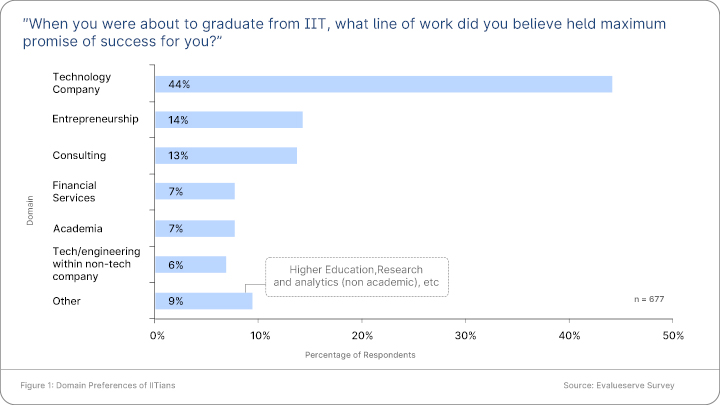
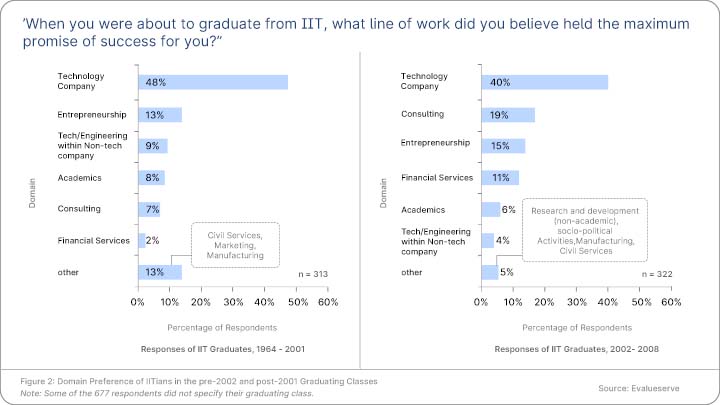
One can see from Figures 1 and 2 below that the percentage of IITians opting for technology and engineering
changed dramatically after 2001. Whereas 57% of those graduating before 2002 believed that pursuing traditional
technology or engineering specialties would provide them better opportunities (48% technology and 9% engineering), this percentage dropped 13% to 44% for the 2002-2008 graduating classes (40% technology and 4% engineering).
Amongst post 2001 graduates, there has been a shift towards careers in consulting, and financial services. About
19% of the respondents from the graduating classes of 2002–2008 believe that experience in the consulting domain
will provide them with better career opportunities in the future as compared to 7% of the respondents from the 1964– 2001 classes. Similarly, preferences for the financial services sector increased from 2% for pre-2002 graduating classes to 11% for post-2001 classes. Indeed, the increasing numbers of top-flight consulting and financial services companies offering attractive salary packages while recruiting from IIT campuses, along with the proven success of IIT alumni in these firms are certainly two factors helping to precipitate this change. Other factors include a buoyant Indian economy and a booming Indian stock market.
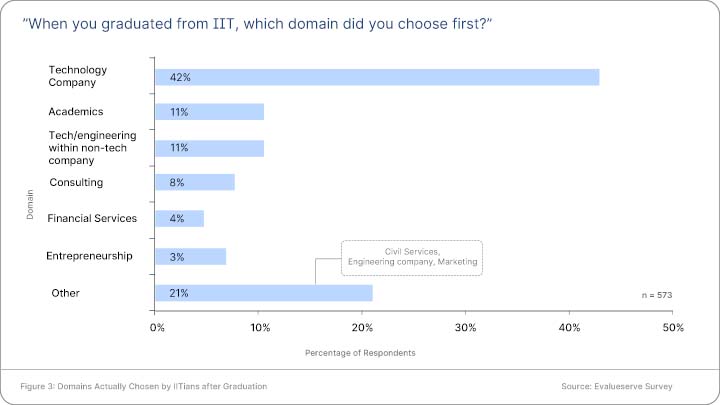
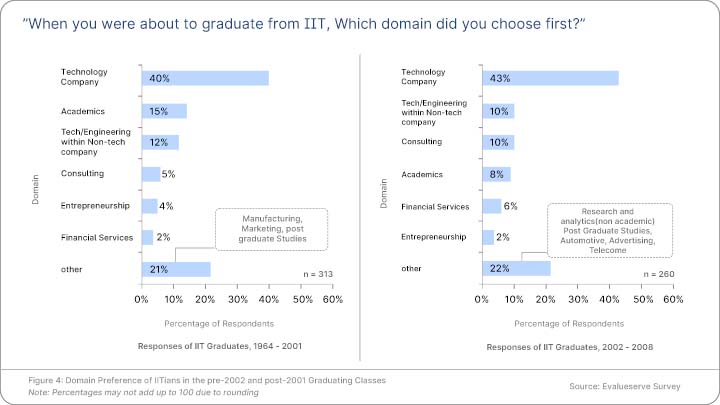
Figures 3 and 4 highlight the career domains that were actually first chosen by the IIT graduates. Interestingly,
although technology or engineering choices increased for the graduating classes of 2002-2008 (including those who
would graduate during the spring of 2008), in reality the number of graduates who selected technology and
engineering as their career of choice has remained constant at 52–53%. On the other hand, this survey does reveal
a rise in the percentage of graduates with first jobs in consulting and financial services from 5% (among pre-2002
graduating class respondents) to 10% (among 2002-2008 graduating class respondents). Similarly, those who chose
academics as their first career decreased from 15% to 8%. Interestingly, some IITians have also ventured into fields
that were by and large unexplored by earlier IIT alumni, including media and entertainment, sports, literature, rural
and non-profit sectors.
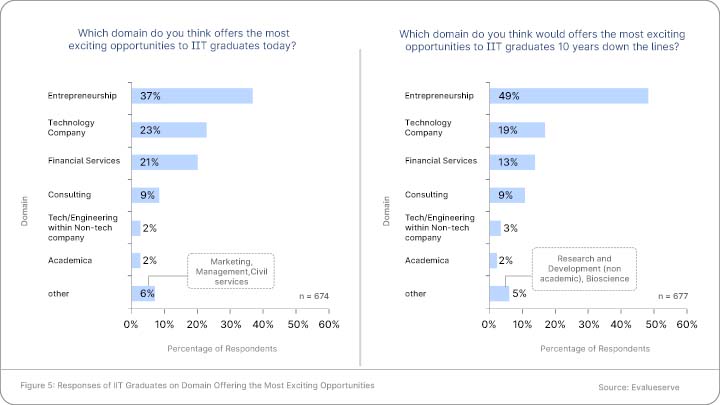
Our survey also reveals that overall, IITians currently believe that entrepreneurial careers will offer the most exciting
opportunities, followed by technology, financial services, and consulting. These four areas are likely to be in favour in
the coming decade, and almost half believe that entrepreneurial opportunities will continue to provide the most
exciting careers in 2017. It seems the belief in entrepreneurial careers is going through an inflexion point – while
only 13% respondents from the 1964-2001 graduating classes believed that an entrepreneurial career provides the
best opportunity and 15% respondents from 2002-2008 believed so, 37% of all these respondents believe that
entrepreneurial career provides the maximum opportunity currently, with a substantial rise to 48% who believe it will provide the best opportunities by 2017. Some causes for this optimism include a steadily growing Indian economy (that is projected to grow from US$ 1,030 billion in 2007 to approximately US$ 5,040 billion in 2020), and a thousand- fold increase in Venture Capital and Private Equity funding during the past 15 years (from US$ 13 million in total funding in India in 1992 to more than US$13 billion in corresponding funding in 2007).
Indeed, since an increasing number of IITians are staying in India after graduation, such optimism for
entrepreneurship bodes well for India, whose economy is growing very rapidly but may be dampened if enough
business leaders are not produced during the next ten years.
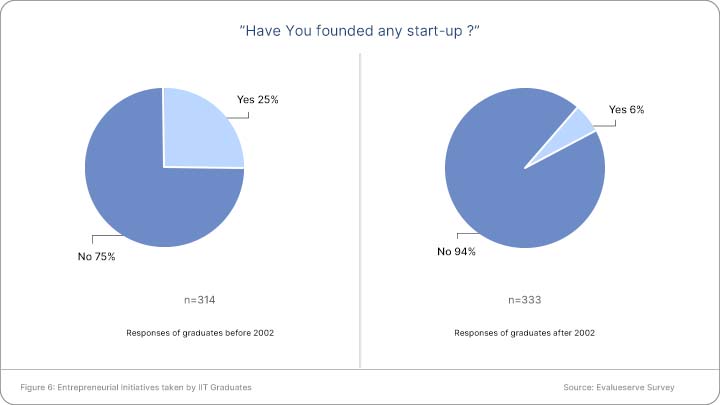
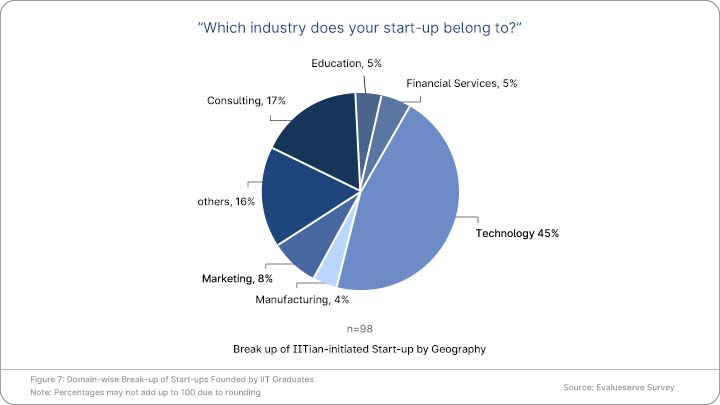
25% of IIT respondents who graduated between 1964 and 2001 started their own entrepreneurial ventures. These
start-ups have been “founded” across diverse segments including technology, education, consulting, financial
services, marketing and manufacturing. However, start-ups in Technology and Telecommunications continue to be
the most favourite domain where IITians have felt most comfortable in making their investments. Note that only 6% of those graduated during 2002 and 2008 have founded start-ups, which is not surprising given the lack of experience recent graduates would have gained to date. Given Evalueserve’s findings, this number will rise substantially over time.
Finally, it seems IITians have been moving away from careers in academics and are likely to move away even further
in the future. 8% of respondents graduating pre-2002 believed that academia held the maximum promise as a career,
6% of the respondents graduating during 2002 and 2008 believe the same, but only 2% of the respondents believe
that this would be the case going forward (between 2008 and 2017). Unfortunately, this trend could negatively impact doctoral programs in both the United States and India – especially for technical and engineering departments at colleges and universities dependant on PhDs. In particular, most IITs already have a shortage of research and
teaching faculty that could certainly exacerbate this shortage, which in turn may jeopardize the ability of the IITs to
increase the admission of new students.
Figure 8 provides the break-up of all 677 respondents according to their current country of residence. From a
statistical perspective, since the total number of IIT alumni graduating since the inception of IITs in early 1960s is
approximately 130,000, Evalueserve’s results should be used simply as a trend analysis with a margin of error of +/-
2% at a confidence level of 90%. It would be worthwhile conducting further research in this area with a substantially
larger set of IIT alumni.
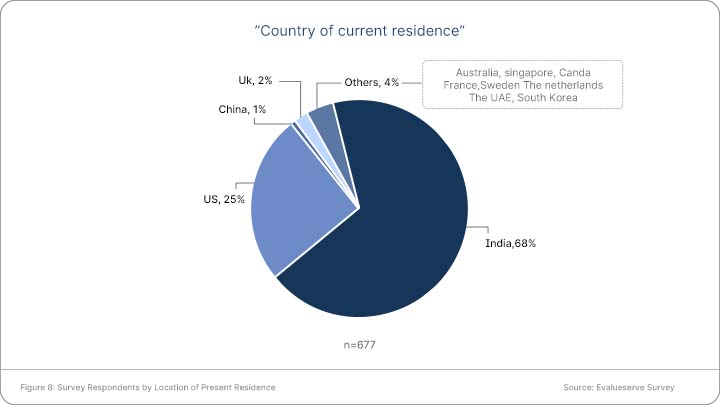
Note: The number of respondents was surveyed to correlate with the approximate number of IITians living in these
countries.
Blog Written by
CEO, Chief Data Scientist at Scry AI
Author of the book The Fourth Industrial Revolution
and 100 Years of AI (1950-2050)


