Book a Demo

Financial Spreading Software for Rent Roll Analysis in Real Estate and Lending

Rent rolls hold financial signals that matter, but most of them arrive buried in formats that slow down analysis and weaken visibility. Scry AI supports financial spreading for rent roll analysis by extracting, standardizing, reconciling, and structuring rent roll data for faster underwriting, portfolio review, and reporting.

Book a Demo
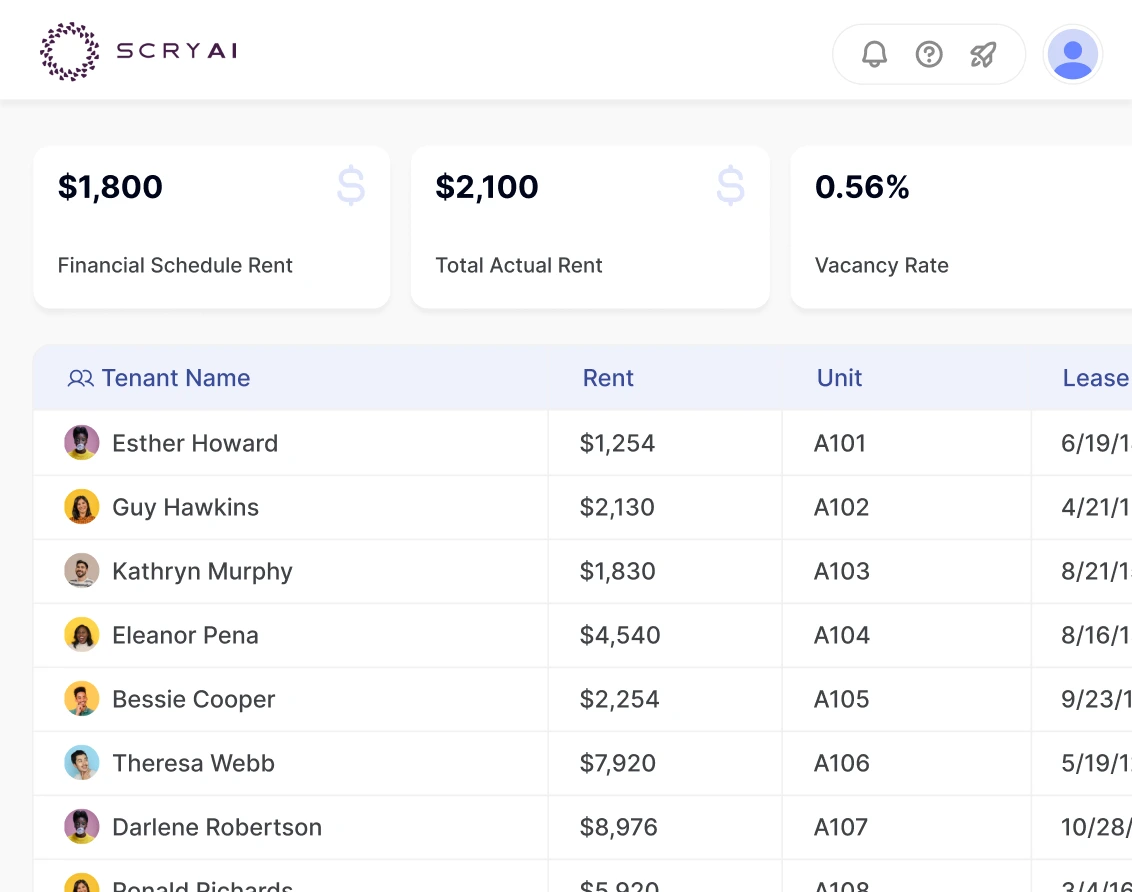
Investment Analytics Software Built for Real-Time Investment Intelligence

The Reality of Rent Roll Processing in Real Estate & Lending

Rent roll processing becomes difficult before analysis even begins. Different properties and stakeholders submit rent rolls in inconsistent layouts, naming styles, and levels of detail, which makes records harder to compare and totals harder to trust.

Before any financial review can move forward, teams often have to interpret the data, validate what is present, and prepare it for use. That effort grows with portfolio size and reporting frequency. Teams are then left combining rent rolls across properties and checking rents and charges manually.

How Rent Roll Processing Currently Works

Rent rolls do not become useful at the moment they are received. The data must pass through a series of steps that add time and manual effort.

1
Inaccurate data extraction
Tenant details, unit information, rent amounts, and charges are pulled manually from incoming rent rolls.
2
Imprecise data interpretation
Different formats, labels, and reporting styles need manual reading before the data can be understood properly.
3
Manual data mapping
Fields from different rent roll formats are matched manually to internal templates or analysis requirements.
4
Prolonged data consolidation
Rent roll data from multiple properties is combined manually across files and reporting periods.
5
Manual reconciliation
Totals, rent values, and charges are checked by hand to identify mismatches or missing information.
6
Complex data structuring
The final dataset is reshaped for underwriting, portfolio analysis, reporting, or downstream systems.

Scry AI’s Financial Spreading of Rent Rolls Solution

Built on Collatio®, Scry AI’s Financial Spreading of Rent Rolls Solution closes the gap between incoming rent roll files and meaningful financial use. It helps teams spend less time preparing the data and more time working with it.

  • Automated data extraction

    Extracts rent roll data from PDFs, Excel files, scans, and images.

  • Intelligent data capture

    Captures property details, unit data, tenant information, rents, and charges.

  • AI-driven standardization

    Converts varied rent roll formats and terms into one structured dataset.

  • Multi-property consolidation

    Brings rent roll data from multiple properties into one unified dataset.

  • Automated reconciliation

    Validates totals, rents, and charges to flag gaps or inconsistencies.

  • Structured output generation

    Creates clean system-ready datasets for reporting and downstream integration.

Clients

We are trusted by enterprises globally.

Expert 1 Expert 2 Expert 3 Expert 4 Expert 5 Expert 6 Expert 7

Turn Raw Rent Rolls into Clear Financial Insight

Prepare rent roll data for faster review and stronger financial judgment.

Book a Demo

Insightful Resources

Discover how SCRY AI solutions bring accuracy and innovation in document processing, conversational AI, and IoT operations.

Frequently asked questions

The answers below cover the questions teams usually ask before adopting software for rent roll analysis across real estate and lending workflows.

1. What does financial spreading for rent roll analysis mean?

It means extracting, standardizing, reconciling, and structuring rent roll data so it can be used more reliably in portfolio review, underwriting, and reporting.

Scry AI supports rent roll analysis through Collatio®, which automates extraction from mixed document formats, applies validation checks, and produces structured outputs for financial workflows.

It can work across PDFs, spreadsheets, scans, image-based reports, and other mixed-format reporting packs.

Yes. The solution is designed to support multi-property consolidation, so teams can work from one unified dataset.

It helps surface inconsistencies in totals, rent values, and charges earlier, which improves data trust and reduces risk before analysis or underwriting decisions are made.